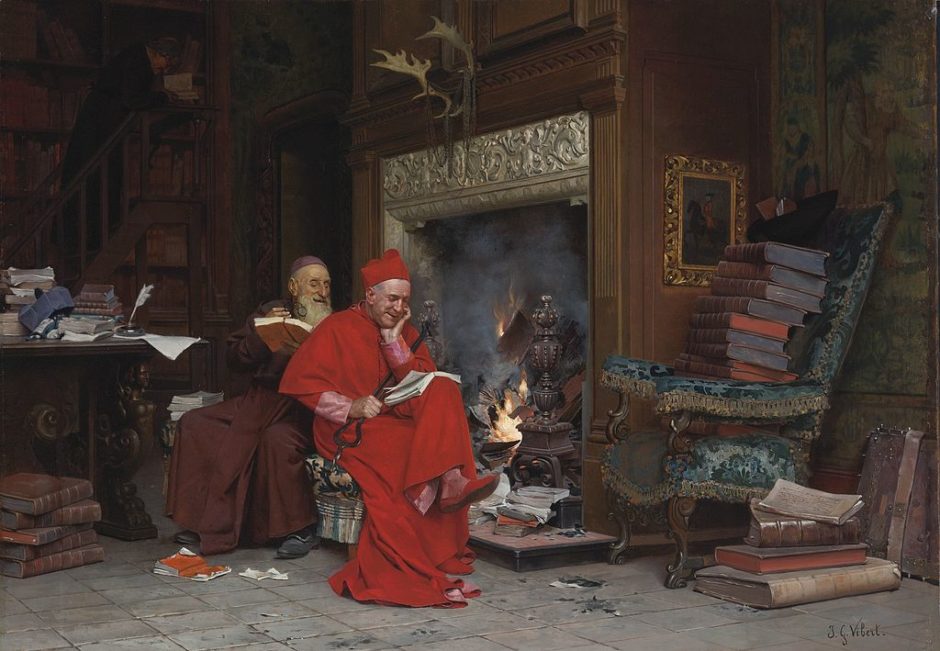
 “A man content to go to heaven alone will never go to Heaven” – Boethius
What have you done, lately, to help someone get to Heaven?
Today is the feast of St. Severinus Boethius (+525), the author of the Consolation of Philosophy. He was a pivotal figure at the cusp of late Antiquity and what are called the Middle Ages.
Boethius was a member of an ancient Roman family. Among his accomplishments were translations and commentaries of Aristotle’s works on logic in Latin along with Euclid’s Elements. He also wrote on arithmetic, geometry, music, and perhaps astronomy and he coined the term quadrivium (four-fold way), the basis of education for centuries, now revived in a way in homeschool circles (thank you, Dorothy Sayers!).
Boethius was an important figure in the court of Theodoric the Ostrogoth. Theodoric would eventually come to believe that Boethius was conspiring against him and threw him in prison before executing him. While he was in prison, he composed the astonishingly influential Consolation of Philosophy.
Here is his entry in the Martyrologium Romanum:
6*. Papiae in Liguria, commemoratio sancti Severini Boetii, martyris, qui, scientia ac scriptis praeclarus, in carcere detentus tractatum scripsit de consolatione philosophiae et Deo usque ad mortem a Theodorico rege inflictam cum integritate servivit.
Who wants to take a crack at the Latin?
Take note that the entry calls him “Saint” Boethius. So does the official Vatican Curia’s calendar. He is celebrated as a saint in Pavia.
You may be interested to know that Boethius’ tomb is in the crypt of the same church where St. Augustine’s remains are interred: San Pietro in Ciel d’oro in Pavia, south of Milan.
Here is Lady Philosophy explaining God to Boethius in the guise of 15th c. France.

It’s too bad that hats are not more in style these days.






























At Pavia in Liguria, commemoration of Saint Severinus Boethius, martyr, who [being] knowledgeable, wrote a very clear treatise on consoling philosophy and on God, while being detained in prison. Towards the death inflicted from Theodorico the king, he always served integrity.
Father, of course we should add to Boethius’s quadrivium, which included arithmetic, geometry, music, and astronomy, his trivium, which comprised grammar, logic, and rhetoric. I believe the trivium was preparatory work for the quadrivium. Together, trivium and quadrivium were the seven liberal arts. Perhaps we should note that the Synodarity Synod desperately needs some trivium? ?
At Pavia in Liguria, a remembrance of Saint Severinus Boethius, martyr, exceptional in knowledge and writing, who, when/although confined to prison, wrote the tractate “De Consolatione Philosophiae” and served God up to the point of a death imposed by the king Theodoric.
The locative in the first line threw me for a loop for a minute!
*Served God utterly! Mea culpa.
Ah yes, the infamous no single person in the carpool lane!