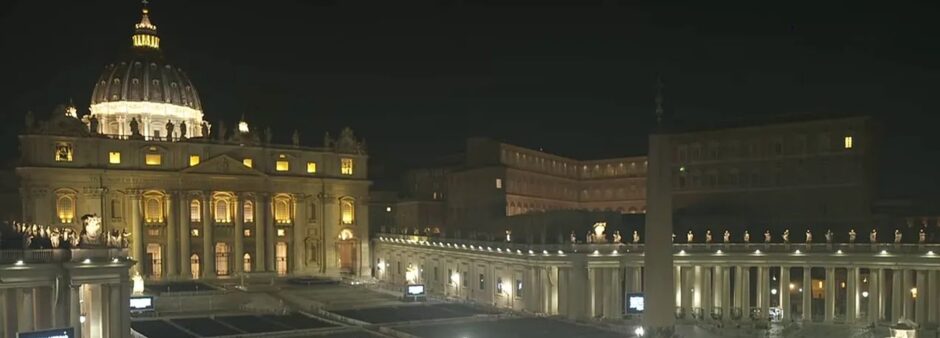
Congratulations to all those who belong to the Ordinariate of the Chair of Peter a fine feast day.
Today is an opportunity to reflect of the will of the Savior about a necessary element for His Church: the Petrine Ministry.
Once upon a time, there were two feasts of Peter’s cathedra, chair, his official role as teacher who strengthens the brethren, etc.
On 18 January we would celebrate Peter’s cathedra in Rome.
On 22 February we would celebrated Peter’s cathedra in Antioch.
Peter went to Antioch, a key city in the East, and there had a disagreement with Paul. Peter spent about 7 years in Antioch, guiding the church as its bishop, before he pulled up stakes, and… I guess… cathedra… and went to Rome. He wouldn’t have taken a literal chair, but he did take his office and authority, given to him by Christ. He had this office and authority before he went to Antioch, while he was at Antioch, when he left Antioch, when he got to Rome and when he died in Rome.
Because the Petrine Ministry is necessary for the Church, Christ made it obviously a “hereditary” office, just as the Davidic stewards enjoyed with the conferral of keys. After Peter, another man held the Petrine Ministry and so on down to our day. That would have happened whether Peter had stayed in Jerusalem, stayed in Antioch, or had gone to Luoyang in China of the Han Dynasty.
ASIDE: Based on Peter’s move from Antioch to Rome, there are those who say that there is nothing which absolutely connects being the Successor of Peter with being Bishop of Rome. He was, after all, The Rock, when he was in Antioch. He was Vicar of Christ before he went to Antioch. He was Vicar of Christ when he was between Antioch and Rome. For all practical purposes Petrine Ministry and office of Bishop of Rome now seem to be fused together. Most authors think they are inseparable. But… they weren’t, unless one thinks that Christ gave Peter His authority in view of Peter’s future in Rome. Possible, but there’s no Biblical evidence for that. On the surface, it looks like one could be Successor of Peter (who can be anywhere) and someone else Bishop of Rome (who should be in Rome). The majority of theologians would, today, say that the Petrine Ministry, being Vicar of Christ, and being Bishop of Rome are now inseparable by the fact that Peter died in Rome. It is not entirely clear to me how his death “sealed the deal”, as it were.
However, were we to consider the implications of Peter being Vicar of Christ before getting either to Antioch or Rome, one supposes that, in time of need, some Successor of Peter could move his see to, say, Texas.
In any event, that’s an interesting thing to reflect on today when we have Antioch and Rome together on one day instead of two.
Let’s see the Novus and Vetus Ordo Collect for the feast.
COLLECT (NOVUS):
Praesta, quaesumus, omnipotens Deus,
ut nullis nos permittas perturbationibus concuti,
quos in apostolicae confessionis petra solidasti.
There is nothing especially difficult about the grammar and vocabulary of this prayer, though it is theologically profound. NB: the solidasti is really solidavisti, a “syncopated” form.
I’m sure some of you can come up with your smooth but accurate versions.
COLLECT (VETUS):
Deus, qui beato Petro Apostolo tuo, collatis clavibus regni coelestis, ligandi atque solvendi pontificium traditisti: concede; ut, intercessionis eius auxilio, a peccatorum nostrorum nexibus liberemur.
O God, who, having committed to Your Apostle blessed Peter the keys of the heavenly kingdom, bestowed the pontifical office of binding and loosing; grant that, by the help of his intercession, we may be delivered from the bonds of our sins.
Whereas the Novus emphasizes we don’t have to worry about the solidity of the Catholic and Apostolic Faith because of the graces given to Peter and His successors … though is sure doesn’t see that way occasionally … the older prayer concerns the power of bishops and priests to forgive sins. Come to think of it, even if we didn’t pay a lot of attention to what certain pontiffs said and did, we would be hard pressed to be at ease without the ability to make a good confession. If there were a choice between knowing all the stuff that goes on with popes and prelates, and the opportunity of having a good and available confessor around… I know which I would choose.
As a bonus… here are a few photos of St. Peter’s shot some years ago on this Feast of the Cathedra of St. Peter.
It is pretty dark in the Basilica, so steady is the name of the game. Here is a shot through the columns over the main altar toward the apse, where you can see the candles arrayed around the magnificent bronze by Bernini.

A closer view.

The bronze Cathedra is decorated with lighted candles only once a year, today.
The black bronze statue of St. Peter attributed to the marvelous Arnulfo di Cambio was always dressed up in his cope and tiara, with a ring on his finger and pectoral Cross on two days, 29 June and today. Then the modernists in the Fabrica started fooling around. Too triumphalistic. They started cutting out elements. But all of them were back the day I shot these except for the griccia alb, which I can live without I guess. I don’t know if it is back this year or not.

And ….

GO TO CONFESSION!






























This almost forgotten book bu George Edmundson (1848-1930) a learned polymath Anglican clergyman
https://www.amazon.com/Church-Rome-First-Century/dp/1533262160/?tag=whatdoesthepr-20
https://en.wikipedia.org/wiki/George_Edmundson
makes a very strong case, IMO, that the “other place” to which St. Peter departs in Acts 12:17 was Rome, and that his stay in Antioch occurred some years later, and that subsequently he returned to Rome for two extended periods, the last in the last years of his life.
The Collect of the Day from the Ordinariate here, as prayed tonight:
O ALMIGHTY God, who by thy Son Jesus Christ didst give to thy Apostle Saint Peter many excellent gifts, and commandedst him earnestly to feed thy flock: make, we beseech thee, all Bishops and Pastors diligently to preach thy holy Word, and the people obediently to follow the same; that they may receive the crown of everlasting glory; through Jesus Christ thy Son our Lord, who liveth and reigneth with thee, in the unity of the Holy Spirit, ever one God, world without end. Amen.
ASIDE: In antiquity, there were three Petrine Sees – Jerusalem, Antioch, and Rome, with Rome holding the headship or primacy. It is in understanding this headship that we understand how the Bishopic of Rome and the Bishopric of the Universal Church is vested in the same person.
It is not so much the city of Rome that is important but rather the people of Rome that are important. The Pope is the Bishop of Rome THE PEOPLE because he is the Roman Patriarch. The people established a city and that city is the seat of his see. Now the Bishop of Blackduck is the Bishop of the city/geographic area of Blackduck. If I lived in Blackduck, we could for convenience say that I am a Blackduckian, but that is not exactly true as my people are the Roman people (I have been baptized and confirmed into this people, even if I am not persay ethnically Roman I have cast my lot in with them and saying after Ruth that I belong to them now), I just happen to be sojourning in a place called Blackduck.
Should Rome get SMODed tomorrow, the Roman people would be able to elect a new Pope because where there is a people there is (can be) a patriarch.
This is also why there is such a desire to destroy all things Roman because if you can destroy the people, you can destroy the patriarch. Conversely, by maintaining the Roman Faith, a new Pope can be elected. Further, this is why TC is tc because the Roman Rite is the Rite that is that authentic liturgical expression of the Roman peoples and just as you cannot legislate away one’s ethnic heritage, one cannot legislate away one’s spiritual heritage. Pope Benedict XVI understood that simply being a Roman priest means that one may do one’s priestcraft in the Roman Rite as part of the nature and functioning of their priesthood. It is like saying a Byzantine Priest cannot say the Byzantine Rite — it makes no sense.
Anent the question of Antioch, or Rome, or…Texas? In Roswell, Texas, an alternate-history “Graphic Novel” by L. Niel Smith et al., Pius XII moves to Brownsville, Texas after the Nazis take over all of Europe. At the time of the novel, Pius XIII is still in Brownsville.
“Grant, we seek, all-powerful God, that we may not be made to waver by any disturbances—we whom you made strong upon the rock of the apostolic confession.”
Side question—are syncopated forms common in the collects or other liturgical texts? I had only seen them in poetry before.
Etc. Yes, we find syncopation in quite a few orations.
Father, I thought you’d like to see this fascinating example of the importance of good Latin and accurate translations. It turns out the Latin in Newton’s Principia by which he defined his First Law of Motion has been MISTRANSLATED in a way that distorted its meaning until recently: “Countless academics and teachers have interpreted Newton’s first law of inertia to mean an object will continue moving in a straight line or remain at rest unless an outside force intervenes. It’s a description that works well until you appreciate external forces are constantly at work, something Newton would have surely considered in his wording. Revisiting the archives, Hoek realized this common paraphrasing featured a misinterpretation that flew under the radar until 1999, when two scholars picked up on the translation of one Latin word that had been overlooked: quatenus, which means “insofar”, not unless.” This seems right in your wheelhouse! See https://www.sciencealert.com/weve-been-misreading-a-major-law-of-physics-for-almost-300-years
“In antiquity, there were three Petrine Sees – Jerusalem, Antioch, and Rome, with Rome holding the headship or primacy. ”
Not really; rather, Rome, Alexandria, and Antioch. The old, apostolic, and Jewish Christian Church of Jerusalem was obliterated during the Bar Kochba Revolt of 132-35, and the purely gentile church that grew up thereafterward was so institutionally insignificant that until the fifth century it was a mere suffragan see to the Archdiocese of Caesarea Maritima. It didn’t become a patriarchate until 451, after years of adroit politicking by its Bishop Juvenal (bishop from 422 to his death in 458)
Been reading “A Canticle for Leibowitz” again, Pater Zedissimus?