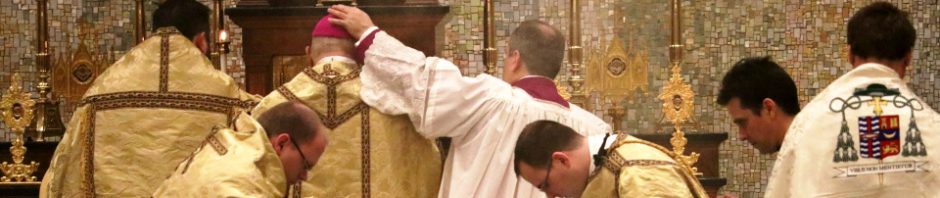
 This time of year many new priests are being ordained and, consequently, many priests observe their own anniversaries.
In the traditional, Vetus Ordo of the Roman Rite a priest can add orations “for himself… Pro seipso sacerdote“, on the anniversary of his ordination. If it is a feast of a saint, as it is today (St. Phili Neri), the orations are said under one conclusion.
I must confess that I add them on other days too. I just need to.
The 2002MR has three formularies Pro seipso sacerdote while the 1962MR has but one (which really is enough).
Let’s look at the prayer in the Vetus Ordo, the Roman Rite:
COLLECT (1962MR):
Omnípotens et miséricors Deus, humilitátis meae preces benígnus inténde: et me fámulum tuum, quem, nullis suffragántibus méritis, sed imménsa cleméntiae tuae largitáte, caeléstibus mystériis servíre tribuísti, dignum sacris altáribus fac minístrum; ut, quod mea voce deprómitur, tua sanctificatióne firmétur.
SLAVISHLY LITERAL VERSION:
Almighty and merciful God, kindly hark to the prayers of my humility: and make me, Your servant, whom, no merits of my own favoring me but by the immense largess of your indulgence, You granted to serve the heavenly mysteries, to be a worthy minister at the sacred altars; so that, that which is called down by my voice, may be made sure by Your sanctification.
The prayer focuses on priest’s self-awareness of his lowliness. Who he is and what he does is from God’s grace and choice, not his own.
It also emphasis the relationship of the priest to the altar, that is, the bond of the priest and Holy Mass. Priests are ordained for sacrifice.
No priest, no sacrifice, no Mass, no Eucharist.
In the older form of Holy Mass, during the Roman Canon after the consecration at the Suppplices te rogamus… the priest bends low over the altar. He puts his hands on it. They, his hands and the altar, were anointed with Sacred Chrism. He kisses the altar. Then he makes signs of the Cross over the consecrated Host on the corporal, over the Precious Blood in the chalice, and over himself.
Christ is Victim. Christ is Priest. The priest is victim and priest at the same time.
This moment during Holy Mass reveals his mysterious bond with the altar, where the priest sacrifices the victim. Sacrificial victim and sacrificing priest are one. At the altar he is alter Christus, another Christ, offering and offered.
In regard to the Sacred Chrism and ordination, a few years ago I heard the sermon of His Excellency, Most Rev. Robert C. Morlino of Madison – deeply missed, rest in peace – at the ordination of priests. He made the recommendation that, in hard times, the men should put a drop of Chrism on their hands, and rub it in, to remind them of who they are.
What also comes to mind, in considering the bond of priest and altar and victim upon it, is the Augustinian reflection of the speaker of the Word and the Word spoken, and the message and reality of the Word and the Voice which speaks it.
The voice of the priest and the priest himself are merely the means God uses in the sacred action, the sacramental mysteries at the altar, to renew in that moment what He has wrought.
Finally, this is done through mercy. The words misericors, clementia, largitas, benignus all point to the mercy of God.
The priest speaks and God makes what he speaks reality.
He takes the priest’s insubstantial words and makes them firm and real.
He takes unworthy men, priests, and gives them His own power.
The priest must get himself out of the way when he is at the altar, where the True Actor is in action, Christ the Eternal and High Priest.
This is why ad orientem worship is so important.
I think that there is little chance of a renewal of Eucharistic faith and piety in the Church without ad orientem worship and without the slow but sure elimination of Communion on the hand.
It leaves me astonished, but not surprised, that some bishops fight this. I suspect I am pretty safe in assuming that they neither know nor have celebrated the older, Vetus Ordo.
The Vetus Ordo teaches us a lot about priests, who they are and what they are for. That’s not wanted by many today. They want something different.
SECRET (1962MR):
Huius, Dómine, virtúte sacraménti, peccatórum meórum máculas abstérge: et praesta; ut ad exsequéndum injúncti offícii ministérium, me tua grátia dignum effíciat.
SLAVISHLY LITERAL VERSION:
O Lord, by the power of this sacrament, cleanse the stains of my sins: and grant; that it may make me worthy by Your grace unto the performance of the ministry of the office that has been imposed.
Priests are sinners in need of a Savior just like everyone else.
They confess their own sins and receive absolution from a priest like everyone else.
They, too, must do penance for past sins like everyone else.
They, while coming to the altar as alter Christus, come to the altar as sinners. There is only one perfect one.
In the older Vetus Ordo of Holy Mass, the priest is constantly reminded about who he is and who he isn’t. In the newer form? Not so much.
In this Secret, spoken quietly, the priest prays for what only God can do: remove the stains of sins from his soul.
The prayer brings also to mind the burden of the yoke of the priesthood, symbolized by the priestly vestment, the chasuble. Whatever its shape, the chasuble is a sign of the priest’s subjugation.
As the priest puts on this most visible of his vestments, he traditionally prays,
“O Lord, Who said: My yoke is easy and My burden light: grant that I may bear it well and follow after You with thanksgiving. Amen.”
The yoke is the ancient sign of subjugation. The ancient Romans caused the conquered to pass under a yoke, iugum.
This attitude of the priest at the altar, formed by the prayer and the very vestment he wears, can teach us a great deal about the nature and design of all the things that we employ for the celebration of Mass.
POSTCOMMUNION (1962MR):
Omnípotens sempitérne Deus, qui me peccatórem sacris altáribus astáre voluísti, et sancti nóminis tui laudáre poténtiam: concéde propítius, per hujus sacraménti mystérium, meórum mihi véniam peccatórum; ut tuae majestáti digne mérear famulári.
SLAVISHLY LITERAL VERSION:
Almighty eternal God, who desired me, a sinner, to stand at the sacred altars, and to praise the might of Your Holy Name: propitiously grant, through the mystery of this sacrament, the forgiveness for me of my sins; so that I may merit to wait upon Your majesty.
On the day of ordination the priest lies down upon the floor.
He is, in that moment, part of the floor.
He is the lowest thing in the church.
Consider two sets of contrasts.
First, there is the contrast of the low state of the servant sinner and the majesty of God.
Second, there is the present moment contrasted with the future to come.
Majestas is like gloria, Hebrew kabod or Greek doxa, a divine characteristic which – some day – we may encounter in heaven in such a way that we will be transformed by it forever and forever. When Moses encountered God in the cloud on the mountain and in the tent, he came forth with a face shining so brightly that he had to wear a veil. This is a foreshadowing of the transformative power of God’s majestas which he will share with the saints in heaven.
The priest waits upon majestas.
He waits on it, in that he awaits it. And he waits upon it. He serves it, like a waiting waiter, he serves it out as well. He also desires it for his own future. But in the present moment he waits upon it as a servant. He is an attendant, in every sense. He is one who waits and he is one who waits.
May God have mercy on all priests, sinner servants, attendant on the unmerited grace and gifts of the Victim Priest and Savior.
May God have mercy on me, a sinner.
Pray for me, a sinner.

Daily Prayer for Priests
O Almighty Eternal God, look upon the face of Thy Christ, and for the love of Him who is the Eternal High Priest, have pity on Thy priests. Remember, O most compassionate God, that they are but weak and frail human beings. Stir up in them the grace of their vocation which is in them by the imposition of the bishop’s hands. Keep them close to Thee, lest the Enemy prevail against them, so that they may never do anything in the slightest degree unworthy of their sublime vocation.
O Jesus, I pray Thee for Thy faithful and fervent priests; for Thy unfaithful and tepid priests; for Thy priests laboring at home or abroad in distant mission fields; for Thy tempted priests; for Thy lonely and desolate priests; for Thy young priests; for Thy aged priests; for Thy sick priests, for Thy dying priests; for the souls of Thy priests in Purgatory.
But above all I commend to Thee the priests dearest to
me; the priest who baptized me; the priests who absolved me from my sins; the priests at whose Masses I assisted, and who gave me Thy Body and Blood in Holy Communion; the priests who taught and instructed me, or helped and encouraged me; all the priests to whom I am indebted in any other way, particularly N. O Jesus, keep them all close to Thy Heart, and bless them abundantly in time and in eternity. Amen.
IMPRIMATUR
+Robert C. Morlino, Bishop of Madison, 6 September 2018






























Thank you, Father, for sharing this. It is both illuminating and moving. Every Catholic should know and be aware of these things at every Mass. Many of us who love the Mass do know them, but it is helpful to be reminded of them, and it is poignant that they should actually be brought to our attention by a priest himself.
Patri Z salutem in Christo plurimam.
Ex animo tibi gratulor, cum trigesimam quartam (eheu fugaces labuntur anni) anniversariam memoriam suscepti sacerdotii hoc die renovas, optimorumque munerum copiam tibi a Domino precor. Hoc in vitae tuae eventu jucundissimo extollo tecum Dei omnipotentis bonitatem qui te mysteriorum divinorum cultorem et dispensatorem, multorumque eruditorem et magistrum fecit. Vale.
I don’t see why, unless this rubric is meant to me taken strictly, these can be added as the prayer ad libitum for those able to celebrate pre-55 when the third oration of the season is a) required and b) ad libitum, as is the case after Candlemas and after Pentecost. (The rubric says that it may be from a votive Mass or any of the various collects.)
There are other possibilities for private Masses too. The 1962 rules flatten all of this. Anyway:
If he was ordained on the vigil of Christmas or if the day falls on the Pentecost vigil, Palm Sunday, or a double of the I class, the prayer is said on the first day of a lower rank.
It can be said at any Mass except Requiems said as the anniversary Mass, before any devotional collects (cf. my point about private Masses which have up to seven) and an oratio imperata but after the required ones.
It is said as a second collect under a separate conclusion on double feasts.
I am reminded of the priest representing Christ every time in the Vetus Ordo when the priest says the words “elevatis oculis in caelum ad te Deum” (with eyes lifted up toward heaven unto Thee, God) and he physically looks up towards heaven. I have always found that a powerful moment in the Mass. Missing in the vast majority of NO masses.
The prayer focuses on priest’s self-awareness of his lowliness. Who he is and what he does is from God’s grace and choice, not his own.
Thank you. This is super clear and worthwhile to remember. But in a way it also applies to all of our good works, which aren’t good in the meritorious sense unless rooted in sanctifying grace.
kindly hark to the prayers of my humility:
I was going to ask whether “harken” is the better term here. Then I decided I could just look up the difference. Apparently (and I don’t know this is solid), the words can be used virtually interchangeably when the meaning is “listen closely”. But not when the intent is to “attend to what occurred in the past”, then it should be “hark back”, not “harken back”. My own sense is that both versions are rarely used, but “hark” for “listen” is effective archaic, only found in the song “Hark, the Herald Angels” and “harken” can be used in ordinary speech more readily, but that’s just my own sense.
It also emphasis the relationship of the priest to the altar, that is, the bond of the priest and Holy Mass. Priests are ordained for sacrifice.
This reminds me of something: In Genesis 4, Abel sacrifices lambs to God and this is pleasing: Abel also offered of the firstlings of his flock, and of their fat: and the Lord had respect to Abel, and to his offerings.
This seems likely to be a first foreshadowing of Christ, the Lamb of God, who made himself the pleasing sacrifice to the Father. What I wonder is whether it is possible to read “firstlings of his flock, and of their fat, that Abel offered both the burnt offering (consuming the lamb entirely), and then in addition the peace offering, wherein Abel offered “the fat” to the Lord and then would partake of the rest of the lamb to signify community with the Lord – ALSO foreshadowing Holy Communion wherein we participate in the Feast of the Lamb. In Leviticus, Moses makes rules regarding these (and 3 other kinds of sacrifice), but because at least the burnt offering originates much earlier, can we surmise others did too, and that Abel shows us an example of the peace offering?
Thanks for the ending prayer.