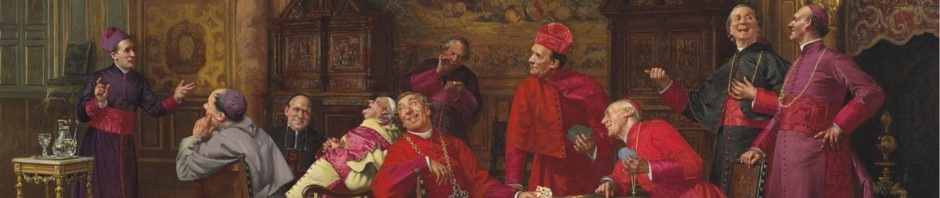
I think this article frames the issue quite well. Vatican II’s document on bishops converted bishops into a sort of “super priests” whereas the document(s) on priests … didn’t do much at all. The article is at First Things.
Some points.
After the obligatory praise blah blah of the Council the writer gets into it:
One area where Vatican II is weak is its theology of priesthood. Some may remember the distinguished Lutheran historian Martin Marty’s bon mot: The “winners” at Vatican II were the bishops and the laity; the “losers” were the priests and religious.
This is probably because the figure of a Pope was developing into someone so gigantic that it seemed almost Popes were apart from the rest of the Apostolic College. Hence the need to rebalance.
Certainly things are out of balance, to the point where priests are sort of indentured servants now. The tyranny of the Dallas Charter is, if my conversations with priests are any indication, increasingly as resented as it is clunky, oppressive, unnecessary and contrary to canon law. I’ve recent spoken with canonists whose theses are about this.
Back to the First Things piece (emphases mine):
The danger today is that bishops are often considered an isolated caste, separated from their priests. Evidence for this is readily available if one consults the National Study of Catholic Priests conducted by the Catholic Project of the Catholic University of America. In extensive interviews, priest after priest expressed fear of a false accusation, knowing that, often enough, they would be denied due process because of the Dallas Charter and its norms. With its lack of due process, the Charter has opened a yawning chasm between bishops and priests. Indeed, the National Study found that an astonishing 76 percent of priests mistrust the American episcopacy. This grave estrangement is unhealthy for the life of the Church.
It did not help matters that bishops failed to apply the Charter to themselves. Even now, after the 2023 promulgation of Vos Estis by Pope Francis, the process for dealing with accused bishops is much more expeditious than that dealing with accused priests. In all of this, bishops seem to occupy, ironically, the very space once thought to be occupied by the pope: isolated and aloof. What is needed is a stronger theological relationship between bishops and priests, a relationship never explored by Vatican II.
You should read the whole thing, but here’s a last point:
Of course, no council does everything. And Vatican II was an extraordinary achievement on many fronts. But if a one-sided papalism emerged from Vatican I, is it not possible that a one-sided episcopalism has emerged from Vatican II?
One theological task today is to embed bishops more clearly within their diocesan presbyterates. The wisdom of priests, theologians, and laity must help guide their actions—with more than “charitable solicitude”—otherwise the Church will be left with disenfranchised priests and an isolated episcopal caste.






























One (yes, I know it is unrealistic unto nigh impossibility; and this is a general thought, not at all a slight on my local church in particular) more reason why far more, far smaller, dioceses worldwide might be ideal: Small enough that bishops can be the pastors of their own cathedral parishes (albeit with the curial priests perhaps as vicars) to keep them grounded; small enough that they remain aware of their reliance upon their priests and the need to lead from among them with earned respect and authority and not mere rank and power; small enough that the people know them and can access them; small enough for them to be spiritual fathers and not a cake topper or visiting celebrity there primarily to make an event feel “important.”
“And Vatican II was an extraordinary achievement on many fronts”
I am really annoyed, not at you, Father Z, but with the article from First Things and the approach to scholarship it represents. I have been trying to write an article about the NBER working paper “Looking Backword: Long-Term Religious Service Attendance in 66 Countries” by Robert Barro, Edgard Dewitte, and Laurence Iannaccone, which I think you mentioned a few days ago (or was it weeks).
This article is really important because it uses already available survey data to extend the time period and number of countries for which religious service attendance data is available and it for the first time develops a set of panel data for attendance at services by children. Rorate Caeli was the first site I saw mention it and, like everyone else, focuses on its event study concerning the effect of Vatican II on church attendance by Catholics relative to nonCatholics. But the results of that test are not the point. The authors and every other scholar on the sociology and/or economics of religion already knew this. Apparently the hierarchy of the Catholic Church (with the possible exceptions of Benedict XVI) has not been able to see what secular scholars of religion see, or they pretend not to see it because they would have to admit Vatican II was a mistake. (During a phone call in May 1998 Malachi Martin told me that Pope John XXIII had been tempted by Satan.) Anyone who honestly thinks Vatican II was an extraordinary achievement, cannot see the trees for the forest. The reason the authors of the NBER paper do the event study is to show that the new data set is useful and because it formally yields a result everyone knows is true. Just look at the references in the article on religious service attendance. The famous Andrew Greely pointed out that the Council changed church culture by (1) changing the liturgy; (2) changing the way the church viewed non-Catholic religions, especially Protestantism and Judaism; (3) abolishing or deemphasizing many individual pious practices such as mandatory abstinence from meat on Fridays; (4) openly discussing the possibility of revising Church teaching on birth control; and (5) allowing priests to leave the priesthood in order to marry. (This list is from Barro et al., page 22 and is based on Andrew M Greely’s The Catholic Revolution New Wine Old Wineskins and the Second Vatican Council, Berkeley CA, University of California Press, pp 54-57. It is interesting that Greely attributes the decline in Mass attendance to Pope Paul VI’s 1968 decision to uphold the Church’s traditional teaching on birth control rather than the more liberal changes.) But there is also this paragraph from the paper:
Berman, et al. (2018, p. 154 ) say: “… the Second Vatican Council led to broad-based institutional decline within Catholicism. The losses included reductions in the number of people becoming or remaining priests, even larger reductions in the
number of nuns…” They argue further that Vatican II’s depressing influence on the number of nuns led to a sharp decline in fertility among Catholics because of the loss of childbearing support. Along similar lines, Gihleb and Giuntella (2017, p. 192) say: “the Vatican II reforms in the early 1960s inadvertently produced a dramatic change in the cost/benefit ratio of religious life and drained Catholic schools of critical human capital. Between 1966 and 1980, the number of Catholic sisters (nuns) was reduced by more than 30%. This unexpected collapse was followed by a parallel decline in the number of Catholic schools in operation.”
It is so clear that everyone who thinks Vatican II did some goods things or was an extraordinary achievement either is blind as a bat intellectually or approves of some sort of pet reform implemented as a result of the council (like vernacular liturgy or guitar Masses) which they like without regarding what the consequences of the whole thing were.
I cannot believe I put up with going to a NO Mass.
By the way a set of panel data has data on a large number of individuals (in this case individual countries) over at least three or four separate periods of time. It is very useful when there are important variables that cannot be observed that otherwise would bias the estimates.
I understand why the author focuses so much on the Dallas Charter. But it was the “collegiality” brought about my Vatican II that brought about the Dallas Charter. The result is that these bishops find themselves bound more now than ever to the inner workings of the company, instead of the things going on at home.
A priest preachers something that is controversial? Why is he not getting in line with the company? The culture of the younger priests lean to the tradition? The company hates the tradition, and believes that this is a problem that needs to be fixed.
Notice that these bishops are not defined by the places that they have been appointed. Jude is not the bishop of Black Duck. He’s an American Bishop in a small diocese.
But, dear Bthompson (not thinking what you write is utterly wrong, just adding a different perspective),
on the other hand, the ideal of a diocese right now is that she runs her general business and her parishes largely by her own diocesan priests which are recruited and trained in her own seminary that she runs; and that her Cathedral features a chapter of canons which sings the Divine Office there. And the chapter also has vicars to step in for them if they are busy due to their curial jobs; the communal Office is not left undone.
Not necessarily something every diocese does achieve I guess, but it is the ideal right now does have. And these are good things. Now, somehow, I cannot imagine that in dioceses as small as you suggest…
And also, some sort of leadership will naturally emerge. If dioceses are small, that will fall to the metropolite, or the primate, or the chairman of the bishops’ conference, or if we have a rather papalistic attitude to the nuncio (the third of these happens often enough even now with our big dioceses)…
Prior to Vatican II, an ordained priest was “consecrated”, not “ordained”, a bishop, by three bishops, one consecrator and two co-consecrators. The priest already possessed “jus ordinis”, and was given, by episcopal consecration, “jus jurisdictionis”. Suddenly the episcopacy became a new higher “order” requiring separate “ordination”. While certainly before Vatican II there was a chasm between bishops and priests, aka “higher” and “lower” clergy, Vatican II only widened this chasm.
Well, dear Saint110676, as for that the Council was right, or rather, there was no actual difference between what was before and after the council. The teaching that the episcopate is a degree of the sacrament of Holy Orders was always the traditional one; it was the theory to the contrary that was the theological innovation. Such a theory, yes, existed for some time, also had prominent support for some time, but it was not “the theory prior to Vatican II”. It had long been given up before Vatican II, as a look in the Catholic Encyclopedia article “Holy Orders” will make clear.
A look at both the ritual for an episcopal consecration, and the ritual for the presbyteral ordination which contains words like “ordo secundae dignitatis”, can hardly leave anyone in doubt that Vatican II was right on this one.
That is in principle; whether it took the right practical consequences is a different question.
The points I made were brought to me by a Catholic member of the Lutheran-Catholic Theological commission. In the Lutheran communion, there are some synods which have bishops and some which do not. His point was that bishops having a special “order” in the Catholic church would be a stumbling block for Lutheran-Catholic unity. This person, now deceased, former teacher, was a distinguished Scripture scholar, with strong opinions, to be sure, but neither a Church historian nor sacramental theologian. I appreciate your important clarification.
As a priest of an Archdiocese I have come to view my Archbishop as merely my employer. There is no care or concern for us. Priests are thrown out based on the most tenuous accusations. There is no regard for canon law. Support or its lack is used as a way to get priests to submit to voluntary laicization. Some connected clergy who “misbehave” are given a total pass even when guilt is known.
Indeed bishops relationship with their clergy definitely needs some reform.
Unless I’m very much mistaken, one of the leading forces (if not THE leading force) behind the Dallas Charter was a man going by the name of Theodore Edgar McCarrick.
Dear Saint110676,
well, I’m neither a Church historian nor a sacramental theologian myself. While I am a firm adherent of the idea that it is not the duty of the reasonably informed “laity” – laity even in the colloquial secular sense of the term – to keep their mouth shut, of course your answer required that clarification.
I’m still right on the facts: That one cannot read through the texts of the episcopal consecration and priestly ordination – at least as presented on the internet and attributed to the time of Pope Leo XIII to be exact – without getting the idea that the former too is sacramental is my personal opinion, but one of the “it’s really obvious” kind. That the Catholic encyclopedia teaches it as the opinion of the large majority of theologians (conceding, in a somewhat surprised tone, that the contrary “finds able defenders even now”), that Ludwig Ott says that Pope Ven. Pius XII says it implicitly, and that the Second Vatican Council teaches it explicitly are, quite simply, facts.
That being said, I wonder how your source got that idea:
>>In the Lutheran communion, there are some synods which have bishops and some which do not. His point was that bishops having a special “order” in the Catholic church would be a stumbling block for Lutheran-Catholic unity.
We had better ask our reverend host, who was a Lutheran once, but I don’t think this could be a stumbling block for Lutheran-Catholic unity. I mean not that it would matter much, there is this huge stumbling block for Lutheran-Catholic unity that is called “Lutheranism”, but the fact that we Catholics have bishops? So does Lutheranism per se (I’ll explain in the following paragraph). The presbyterians don’t, but they are very much different from Lutherans.
Now I admittedly know less about Lutheran theory than even about the Catholic one, but Luther never disputed that the Church’s structure is episcopal. He may even have conceded, when not rambling, that it was also papal. His theory was that a situation existed where due to temporal necessity one had to do without them, and then everybody could be bishop by virtue of his baptism, chiefly the local territorial prince because he was at least a Christian and had the power. Hence the (German) territorial prince became what is called “summ-episcopus” of their Lutheran churches. (Not the one from whose investiture they derived their authority, the Holy Roman Emperor; he was not a Lutheran, but some of the territorial princes were.) But this is, by Lutheran theory, an exception to the rule to be discontinued when the Church came back to (what he considered) true Christian doctrine.
(Kuehnelt-Leddihn’s word that Luther was the Lefebvre of his day does have, as we see, a lot of basis in fact. – There is the important distinction of course that what Luther considered true Christian doctrine contained heretical novelties and Lefebvre’s didn’t. As I always say, there is no way around the question what is true and what is not.)
But anyway, that’s why bishops should be as little of a stumbling block for Lutherans as for, well, Episcopalians. They are one for Presbyterians. – But then, perhaps practically the difficulties, of the question should ever be on the table, would be the other way round, and not so much although as because the Presbyterians have no dignitaries called “bishops” with vested interests (“where do I stay in all that”) and the others do… Human beings are, after all, still human beings…