Jesuit-run Amerika Magazine bravely comments about Leo XIV and the TLM … behind a paywall. (There are ways….)
Mind you… anything or anyone jesuitical commenting on liturgy should right away be held as suspect. There are exceptions. Is this one? My emphases and comments.
Pope Leo’s Latin Mass Problem
by Terence Sweeney [See what else he has written for Amerika HERE and get a sense of his positions.]
October 22, 2025
I don’t envy Pope Leo XVI as he determines how to approach dueling papal edicts about the celebration of the Tridentine Rite. His predecessors Pope Benedict XVI and Pope Francis took markedly different approaches to liturgical reform. Leo must chart a course between them while settling on which is fundamentally the correct path. [Why does it have to be “between” them? Is this a Hegelian approach? I am trying to picture what not between them would look like. I admit it is not easy to see it. Is there one? I guess one would be “Today in a surprised move, Leo XIV abrogated the Novus Ordo, calling on all Roman Rite Catholics to use the pre-55 Missale.” And then the LSD wears off….]
The problem? Pope Francis’ motu proprio “Traditionis Custodes” and Pope Benedict’s motu proprio “Summorum Pontificum” offer contradictory claims about the liturgy. Beyond dealing with anti-magisterial tendencies often found in liturgically traditionalist Catholic communities, [a claim based on… what? But you are simply supposed to accept that premise.] Leo must determine which moto proprio best expresses the unity of prayer and belief in the life of the church. [Again with the binary limitation.] It is a fraught choice but one of the key ones of his papacy. The goal is to ensure that the law of faith and the law of our prayers (lex credendi et lex orandi) are mutually enriching, such that there are no disjunctions between the way we pray and what we believe—and vice versa. [It seems to have been working pretty well most everywhere it was tried under Summorum. Then came the “survey” which was ignored and lied about. Also, “ant-magisterial”? “Disjunctions”? I remind the writer about polls of Catholics and their acceptance of or disagreement with the Church’s moral teachings. Which group has a higher percentage of Mass attendance and adherence to doctrine? Those who frequent the TLM or the Novus Ordo? Which group is more likely to support contraception and abortion and sodomy? So which group is it again that tends to be “anti-magisterial”? Those are issues clarified by the magisterium, right?]
For Benedict, the liturgy promulgated by Pope Paul VI after the Second Vatican Council was the ordinary rite, as in the standard expression of the lex orandi of the church; the Tridentine Rite, [not really an accurate term, since the Rite existed long before the Council of Trent] which largely follows Catholic liturgical practice before the council, is the extraordinary (as in non-standard) expression. But both were expressions of that law of prayer and so the law of faith. [BTW… there are more Rites than the Latin, Roman Rite… just sayin’] For Pope Francis, the reformed rite of Paul VI “constitute[s] the unique expression of the lex orandi of the Roman Rite.” Francis wrote that there was “‘a single and identical prayer,’ [which is a false statement] that expressed the Church’s unity. This unity I intend to re-establish throughout the Church of the Roman Rite.”
In other words, for Francis, there was no extraordinary expression of the lex orandi; there is only one Roman Rite and one unique expression of it, whereas Benedict had held that “these two expressions of the Church’s lex orandi will in no way lead to a division in the Church’s lex credendi (rule of faith); for they are two usages of the one Roman Rite.” For Francis, the continued celebration of the extraordinary form leads to division because it insufficiently expresses in its lex orandi the lex credendi of the church. [When it comes to matters liturgical, in whom shall I put my trust… Joseph Ratzinger or Jorge Bergoglio, SJ? Hmmm.]
A singular rite
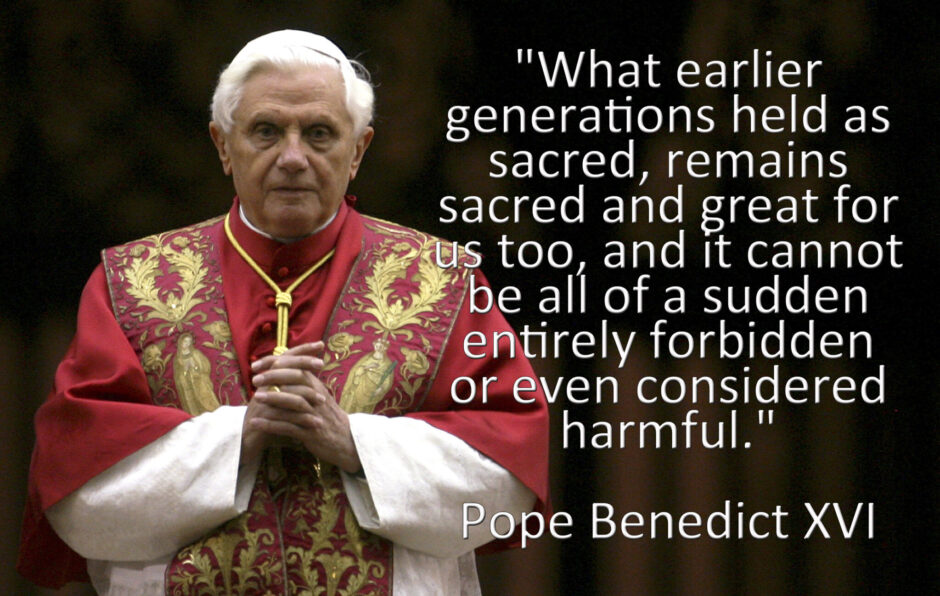
Of course, Pope Benedict had a point when he wrote that “what earlier generations held as sacred, remains sacred and great for us too.” For centuries, the extraordinary rite was used in the celebration of the holy sacrifice of the Mass, which enriched the lives of saints and sinners for centuries. So what could be wrong with its continued celebration?
First, it does not appear that Vatican II or Paul VI intended for there to be two expressions of the Roman Rite. Rather, the council called for, and Paul VI carried out, the reform and renewal of the Roman Rite. This is why the Tridentine Rite was “never judicially abrogated,” as Pope Benedict noted. To abrogate it would have been to say that there were two rites, one no longer allowed and one allowed. There really is only one rite in its unrenewed and renewed versions. [So what? The fact remains… it was never abrogated. The writer seems to be saying, “Well, it wasn’t abrogated, but it really was … like… in between the lines, kinda secret like if you know how to interpret it.” ]
That is why Francis quoted Paul VI in speaking of a single prayer. It is further why Francis stated that “[w]hoever wishes to celebrate with devotion according to earlier forms of the liturgy can find in the reformed Roman Missal according to Vatican Council II all the elements of the Roman Rite.” [Which is patently false statement.] What traditionalist Catholics sometimes call “The Mass of the Ages” is the Vatican II Mass, because it is a singular rite, periodically reformed in the history of the Roman Church and reformed at Vatican II.
The council fathers (including the future Pope Benedict) clearly believed that the Tridentine Rite needed reform and renewal. The aim was not to have two rites; it was to deepen and enrich the one rite of the Roman church. [Something which Ratzinger understood had to take place over time, unlike those who suddenly and brutally shoved the Consilium’s Novus Ordo down everyone’s throats. Bergoglio, SJ used the same approach sudden, brutal imposition. Ratzinger surely had a “Hegelian” model in mind, with the “mutual enrichment” idea. He wanted to jump start the organic aspect of liturgical development which was snuffed out by the imposition of an artificial product crafted by committees.]
In God’s image
It is important to remember that the liturgical renewal was grounded in the renewal of the church’s [Church’s … there, I fixed it for you] philosophy of the human person as well as its ecclesiology.
Vatican II provided definitive teachings about the nature of the church, developed the understanding of the dignity of the human person and restored the baptismal vocation of the laity. Grounded less in neo-Thomistic categories and more in the notion that we are all born in “the image and likeness of God,” the imago dei, both “Gaudium et Spes” and “Dignitatis Humanae” affirmed the human being as oriented towards God and so shaped by our capacity for union with God (a capacity only brought to fruition by God’s gift). Thus the human person, all human persons, can only be understood in light of the person of Jesus. [Yes, we know about GS 22.] “Lumen Gentium” further affirmed that the human vocation to holiness was not restricted to the clergy and religious; rather, all Christians have a vocation to sanctity. [Something I think the Church was aware of before Vatican II. No? Look at the pre-Conciliar liturgical calendar and the Martyrology.]
This understanding of the human person and the meaning of baptism means that laity, as “Apostolicam Actuositatem” teaches, “share in the priestly, prophetic, and royal office of Christ and therefore have their own share in the mission of the whole people of God.” As such, we must understand the entire church as the body of Christ in which each member participates; thus “no part of the structure of a living body is merely passive but has a share in the functions as well as life of the body.” The laity are not just done to; they are active participants in the life of the church as expressed in her service, witness and worship. This “life of intimate union with Christ in the Church is nourished by spiritual aids which are common to all the faithful, especially active participation in the sacred liturgy.” [The question now is: What does he think “active participation” means?]
It is from out of this deepened and broadened understanding of human vocation and the baptismal character that deepened and broadened engagement with the liturgy arises. Thus the council declared in “Sacrosanctum Concilium,” “in the restoration and promotion of the sacred liturgy, this full and active participation [let’s include the most important part, shall we? … “conscious”… SC 14… in the first paragraph: “the faithful should be led to that fully conscious, and active participation”.] by all the people is the aim to be considered before all else.” This “before all else” reminds us that lay liturgical action is the primary purpose of the reformed liturgy. [Again, what is “action” or “active” in the thought of the Council Fathers? They didn’t mean carrying bowls around and piling into the sanctuary as if there is no distinction between the baptized and the baptized and ordained. Let’s go on.]
The council fathers engaged in liturgical reform [Hmmm… which were the “council fathers engaged in liturgical reform”? All of them? I don’t think so. Which, then?] were deeply troubled that in the Tridentine Rite, [Again, an inadequate term, but it can slide…] the laity were often at risk of being, as “Sacrosanctum Concilium” states, “strangers and silent spectators.” Certainly, in their inward devotion they could participate, but human participation is not only inward. It is full, active and conscious and thus enacted in word, movement and reception. [What is left out here is that the “inward” must be both chronologically and logically prior to the “outward”.] While the Tridentine Rite is silent on the movements and actions of the laity, [… “qui tacet consentire videtur”…] the rite promulgated by Paul VI invites [?… aka “requires”?] us in, body and soul, to the actions of the liturgy that we offer with the priest. [Another way of looking at this is that the older, traditional form respects the congregation by not imposing on them with their own rubrics, unlike the Novus Ordo] The lex orandi of the contemporary liturgy expresses the lex credendi of the church’s ecclesiology and its theology of the laity. The Tridentine Rite does not do so, or at least not as ably. [“or at least not as ably”… interesting…] To celebrate the latter is to have insufficient practice of worship that insufficiently expresses church teaching. [I don’t think he has made his argument effectively. Again, the issue is really that “inward” part, isn’t it. A person can do things outwardly, and his mind is a thousand miles away. You can, for example, sing a song’s lyrics flawlessly to the observer or listener, but in your head you are going over the grocery list and other things you have to do. I maintain that a little old lady who can barely see or hear anymore, and who can’t carry anything but her cane, unable to get up easily and in no way can kneel, can sit quietly with her heart and mind joined to what she knows is happening at the altar she can’t see and be by far more “actively” participating then the crowd singing every word and carrying things around and slapping each other on the back. She isn’t being passive. Her participation is actively receptive. It is an active receptivity, mind/heart engaged, that the Council Fathers were aiming at. What I think the writer is missing here is that the Vetus Ordo is more demanding because it contains (if that’s the right word) apophatic elements which the Novus Ordo lacks. Consequence to explore: QUAERITUR – If more demanding, more rewarding?]
Much of what characterizes the ordinary form of the liturgy is its broadened sense of participation in the sacred mystery of the Mass, balancing two essential aspects: “the eucharistic sacrifice of His Body and Blood” and “a paschal banquet in which Christ is eaten.” [Uh oh… look out!] A banquet invites all to participate with the host; thus we conform our sacrifice with the priest while sharing in the banquet through the offertory, sign of peace, reception in both kinds and ritualized movements of our bodies. For this reason, the council fathers taught that full, active and conscious participation is a non-negotiable lex orandi, one expressive of the true meaning of being a member of the people of God gathered at what is both the altar of sacrifice and “the table of the Lord’s body.” [So much for the little old lady in the pew. I guess she’s not participating. Moreover, we all accept the “banquet” aspect of the Eucharistic liturgy. However, the “banquet” aspect is certainly outweighed by the “Sacrifice” aspect, as is clear from the fact that the final cup of the Last Supper was only taken upon the Cross of Calvary. Our forebears certainly recognized the “banquet” aspect of Mass, as Thomas Aquinas demonstrated in his Corpus Christi texts. However, over the centuries of deepening understanding of the mystery of Holy Mass, the Church has constantly emphasized the Sacrifice, not the “banquet”. Hence, I think the writer gets it wrong early in the paragraph in that “balancing” these aspects. They are not equal and can’t be balanced, even though we give due respect to the lesser. In the traditional Roman Rite for Communion outside of Mass, the priest or deacon says, “O sacrum convivium, in quo Christus súmitur recólitur memória passiónis eius, mens implétur grátia, et futúrae glóriae nobis pignus datur” and then in the famous Collect returns to stress the Passion: “Deus, qui nobis, sub Sacraménto mirábili, passiónistuae memóriam reliquísti…”. In addition, anyone who has attended the older, traditional Rite for some time can certainly participate fully, consciously and actively. Always has been able to. And this was a fruit of Summorum Pontificum, by the way. The demonstration (as if it had to be demonstrated) through the side-by-side celebration of the two Rites that one can participate fully, consciously and actively in both.]
The development of doctrine is never a rupture, but it is an enriching of the tradition. This is why with “Traditionis Custodes,” Pope Francis served to preserve the tradition, because he guarded its full expression. [Oh dear. He went of the rails here. The imposition of the Novus Ordo itself was a RUPTURE of galactic impact! And Traditionis custodes was yet another RUPTURE.]
Leo must take up that custodial role himself. If “Summorum Pontificum” and “Traditionis Custodes” offer different understandings of the lex orandi of the Roman Rite, then Leo must affirm one of them as the right understanding of the faithful—and thus resolve a significant division in the life of the church. [There’s the either/or again. What if Leo comes up with something else? I’m not sure what that would be, but hey! Maybe he will.]
Incorporating traditional elements
Leo would be wise in implementing “Traditionis Custodes” in a pastoral way, but also in a way that affirms the liturgy as practiced by the vast majority of Catholics today. [Once someone starts talking about “majority”, our alarm bells should ring. One might ask: How is the “majority” approaching the Eucharist these days? I think the first response is, “once in a while” rather than weekly and also “unconfessed for years”. Hence, most Communions are probably received in the state of mortal sin. Is that the majority we are talking about?] In so doing, he should direct bishops to affirm a core insight that actually comes from traditionalists in the church: The contemporary liturgy needs more reverence and a more transcendental orientation. I agree with traditionalist Catholics that too often these have been neglected in the way that many celebrated the reformed liturgy. We need a deeply traditional celebration of the contemporary rite of the Mass. [Okay. Let’s go along with this because I think that a rising tide raises all boats. Making something better is a good thing. At the same time, it is an amusing line of thought. Let’s make the Novus Ordo better with elements of the Vetus Ordo. On the other hand, if we argue that the Novus Ordo is improved through those traditional elements, then why not just use the Vetus Ordo? We return in a circle to Ratzinger’s vision of organic development pretty soon.]
How can this be done? First, the ordinary form of the Mass needs to integrate Latin more fully into its expression. Some of the Latin prayers in the Roman tradition remain essential expressions of our unity and universality, especially the Sanctus, Angus Dei, Gloria and Pater Noster. They should be prayed together in Latin. [I believe the writer is aware that the Novus Ordo is officially in Latin. Everything else is just a translation.]
Second, we should give pride of place and priority of usage to the Roman canon (Eucharistic Prayer #1) in the celebration of the Mass. While the implementation of four Eucharistic canons was a great gift of the reforms of Vatican II to the celebration of Mass in different circumstances, [gratis asseritur, gratis negatur] there is nothing wrong with making normative a canon that most fully incorporates the liturgical tradition of the church.
Third, celebration of the Eucharistic prayer ad orientem can be welcomed as a rich liturgical option. [LOL! It is in the N.O. rubrics!] Similarly, parishes where the Tridentine Rite has been celebrated as an option should be encouraged to celebrate the ordinary form fully—but in Latin, ad orientem, and with many of the aesthetic features that do genuinely elevate the mind and heart to God. [Let’s turn the sock inside out. Let’s encourage… nay rather… force people occasionally to attend the TLM. That would be fair, right?]
Fourth, the many liturgical abuses that go unchecked in many parishes should be more expressly condemned and eliminated. This is an urgent manner and should be treated that way. [But it hasn’t been and it won’t be. Who is going to do that? Bishops? Here I think we have an argument for “market forces”. Guess where there are no liturgical abuses. … … Yup. That’s right.]
By implementing “Traditionis Custodes” with these pastoral touches, Leo can show himself to be a pastor to those attached to the Tridentine Rite and affirm that they are still deeply committed Catholics. [How condescending. That was unworthy. Let’s look a polls about Mass attendance and adherence to the Church’s teaching on moral issues and see which group is “deeply committed”.] He can thus encourage pastors to be sensitive to the good motivations that shape the longings of more traditional Catholics while avoiding spiritual harm. [? Not sure what that means. I think he might be talking about the spiritual harm bishops like those of Charlotte and Detroit and Knoxville have done to their flocks.]
It is part of the mission of the pope to guard the tradition and ensure unity. [There’s the shibboleth. Why is it that liberals (after all, he teaches at Villanova and writes for Amerika) think that unity is only the unity of lockstep marching jackboots?] To do so, Pope Leo XIV will have to reconcile the liturgical division between the previous two papacies and amongst Catholics. It will be no easy task, but I certainly trust that he is the right man to watch over the fullness of what has been handed on—and thus to bring greater unity to our prayer and belief. [Unity … Here’s something to chew on. I have a good friend who is a Ukrainian Greek Catholic priest. We have really different ways of praying. I am in unity with him. I know several priests of the Anglican Ordinariate. We pray differently in some ways and the same in others. I am in unity with them. Why does “the left”, if we can use that category, insist that in unity means identically?]
Satis superque.
Ceterum censeo litteram “Traditionis custodes” esse delendam.




 Loading ...

























My first decree as Pope is to disband the Jesuit order.
I hope Jesuit Fr. McTeigue responds to the article from the Jesuit publication. It seems to be the sort of explanation that Fr. McTeigue was asking for in his recent video.
Father, we are close in age, and many of the arguments in this article about ‘participation’, etc., are the same tired arguments that have been used since the Council. What l really sense is a ‘last days of the Third Reich bunker mentality’ from the hierarchy to completely eliminate the old rite from the landscape before the young generations of faithful and clergy put things right.
The calls for a more reverent and transcendent celebration of the Novus Ordo seem hypocritical. The “reformers” have been in charge for 60 years. If they actually wanted “reverence” we would have it. They don’t. And reverence is not imposed by us on a neutral rite. The Old Mass actually gives birth to reverence by the truth it expresses and how clearly it invites someone to actively participate in Christ’s Sacrifice. It built cathedrals, inspired Dante and countless other artists. The Novus Ordo is missing that, because much of it got intentionally removed. To my knowledge Marty Haugen has not written a setting for the Dies Irae, and such a suggestion would be absurd. [ARG! ARG!!! I CAN’T UNSEE THAT! OH NO!] The Old Mass and the normal way in which the Novus Ordo are celebrated are as contrary as oil and water, and everyone can feel the disconnect. So until there is real enforcement on how the Novus Ordo is celebrated, that affects local parishes with similar teeth as TC, I find any calls of reform to lack credibility.
If the new Mass is essentially the same as the old, then why is it so important to prohibit the old? It’s only some minor tweaks but it’s also absolutely critical that everyone use the new?
You clearly have a great deal of patience since you have addressed so many of the bald assertions and personal perspectives disguised as facts in this article. I admit to fatigue, so I applaud you, Fr. McTeigue, Dr. K and many others for continuing this fight. We seem to be going through a period of mediocrity in the leadership of our Church, and the term mediocrity is kind. Having been blessed with a revived TLM a reasonable drive away for the past several years, I dread the idea that my wife and I will, for the rest of our lives, be left to the NO as we see it practiced around us.
I could say many things, not all polite and some requiring confession afterwards to such a man.
As a layman, husband (15 year anniversary today, thank my lovely wife) and father of four, having attended 4 universities now for a varied education, I am SICK TO DEATH of certain members of the church assuming they know better than me and I should just sit down and shut up. Dressing such arguments up in such flowery language and tongue twisters isn’t smart, it’s stupid. It’s all hand wavy and “look at this!”
“Pope Francis’ motu proprio “Traditionis Custodes” and Pope Benedict’s motu proprio “Summorum Pontificum” offer contradictory claims about the liturgy.” – we were told that wasn’t so for years, that they were in close accordance and complimented each other. I remember. FFS.
Sweeney wrote “The council fathers (including the future Pope Benedict) clearly believed that the Tridentine Rite needed reform and renewal. The aim was not to have two rites; it was to deepen and enrich the one rite of the Roman church.”
Yeah…about that…the deepening and enriching has seriously been lacking. More like the supporters of the NO have gone out of their way to make everything as superficial and banal as possible…as if to wipe away any memory of the scared.
“…full and active participation …”
They sure are stuck on this phrase. And we let them continue to use it as an excuse for the NO.
I don’t doubt there were Catholics who exhibited minimal effort towards the TLM in ages past. But the idea that you can force people to participate is ludicrous. This is born out by the atrocious weekly attendance numbers at NO Masses. My experience in organizations has been when you start changing things to attract and/or satisfy those who don’t regularly participate in the group you end up wrecking it for everyone and never get those reluctant participants to fully engage. More likely the innovators were less concerned people weren’t participating in the TLM because of its format but rather desired a more protestant approach to “worship” that involved the whole congregation doing something. (If you’re doing, you’re not contemplating.) When I see clips of Masses like at Holy Family in Inverness, Illinois it looks very protestant.
As you pointed out Father “A person can do things outwardly, and his mind is a thousand miles away.” Personally, I find the TLM to be engaging. I don’t want to miss a part of it because I understand it all has meaning. I find it moves along effortlessly and suddenly it’s time for communion. In contrast, at the NO I find myself impatient and not inclined to participate in the various music interludes while someone walks somewhere. The whole Mass often seems disjointed as if someone said “ok, let’s do this now” and some ones goes over there and someone else stands here. And now we sing.
The NO adherents love the banquet analogy. Just hanging out and having a meal. The homily I heard the other day about the master tossing out (and worse) those not properly disposed towards his wedding banquet and the reminder (as Father gestured towards the altar) that we’re invited to a wedding banquet. The implication being we need to understand the solemnity of what we’re attending.
Luke Welborn commented, “The “reformers” have been in charge for 60 years. If they actually wanted “reverence” we would have it. They don’t.” Much like if Chicago wanted a safe city not besieged by gangs they’d have it. For some reason the NO can’t be corralled and tempered but the TLM can be shut down without hesitation despite lacking the infractions of the NO. The NO invites innovation and is the source of numerous examples of irreverence. The TLM doesn’t invite innovation. In fact, it’s fault is it continues to be the same as it always was. No one ever complains of an irreverent TLM. Yet we’re asked to believe the NO is a better expression of our Catholic faith.
We must be doing something right or they wouldn’t be giving us so much attention.
“Unique” is a funny way to describe the Ordinary Form.
There are what, nine canons? Four or five “Mysteries of faith”? The cup may or may not be offered to the people.
Use some Latin or Greek, nor not. Use the vernacular, or some other language unknown to the public (like Irish on St. Patrick’s Day).
Liturgical dancing.
Amazonian Rite.
These are just a few of the myriad of options open to the celebrant. Or is it “presider” (thinks a moment). No, I’ll stay with celebrant.
It’s not what I think of as a ” unique expression of the lex orandi of the Roman Rite,”
Tangentially, I belatedly checked again and see that the “Let’s Sing with the Pope” video series now includes a Latin Ordinarium, but have not tried it yet.
But I am still troubled by the refusal of many priests in the FSSP, ICKSP, etc to accept Pope Benedict’s position on celebrating the NO. Did he not tell the bishops that such a refusal would show that these priests are not in full communion with them?
For me the word “disjunction” is proof that this author’s capacity to reason, deduce, make basic inferences, and even be aware of himself are catastrophically impaired. To disjoin means to separate –> it doesn’t take much thought to understand that the precedent cannot disjoin. Only the antecedent, that which follows in time, can join or disjoin FROM THAT WHICH EXISTS, and that must include the precedent.
So did Benedict disjoin from St. JP2? No, he provided some clarity and a push in a direction the preceding (see what I did there?) pope had started. Did Francis disjoin? Absolutely he did, he declared as much.
As for the faithful, they are disjoining when they make use of the valid rites made available to them? How can that be? They have not added something new, they have not said “here is a dogma we will not follow”, like some other people have.
But this whole thing about V2 and New Mass/Old Mass –> again, how can the Old Mass have disjoined from the New, when it is precedent? How can ANYTHING which is PRE-conciliar disjoin from anything post-conciliar?
No, a thinking author, aware that his article might be read by thinking readers, would never put such a word on the page, because it would open his line of argument to exactly this point.
I think he needs prayers, and maybe some professional medical attention, as well. [C’mon. Really?] And after that, hopefully he will be assigned to the Vatican Dicastery of Salvation through Push-ups, a little-known Vatican office investigating if there wasn’t some oversight by Ss. Paul and James, and trying to answer the question on the lips of every drill sergeant since the Ascension, how many pushups does it take to enter the Kingdom of Heaven.
I think that the Church should simply declare that the “Novus ordo” and the TLM are different rites belonging to two different ritual Churches (apologies if my terminology is not quite accurate), give every priest and deacon a one-year window to decide definitively to which rite/Church he will belong, and declare that for the next fifty years every Roman Catholic layperson can switch one time to the TLM rite without having to go through whatever process (I assume that there is one) laypeople usually have to do in order to switch rites/Churches. The people who stay in the “Novus Ordo” rite/Church can even keep the name “Roman Catholic,” so far as I’m concerned. I’ll gladly be called a Tridentine Catholic if I can have the TLM.
Sweeney wrote “For Francis, the continued celebration of the extraordinary form leads to division because it insufficiently expresses in its lex orandi the lex credendi of the church.”
If I understand correctly the way we worship is what we believe. If that is correct then how is it that the worship of the TLM insufficiently expresses what we believe? The numerous genuflecting, signs of the cross, bowing, petitions for forgiveness, reminders of sacrifice, collects that stir the imagination, not to mention the external but important things like beautiful sanctuaries, candles, properly attired altar boys, etc, etc, etc seems to express pretty well what the Church believes.
The stripped down NO does none of that. But it does express something of what those who promote its use believe in.
To be honest I never understood how the two rites were to mutually enrich each other. The NO deleted a lot of what the TLM contained so how would the TLM enrich it? And the NO with its pared down so-called simplicity would enrich the TLM how?
I don’t see why the mutual enrichment is Hegelian, beyond perhaps a superficial similarity.
You make my day Father when I open the Blog and see RED.
You hit it all. Not that I have read all encyclicals but I noticed that the older encyclicals were written for everyone. Not scholars or Theologians . Clear and concise. Jesus spoke in parables to make us think. The Apostles confirmed his teaching when they spoke.
Why do they feel it necessary to go on and on like there is a prize for the most words used?
“…to bring greater unity to our prayer and belief.“
I think this is the crux. Once TLM attendees are forced to regularly worship at banal or abuse-riddled NO Masses, the better chance everyone will finally accept things like abortion, religious indifference—and most importantly—sodomy.
What is wrong with these people?? Open your eyes and your mind- For 60 yrs+ as a Catholic, I have witnessed some of the worst (and best?) of the liturgical abuses the V2 modernists have put on display, not counting the vapid and empty homilies that usually accompany them. I am sick and tired of the NO apologists attempts to tell us you can’t fully participate in the VO Mass-so, if I were jumping up and down in the aisles or pews like a holy roller, I’d be”fully participating” in the Mass. The Catholic laity has been so badly catechized and dumbed down over the past 60 yrs. as a result- the fruits of those modernists coming out of V2 is rotten to the core; the numbers and weekly reality bear that out. Downplay the Mass as a Sacrifice, drop most of the liturgical prayers/practices, sing too many Protestant hymns, deface the beauty of our churches, under catechize the laity and voila, you have the NO-
Here’s my issue with all of this.
1) There are many many deeply faithful, Orthodox Catholics who attend NO Masses. In a lot of places it’s simply not practical or available to just “go to a Latin Mass”… so while we can crucify this guy for some glaring flaws in his argument, it certainly seems like a step in the right direction. Heck the fact that someone writing for “Amerika” magazine is making an attempt is refreshing to me.
2) All these discussions in the comments section seem to ignore the gross liturgical abuses that were happening pre-Vatican II. To white wash this and just imagine that a bunch of progressive Cardinals woke up one day and said “we should reform the liturgy” is patently false. Priests in many places were not the wonderful, Orthodox, reverent Priests we now see across the FSSP, ICKSP, and the many wonderful NO Diocesan Priests.
Bottom line, if we want to move the Overton Window back in the right direction, blasting every attempt at Orthodoxy that is made by people who genuinely may be ignorant is not the way to do it.
@Ionathas Gnosis ph. d.
It seems to me thar your proposal does not solve anything and creates infinite problems.
@OKC Catholic Dad
“To white wash this and just imagine that a bunch of progressive Cardinals woke up one day and said “we should reform the liturgy” is patently false.”
Sure, but it was a very wrong attempt at a solution.
A good analogy is, I think, to be found in a mechanic’s shop: if the engine is knocking, a paint job and some white-walls isn’t going to fix the problem.
A mechanic who says otherwise isn’t just bad at his own job. He’s probably bad at every job.
Updating my tangent:
I tried the “Let’s Sing with the Pope” Kyrie: it was from “De Angelis” – with a surprisingly ‘choppy’ style in the lesson from our friendly and learned series-master (with a sort of breath-and-vowel-intrusive-repetition), happily smoother all round in the clip from St. Peter’s at the end.
maternalView
What was missing in the typical practice was identified in this comment by Archbishop Lefebvre on the 1965 revisions to the Missal.
https://archive.ccwatershed.org/media/pdfs/21/12/09/09-35-37_0.pdf
I’m going to shamelessly steal a critique that I’d heard some years past, mostly because it’s so dang apt:
RE participation, I get the impression that the author has never attended a football game or a good movie.
One of the hallmarks of a well-played, competitive game or a compelling movie is…audience participation. TECHNICALLY, the spectators are not allowed to influence the conduct of a game. TECHNICALLY, the audience of a movie has no say in how the movie will progress or end. More realistically, …well, now and then, you’ll see a team suffer a penalty for unsportsmanlike conduct because the crowd became a bit too boisterous. …and many times people praise or chastise a movie.
In both cases the audience has no need to do anything at all besides sit.
Maybe eat some popcorn.
In both cases though, …audience participation plays a key role.
Silence…. does not always mean tuned out.
Yes, we know the Mass suffered abuses prior to Vatican II.
I think the Novus Ordo has suffered many too.
jflare29: When the Met in NY put up a new production of Tosca (I saw it) the audience BOOOED the artistic director. They had to take it down and do something else. Alas, they could not revive the Zeffirelli production.
Audiences matter, as anyone who has played on a team-sport team know.
The only way to clean up supposed abuses in the TLM was to force us into a stripped down NO which introduced new abuses?
Riiiight.
Dig into the history, writings & beliefs of these guys who created the NO and it’s not about maintaining the beauty & integrity of the Mass. They sound like protestants. They were arguing and maneuvering for changes to the Mass since the 1800s. No they didn’t just wake up one day and destroy the TLM. They worked at it for DECADES.
If these people were full of good intentions then why have they done everything they could to destroy anything resembling pre-VII devotion or worship? It was all bad? And if it was all bad where are their glorious successes? Shouldn’t that be attracting everyone to the one, unique, singular expression of our faith- the NO?
Ionathas, RE changing from Novus Ordo to TLM, …I don’t think there is any such thing as a rite or process involved. Mostly you simply…. change. I had attended Mass at one church for a time after leaving the service, then learned another parish offered Chant sometimes. I went to Mass at that parish and changed my registration that week-end. Several years later, some years after Summorum, I wound up moving again to the local TLM parish. Technically, our bishops allowed dual registration, yet I find keeping track of one parish tricky, so I decided against trying to do two.
I’m not aware of any formal process one must accomplish.