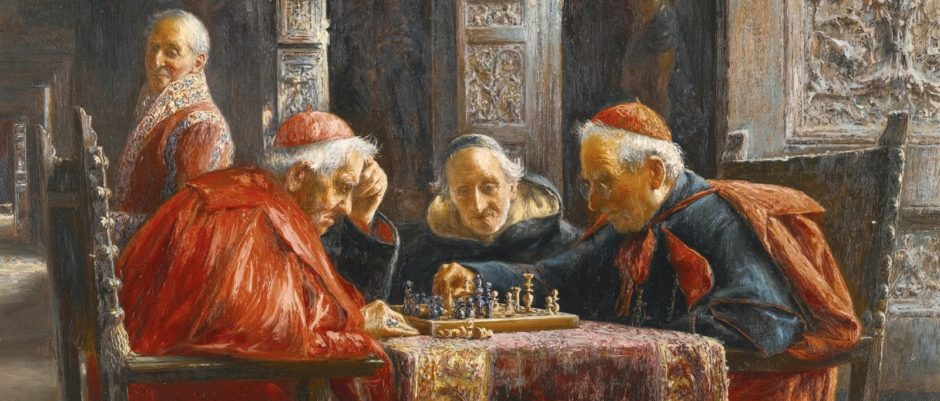
Do you remember all the way back to the dark year of 2023? Newly minted Cardinal Fernandez of the DDF vowed in an interview that he was not a “Soros spy infiltrated in the Church.”
Hamlet 3.2.245
According to Crux:
[Fernandez] also emphasized the importance of another charge given him by Francis, which is to ensure that all Vatican departments are in alignment with the “recent magisterium.”
“It can happen that answers are given to certain theological issues without accepting what Francis has said that is new on those issues,” Fernández said. “It’s not only inserting a phrase from Pope Francis, but allowing thought to be transfigured with his criteria. This is particularly true for moral and pastoral theology.”
[…]
I must ensure that both the documents of the dicastery and those of others ‘accept the recent Magisterium.
The “recent magisterium”?
“thought… transfigured with (Francis’) criteria”?
I was immediately reminded of Mao Thought which stressed the importance of contradictions. That is, if there is a goal, there are contradictions. But there will always be contradictions, which means that revolution must be continuous.
Continuous revolution is slightly different from the other side of the Communist horror of Marxist-Leninism which had the principle of “permanent revolution”. What might be an example of Mao Thought, translated into the “current magisterium” which is transfigured by new criteria? For example, as resulted from Amoris laetitia the defense that “lived experience” shows that requiring sexual continence in an adulterous marriage as the basis for possible reception of Communion (scandal being avoided) is really just an impossible ideal that people can’t be expected to attain. Hence, we have to transform the teaching about reception of Communion in light of today’s lived experience. This is like the Mao Thought idea of “from the masses, to the masses,” namely, drawing from their experiences, and leading us to new understanding.
If you go to wiki and look for a definition of the Marxist concept of “permanent revolution” the long article opens with this distilled passage:
Permanent revolution is the strategy of a revolutionary class pursuing its own interests independently and without compromise or alliance with opposing sections of society.
Let’s replace some terms.
- revolutionary class = progressivist promoters of discontinuity who require a positivistic reinterpretation of all doctrine, worship and praxis in light of their particular “spirit of Vatican II” ideology.
- opposing sections of society = those who maintain continuity with tradition in worship, doctrine and praxis.
Permanent revolution is the strategy of _1.__ pursuing its own interests independently and without compromise or alliance with _2.__.
A main point of “permanent revolution” as well as Maoist “continuous revolution” is that there is no compromise with those whom you have designated as the opposition (whether they are actively opposing or not). Once you have targeted them as standing in the way, you pursue your goal relentlessly and with no possibility of compromise.
Everyone on both sides suffers in this scenario. Trotsky, who was a proponent (not the first) of permanent revolution, is said to have said: “You may not be interested in war, but war is interested in you”. Even if you desire peace, the pervasive nature of conflict driven by others means it will eventually involve or affect you. Ask the faithful in Charlotte.
In this time of seeming permanent revolution no one can be a bystander.
The concept of permanent revolution provides a useful interpretive lens for understanding the internal logic of the The Roche Report, even though the term itself is never used.
The Roche Report (HERE) portrays liturgical history as a process of continual reform. Stability is treated as inherently suspect. Hijacking Ratzinger, by defining tradition primarily as movement (“a living river”) that must keep flowing, it disqualifies settled liturgical forms from enjoying lasting normative authority. What results is a functional analogue to permanent revolution. Reform is not ordered toward consolidation, reception, and repose. Reform is presented as an ongoing necessity intrinsic to fidelity to the “spirit” of the Council. Those are my “”, because it is impossible to express that sort of reform as intrinsic fidelity to the letter of the Council.
Within this framework, resistance to further change is recast as pathology. In the Roche Report the equivalent is “if you disagree or have questions, you don’t have the correct ecclesiology“. If you cling to your outdated liturgy, you are against the current magisterium and the new ecclesiology which is imbued with the spirit of Vatican II and transformed by Francis’ criteria.
In the former Soviet Union and in some sectors of the Church today, resistance to the official line coming down from The Whatever High Atop The Thing is tantamount to mental illness. The Soviets called it “sluggish schizophrenia”. You would be institutionalized. After all, the Soviet system was clearly the best possible and quite simply flawless. To resist it was a sign that you were mentally ill. Today, anyone who resists what is clearly the most incredible and miraculous Second Pentecost for the Church must be a dissident who, for the sake of unity, must be dealt with by being pastorally “un-personed”, to borrow a notion of Rawls. Rawls wasn’t a Marxist, but his ideas about consensus tangentially intersect.
Once you eliminate the naysayers, you have consensus.
Solitudinem faciunt, pacem appellant.
Because language needs to be fluent – fluent faster than language usually flows – they had to get rid of non-evolving Latin. Now, as the East Germans did with their dictionaries, they can freely start redefining terms. For example “sound tradition” is allowed to exist only insofar as it authorizes new reform, while “legitimate progress” becomes the criterion by which tradition is judged. The logic is circular: tradition must change in order to remain tradition, and any appeal to continuity that limits reform is dismissed as backwardism and ossification. As in permanent revolution, stability appears not as an achievement but as a failure of nerve.
This helps explain why the Roche Report – and those whom it echoes – cannot admit the possibility that the post-Conciliar reform itself might be subject to critique.
If reform is structurally ongoing, then to question a reform is not to engage in discernment, but to resist the revolution.
Hence the move to redefine disagreement as an ecclesiological defect rather than a theological or historical argument.
Unity, in this schema, is secured not by shared inheritance, but by universal submission to the latest authorized stage of reform.
Hence, force.
Read this way, Traditionis custodes functions not as a truly pastoral intervention than as a consolidation measure via brute force. It suppresses traditional liturgical forms because they represent a counter-principle, namely, that the liturgy can reach a state of normative maturity and stability.
In that sense, the Roche Report reflects the same logic as permanent revolution: reform must be permanent, critique must flow in only one direction, and the possibility of a stable tradition standing in dialogue with the post-Conciliar reform is excluded in advance.
Hence, the overturning of Summorum Pontificum.
Hence, the need to restore something like Summorum Pontificum.
Hence, the mad scramble to prevent anything like Summorum Pontificum.
Hence, The Roche Report put into the hands of all the cardinals: dezinformatsiya.






























The people who suffer most in the revolution are those most fully-engaged in living: work/vocation, family, community and common good. They don’t have time to demonstrate, join a mob, or be “activists.” The demonic mobs (and I do mean demonic–ICE units should have an exorcist with them) who harass and attack federal agents are a case in point. Conservatives are not out counter-protesting because they have lives. Saul Alinsky’s influence is huge today. I’m reading another novel by a mostly-forgotten American (New England) writer, Kenneth Roberts. This one is about a “loyalist” who is driven out of his home merely because he wants to work things out with the British, but the mobs are having none of it. An elderly character explains to the protagonist that they (the loyalists) are the real conservatives, not the mob: “We dissent from extreme and injudicious measures, from violence, from oppression, from revolution, from reckless statements and misrepresentations.”
Verrrry interrestingk…
And yet the Lord has already won, and it is our lot to witness these odd and frightening developments. The layman sees it, knows that it must be resisted, and wonders, “how?”
Maybe just laugh uproariously at their sermons? Laughter was devastating against the Soviet bloc.
Walk out for a smoke break during their sermons? Walk out and go to a different Mass when you see the celebrant is the leading Modernist? St. Francis of Assisi said to never conflate the sinful minister with the efficacy of the sacrament, so that’s out – oh, wait, am I being too rigid, not legitimately progressing, if I take advice from some dude in the 13th century?
Send all your communications to your local ordinary in Latin, preferably as illuminated manuscripts, including their blasted bishops’ appeal checks?
Clearly, physical fighting is wrong, but if they tried to excommunicate you for striking a bishop, I guess there’d be a ready defense in claiming they were ossified medievalists not in tune with the recent magisterium.
For now, it seems it’s still pray, fast, and give alms that counter the Revolution.
“Violence can only be concealed by a lie, and the lie can only be maintained by violence. Any man who has once proclaimed violence as his method is inevitably forced to take the lie as his principle.”
– Aleksandr Solzhenitsyn
Permanent revolution (or the continuous action of an ill defined spirit) also centralizes power into the hands of the executive administrators (in communist states-the politburo, in Catholicism-the Pope). Since permanent revolution implies no consistent definitions nor standards, then disputes will continuously arise among those carrying out policy at the local level- such disputes can only be decided by the central authorities (the true believers- the anointed- the experts).
According to Solzhenitsyn (I think volume 2 of Gulag Archipelago) those who suffer most in the prison camps are the true believers in the Party. If only Stalin knew they were there, he would release them. Meanwhile, those who discovered God while in prison found salvation. It makes me think of the young and old priests who are mistreated by their bishops. Those who know the Pope as a man is fallible see injustice by a Bishop and fight it. Those who count on the Pope to do something about it, suffer thinking their deliverance will occur only if the Holy Father knew.
Why after all this time do I find this report bone chilling? Didn’t we all know the disposition of the late pontiff? The embodiment of the worst pejoratives about the Jesuits and a comical exhibition of the dreaded Latin American dictator? It is impossible to forget the perspective of Peter Kolvenbach, SJ [Superior General 1983 – 2008] who told Pope John Paul that Father Bergoglio was emotionally unstable and temperamentally unreliable when he was being considered for the episcopate.
While our Lord exhorts us to be wise as serpents and gentle as doves, He also advises us to let our yes be yes and our no be no, always in service to His divine revelation, not in the promotion of our own notions. Persistent appeals to the action of the Holy Spirit which contradict what the Holy Spirit inspired in the previous epochs fall very seriously, even mortally, flat. Pastoral practice cannot ever stand in contradiction to doctrine. Our persistently unsuccessful attempts to thread the needle of right respect for Peter and reconciling the contradictions flowing from the Chair are symptomatic of a critically treacherous situation which will not be healed by a deference to soft-peddled error tickling the ears of the theological avant-garde and those enslaved to their own impulses.
I am a bit slow but have arrived at the conclusion that all of this is pure unvarnished Modernism, which I believe has been officially proclaimed Heresy.
Anyone who doubts this should go back and read Pope Pius X letter on Modernism, c 1907.
Reread it once a week until you get it.
The new mass while technically valid is nothing but a Modernist tool. Start calling it what it is. The mass of the Modernists or the Modernist rite of the Mass.
Also, freely and openly charge anyone promoting the updating of the Churches teaching on faith and morals or the Liturgy to better align them with “ modern man” with promoting Modernist Heresy.
It is time to stop talking to ourselves and speak out the Truth loudly and clearly.
timothyturtle,
Kennedy Hall published a book on Pius X’s encyclical Pascendi last year. The title is “What Happened to Catholicism?” It is an excellent overview of how Modernism was brought into the Church.
If anyone has officially translated “recent magisterium” in into Latin, I suspect the result might be “novissimum magisterium” – and I further suspect that St. Augustine might (with an eye to its actual intent) gloss that “libido dominandi”.
I’ve known a guy for years who many years ago was selling a stock over the telephone in a company called US Oil and Gas. He was very good at it and made so much money that he owned a new Rolls Royce. There was only one problem: US Oil and Gas had no oil or gas.
I asked him once what he would tell people when they protested that his golden stocks had become little else than dust. He said he would double down, saying everyone had to take advantage of the latest offer.
And that brings us to the Roche letter. He assures the reader that the liturgical changes were for pastoral, ecumenical, and missionary reasons—and doubles down: These liturgical changes are very important and will improve the pastoral, ecumenical, and missionary activities of the Church. He knows, however, that the opposite has happened. Then comes the excuse—the fault lies with everyone else.
To put it another way. The liturgical changes were necessary for enculturation. Why did they not work? Because contemporary culture is not receptive.
The simple truth is that Cardinal Roche and his allies have no oil or gas.
BTW, the friend did time in prison, began college courses there, finished when he was released, and turned his life around. Married now with 3 children, he works for FAO in Rome.
Also: It has become common to accuse advocates of Latin liturgy and the Roman Rite of nostalgia. Of course, it’s normal for Catholic to want to return to a time when priests didn’t leave the priesthood or were being perp-walked.
The word nostalgia does not mean longing for the past. Instead, it refers to homesickness. It has been said to be the theme of the Odyssey, in which Odysseus (Ulysses) spends 10 years trying to return home after the Trojan War.
God is the Alpha and Omega. St Thomas uses the words Exitus and Reditus,
going out from God and returning. Thus, like Odysseus our home is not only where we were from but also where we hope to return, both of which are God–neither of which are merely sentimentalism.
I am reminded of the paragraph in Ecclesia Dei Afflicta (1988) discussing a notion of Tradition that “does not take sufficiently into account the living character of Tradition.” It then goes on to cite paragraph 8 of Dei Verbum about Tradition “which, as the Second Vatican Council clearly taught, ‘comes from the apostles and progresses in the Church with the help of the Holy Spirit. There is a growth in insight into the realities and words that are being passed on. This comes about in various ways. It comes through the contemplation and study of believers who ponder these things in their hearts. It comes from the intimate sense of spiritual realities which they experience. And it comes from the preaching of those who have received, along with their right of succession in the episcopate, the sure charism of truth.'”