Some years ago I read a stunning, alarming, enlightening book:
Disinformation: Former Spy Chief Reveals Secret Strategies for Undermining Freedom, Attacking Religion, and Promoting Terrorism by Ronald Rychlak and Lt. Gen. Ion Mihai Pacepa.

Rychlak wrote books about the smearing of Pius XII (e.g., Hitler, the War, and the Pope). He is a law professor who teaches about evidence.
In this book, Disinformation, he teamed up with the guy who ran intelligence for Romanian despot and Soviet thug Nicolae Ceausescu. Ion Pacepa fled to the West – the highest Soviet ever – when he was asked to start killing people. He is an expert on the Soviet technique of framing, disinformation, creating false narratives and history. The book exposes the Communist background with seemingly-benign organizations and explains the treatment received by Cardinals Stepinak, Mindszenty, Slipyi and Wysznski and, of course, Pius XII.
There is a section on how KGB and Communist agents worked to make sure that the disinformation Broadway play, The Deputy, was staged to smear the anti-Communist, anti-Nazi Pius XII as a Nazi collaborator.
This book is an eye-opener. The involvement of the KGB and other Communist block intelligence agencies with one well-known name and publication and organization – Catholic too – after another is jaw-dropping. Their methods of infiltration and distortion of truth are astonishing. The influence has lasted down to our time.
You can see how the Left has worked for decades, and how the catholic Left has been influenced.
NB: Disinformation is not the same thing as misinformation. Disinformation is a remaking of evidence. Pacepa and Rychlak give the example:
Let us assume that the FSB (the new KGB) fabricated some documents supposedly proving that American military forces were under specific orders to target Islamic houses of worship in their bombing raids over Libya in 2011. If a report on those documents were published in an official Russian news outlet, that would be misinformation, and people in the West might rightly take it with a grain of salt and simply shrug it off as routine Moscow propaganda. If, on the other hand, that same material were made public in the Western media and attributed to some Western organization, that would be disinformation, and the story’s credibility would be substantially greater.
One technique of the wielders of disinformation was/is to create “facts” with a smidge of truth but which in truth pointed in another direction and then, methodically, promote those “facts” later on as “history” and “scholarship”. Then, suborn prominent organizations to disseminate the manufactured disinformation “facts” until they are the foundations of articles in the footnotes of journals and books. For example, you have probably heard of the complete lie of a play Broadway play The Deputy which portrayed Pius XII as a Nazi sympathizer. That planted the in the public imagination. Eventually, the lie would be built upon until we saw the publication of deeply evil and mendacious books about Pius XII by the likes of the execrable John Cornwell. Remember that?
Relentless disinformation becomes very hard to clarify because it becomes engrained in a large number of people.
And once you start using its and you see that it works…
Soviet leader and long-time KGB head Yuri Andropov, apparently a real aficionado of dezinformatsiya, put it this way: “[Dezinformatsiya is] like cocaine. If you sniff once or twice, it may not change your life. If you use it every day though, it will make you an addict—a different man.”
When the first attempts by Stalin and crew to bring down the Church failed, they turned on the disinformation machine:
According to [General Aleksandr ] Sakharovsky, [who in 1949 created Romania’s political police, the Securitate, and was now its chief Soviet adviser and its de facto boss] World War III was conceived to be a war without weapons—a war the Soviet bloc would win without firing a single bullet. It was a war of ideas. It was an intelligence war, waged with a powerful new weapon called dezinformatsiya. Its task was to spread credible derogatory information in such a way that the slander would convince others that the targets were truly evil. To ensure the credibility of the lies, two things were required. First, the fabrications had to appear to come from respected and reputable Western sources; and second, there had to be what Sakharovsky called “a kernel of truth” behind the allegations, so that at least some part of the story could be definitively verified—and to ensure that the calumny would never be put to rest. In addition, the originator had to do his best to ensure that the story got plenty of publicity, if necessary, by having agents or leftist sympathizers in the West publish articles putting the desired spin on the alleged information.
A few of weeks ago, at the first Consistory of Cardinals called by Leo XIV, there were to be four topics of conversation. They were whittled down to two. One of the topics set aside – probably the most important – was liturgy, which of course meant also the Traditional Latin Mass.
Enter: the Prefect of Divine Worship – in ideal times a usually reliable source. He distributed his own “essay” to all the Cardinals.
Let’s call it the “Roche Report”. HERE
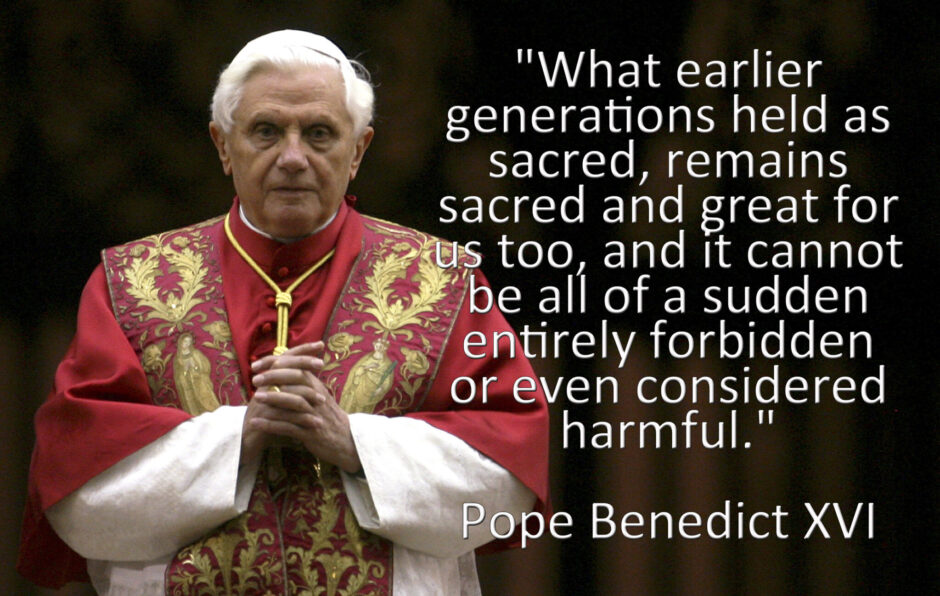
The Roche Report portrays liturgical history as a process of continual reform. Stability is treated as inherently suspect. Hijacking the highly regarded Joseph Ratzinger to provide a “kernel of truth”, by defining tradition primarily as movement (“a living river”) that must keep flowing, The Roche Report disqualifies settled liturgical forms from enjoying lasting normative authority. What results is a functional analogue to permanent revolution. Reform is not ordered toward consolidation, reception, and repose. Reform is presented as an ongoing necessity intrinsic to fidelity to the “spirit” of the Council.
Those are my “”, because it is impossible to express that sort of reform as intrinsic fidelity to the letter of the Council.
Several commentators have lately remarked how embarrassingly inadequate The Roche Report is, and downright wrong in details – but not all details.
My point?
A few days ago, the ordinary of the “Windy City” published on their archdiocesan website a glowing op-ed of admiration for The Roche Report and its notion about how we need more “formation”.
So, Roche gives The Roche Report essay to the Cardinals. Now this Cardinal is citing it authoritatively in his publication.
Meanwhile:
The suppression of all the Eastern and Oriental rites will be a sad thing, but here we are. https://t.co/IOj0ifBtXk
— Fr. Brendon (@padrebrendon) January 26, 2026






























The good Cardinal Archbishop of Century City apparently didn’t read far enough in his history book. Every rite which was at least 200 years old at the time of the Council of Trent was positively encouraged to continue in use.
Thank you for the reminder about the book Disinformation.
In my retirement one of the activities I enjoy is trying to figure out what is or is not “disinformation.” When your life has spanned from the late ‘40s to the current time there are things you have observed personally which are being rewritten. Once we are gone along with our personal experiences it will be harder and harder to know “what really happened”.
Ahh, the Cardinal Archbishop of Chicago again seeks relevance and the spotlight. With all of the other problems in Chicago, what did those poor folks do to deserve this over-educated George Jetson lookalike less that 20y after they’d been gifted with another arch-political Archbishop (well-known for his seamless garments)? Talk about birds of a feather! Cardinal Blasé seems to despise the Catholic Faith, as well as a large swath of the Faithful and his own clergy; and it will be a happy day in the Holy Catholic Church when he is sent to his well-deserved retirement. And the identity of his successor will likely tell us more about who Pope Leo IS than any of his other acts thus far!
Has there been any outcry from the various Eparchs about this overt-Latinization language from certain of our prelates? Does anyone “in the know” think there will be? All this talk of “unity of the church” being preserved simply by the imposition of a single rite is at best naive and at worst deliberately antagonistic toward the other 23 sui iurus churches in communion with Rome. “Church unity” has managed to survive lo these many centuries with other rites preserving their own heritage…
The Cardinal Cupich reference hits home for this Chicagoan, and I hope with Archlaic he is replaced by someone worthy of the job. Unless he never is replaced. In any case, no one ever grinned such delight as when he appeared on the balcony with the newly elected Leo. Woe.