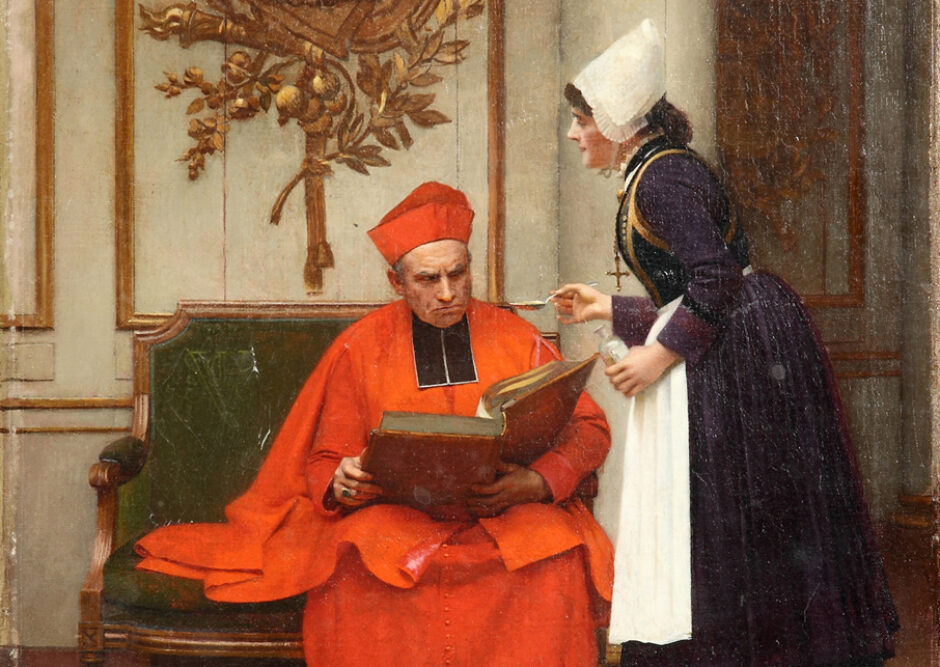
At Crisis Magazine my good friend Msgr. Hans Feichtinger, who was a theologian for the CDF during the Ratzinger years, examined The Roche Report.
Liturgical Terrorism
At its core, liturgical tensions point to deeper issues in theology, the transmission of tradition, and limits of authority.
[…]
Laudably, the text is concise; unfortunately, some of it remains shallow, even insensitive. On the fundamental concepts of reform, progress, or tradition, the text speaks in terms that are quite vague, even bland. Thus, it uses more a rhetoric of (curial) power and persuasion than of theological judgment or genuine awareness of the opportunities and challenges which communities and people in the Church are facing today.
Even the alleged need for better formation and catechesis sounds paternalistic: “Let me explain it to you again.” Curial mansplaining? There are also hints of psychologizing, of diagnosing mental problems—in others, of course. [As I wrote HERE “In the former Soviet Union and in some sectors of the Church today, resistance to the official line coming down from The Whatever High Atop The Thing is tantamount to mental illness. The Soviets called it “sluggish schizophrenia”. You would be institutionalized. After all, the Soviet system was clearly the best possible and quite simply flawless. To resist it was a sign that you were mentally ill. Today, anyone who resists what is clearly the most incredible and miraculous Second Pentecost for the Church must be a dissident who, for the sake of unity, must be dealt with by being pastorally “un-personed”, to borrow a notion of Rawls.”] There is no willingness to look at group dynamics and other limitations affecting those who “elaborated” and/or now uphold the reform, at times not without intransigence.
The word “elaborated” is revealing. Yes, there were many reforms of liturgy throughout history, but Cardinal Roche shows no awareness of how unique the last one was. Appropriately, he calls it “general,” but to simply describe it as a process of organic development is untenable. [To say the least.]
[…]
Beyond what Cardinal Roche seems to imagine, the liturgical tradition is, in fact, alive in a process of organic growth. The mission of his dicastery is less to “elaborate” and actively “develop it” than to allow it (!) to grow and to develop: the grammatical subject in this sentence matters. What we need is not cloning but gardening. [Excellent.] Liturgical reform is not centrally organized paradigm-shifting but a slow, gradual, humanly often unpredictable process.
[…]
And here is a good point toward the conclusion. Directives, sheer positivism, from Rome isn’t going to fix anything. As Hans says, “Lex orandi is something greater”.
[…]
Recognizing that the issues at stake in our liturgical debates fall in the area of fundamental theology is crucial from doctrinal, pastoral, ecumenical, and evangelistic perspectives. In particular, when we refer to lex orandi, we must not reduce the meaning of this term to liturgical texts promulgated by competent authority. No synod or pope can just write a new or updated version. Lex orandi is something greater, and today it challenges both the followers of Lefebvre and the liturgical hierarchs in Rome.
[…]
In what way could the Lex Orandi challenge the followers of Lefebvre? That is left dangling. Since it follows the part about “write and new or updated version”, perhaps it implies that there has been necessary work done since the 1962 Missale Romanum, for example in the revision of and creation of some orations for feasts. For example, in my post about St. Polycarp, I wrote about the Collect for the Novus Ordo which is, in my view, by far superior to the boilerplate oration in the older book. However, that is not something which, if I understand correctly, “the followers of Lefebvre” would object to out of hand, namely, freshening up some orations here and there. I return to my observation: it’s dangling.
Feichtinger’s piece nails the problems of top down micromanaging.
I was amused that he seems to have taken a little shot at me, buried in the text. HA! He always was a secret “lib” (… not!).
The accomplished liturgist Alcuin Reid dissected The Roche Report for the UK’s Catholic Herald. His piece compliments Feichtinger’s
On futility in liturgical reform (and why seminars are not the answer)
The briefing paper of the Prefect of the Dicastery of Divine Worship, prepared for the Consistory of Cardinals and published last week, has drawn much criticism, and rightly. It is at best risible. Yet this is truly no laughing matter. Indeed, given its status, it necessitates serious critical analysis.
However, His Eminence did get one fact absolutely right when he wrote that “the application of the Reform suffered and continues to suffer from a lack of formation” (n. 8).
[…]
This is a good read.
In sum… The Roche Report is faulted by Reid as inadequate, though it correctly admits the reform “suffered and continues to suffer” from lack of formation. He cites Sacrosanctum Concilium 14 to argue that actuosa participatio depends first on clergy being imbued with the liturgy’s spirit and power. Without that foundation, reform collapses. Western Mass non-attendance is offered as evidence that the promised participatory “panacea” failed to fill pews. Seminars are rejected as insufficient. His strong point: formation is caught by living reverent rites. The remedy proposed is ars celebrandi, mutual enrichment, and renewed access to older rites.
Sounds like a good idea to me.
Reid recounts Ratzinger’s description of being swept up into sacred liturgy as boy, slowly but surely taking it in until it was in his marrow. Instead of formal seminars, it just happened over time. As Reid says eloquently:
[…]
This discovery introduced him to Christ Himself, alive and at work in His Church through her sacred rites. When we have entered into such a relationship, how can we possibly tire? This, then, is the spirit and power of the liturgy in which we must be formed: a spirit which makes demands of us, certainly, and which requires our conformity to established, sometimes seemingly antiquated, paths and practices; a spirit whose disciplines and language I must learn and to which I must humbly submit; [An important point, because when a priest learns the Vetus Ordo, he must submit to it, disappear into it, get himself out of the way, whereas in the Novus Ordo, he becomes the focus and driving force of the action which yields to his choices through myriad options.] yet a spirit whose paths lead to the joyful discovery and celebration of Christ alive and working in His Church, and which nourishes us at the very source of all that we need to persevere in our daily Christian life and mission; a spirit which gives us a foretaste of, and an appetite for, the eternal, and which shapes us and sustains us here on earth until we are called to share together in the unending joy of the heavenly liturgy. [actuosa participatio is chiefly learning to be actively receptive to what the main Actor (Christ) is offering through the Church’s liturgy and acts of Religion. It is formation for Heaven.]
This is a spirit more easily ‘caught’ than ‘taught’, by living it and not by being lectured about it, caught by hands joined in a way only used for prayer, by knees bent in adoration, by voices raised in the discipline of the Church’s chant, through the body bowed profoundly, by signs of the cross made, in ashes accepted on our foreheads, through water sprinkled on us, and in so many other ways.
[…]
There is nothing of this in The Roche Report. In fact, quite the opposite.






























“It is formation for Heaven”.
I like that, Father, thanks for the commentary.
In my experience, in general, I have noticed there are two kinds of Catholics in the Church: those who take the Faith to heart, believe all of the doctrines, and do their darndest conform to them, usually having to change something, or many things, about themselves to do so, but they do it, or continually try to do it; and those who learn all the doctrines but don’t internalize them, or really think at all about conforming themselves to the ones most odious to them.
When you meet other Catholics often you don’t know which kind of Catholic they are. But as you get to know them you see and hear which kind they are by their behaviors, what they talk about, and what they allow themselves or their families to do. When the first and second kind get together, the second kind often offer all kinds of explanations and excuses to rationalize their non-conforming behavior, and sometimes scoff at and dismiss those who have internalized the Faith and try to live it. The two kinds of Catholics often don’t become friends.
I think that the heart of the problem in our Church today is that the leadership of the Church flipped from being run by the first kind of Catholics to being run by the second kind. But the second kind are not Catholics at all, and no white cassock or red hat and sash will make them one. And until that problem is addressed, all discussions about liturgy seem pointless.
If Bella Dodd was correct about the “1100 seminarians,” then it’s really not surprising that the Communist techniques of marginalization are being applied to the Church – including the wreckage being described as a “New Springtime.” Just another name for the “Great Leap Forward,” isn’t it?
Also, how ironic that the Novus Ordo, a rite that completely deformed the liturgy, supposedly requires more formation!
Yes, an interesting and useful commentary by Msgr. Hans Feichtinger, exposing the shallowness of Cdl Roche’s remarks.
In view of the date, it is also worth considering Aquinas’ commentary here: https://www.newliturgicalmovement.org/2015/07/st-thomas-aquinass-early-commentary-on.html , in which I find the references to ‘the people’ a contrast to what I remember from the 1950s.