In the ancient Roman Church today was a big day for catechumens.
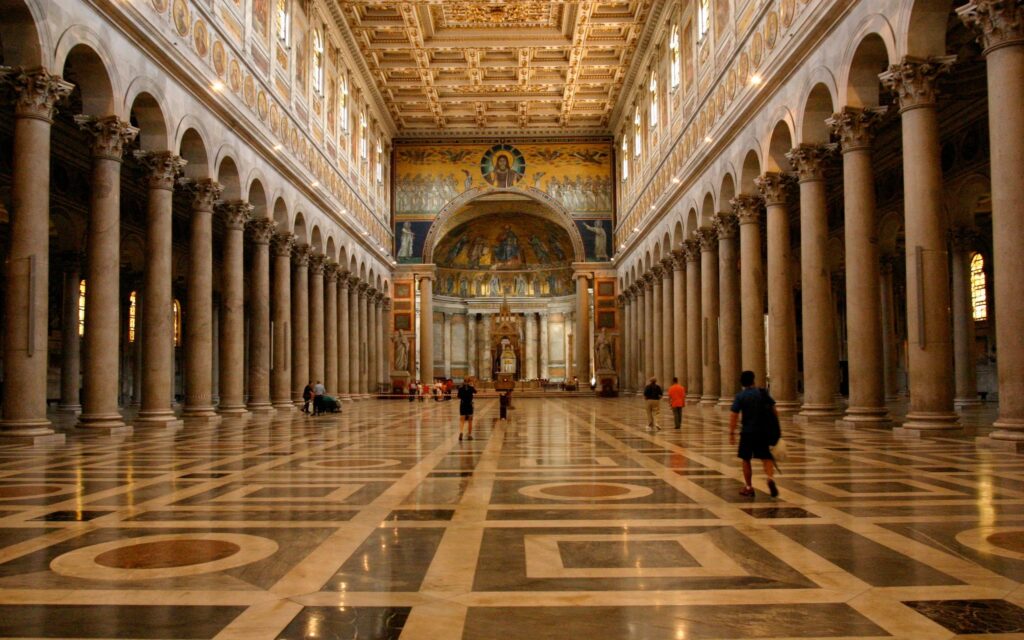
Last Sunday, Laetare, was “midpoint” Sunday because before Lent was lengthened, it was the midpoint before Easter. Hence, Wednesday is called “in mediana” and the Roman Station is St. Paul’s outside-outside-the-walls “in aperitione aurium… for the opening of the ears”. St. Paul is, of course, the model for catechumens because of his own conversion.
Today the catechumens underwent the ceremony of the “opening of ears” echoing Christ’s healing of the deaf man. With solemn rites the Roman Pontiff explained to the catechumens for the first time the Creed, the Lord’s Prayer and the beginning of the four Gospels. So their ears were opened to hear about eternal life.
After the Collect the deacon invited the catechumens to come into the basilica for the aperitio aurium. Their godparents signed them with the Cross. And exorcists laid hands on them. There were then four lengthy exorcisms, the last done by a priest. The first three attack the devil directly. The fourth is address to God. For this fourth, the priests trace the Cross on their foreheads and pray:
O Lord most holy, Father almighty, eternal God, the author of light and truth, I beseech thy everlasting and just mercy on behalf of these thy servants and handmaids, that thou wouldst vouchsafe to enlighten them with the light of thy knowledge: cleanse and sanctify them; give them true wisdom; that being made worthy to receive the grace of thy baptism, they may persevere in firm hope, righteous designs, and holy doctrine.
This was followed by various readings and chants after which deacons brought out the Gospels, which were explained along with the symbolism of the four beasts. Then they were taught the Creed which was to be learned by heart and not written down. They were asked what language they needed, Greek or Latin. They started with the Greek speakers and moved to Latin. Here is a sample from the old Ordines Romani:
Priest (addressing the Byzantine candidates) : ” Dearly beloved sons, you have heard the Creed in Greek; now listen to it in Latin.”
The acolyte then presented the Latin catechumens.
Priest: ” In which language do they confess our Lord Jesus Christ ?”
Acolyte: ” In Latin.”
Priest: ” Declare then their faith which they profess.”
The acolyte then recited the Creed in Latin. ” I believe,” etc.
Priest: ” This, dearly beloved, is the summary of our faith. This is the text of the Creed, composed not by skill of human language, but ordained by God. No man can plead that he is incapable of understanding or of realizing these things. Herein we declare the unity, and the equality in power, of the Father and of the Son ; here we show that the only-begotten Son of God after the flesh was born of the Virgin Mary and of the Holy Ghost, and that he was crucified and buried and that he rose again the third day. We proclaim his ascension into heaven and assert that he sits at the right hand of the Father in majesty, from whence he shall come one day to judge the living and the dead. In this our Creed we confess the same undivided Divinity in the Holy Ghost as in the Father and the Son, and in it we teach the divine Mission of the Church, the remission of sins and the resurrection of the body. ” Therefore, 0 beloved sons, from being the children of Adam you are now to be remade in the likeness of the new man—that is, Jesus Christ; from being carnal you are to become spiritual; from earthly you are to be heavenly. With firm and unshaken faith you truly believe that, as Christ rose from the dead, so also we shall rise again, for that which is done in the head must be done also in the members. ” Indeed, the very sacrament of baptism which you are preparing to receive expresses this hope by its rites, for in it is foreshadowed in a measure both death and resurrection. The old man is cast aside, and the new man arises; the sinner goes down into the water and comes forth from it justified. He who led us to death is rejected, and he who brought us back to life is welcomed. It is through him that you are made sons of God, begotten, not by the flesh, but by the power of the Holy Ghost. ” Impress then in such a manner upon your hearts this brief but comprehensive profession of faith that you may be able to strengthen yourselves by its protection in whatever dangers may befall you. The true soldiers of Jesus Christ always avail themselves of this invincible weapon against all the snares of the enemy. May the devil, who never ceases to tempt us, find you always armed with this holy symbol, so that, having vanquished the foe whom you now renounce, you may be able by the divine assistance of him whom you con-fess to keep the grace of God incorrupt and perfect unto the end. Thus may you arrive at the glory of the resurrection through him by whose mercy you obtain the remission of your sins. ” You have listened, dearly beloved, to the symbol of the Catholic faith; and when you now go hence, learn it by heart without altering a syllable of it. The mercy of God can do all things; may it lead you thirsting to the faith and to baptism, so that we who teach you these divine mysteries, and you also who listen to them, may together reach the kingdom of heaven. Through the same Jesus Christ our Lord,” etc. Deacon: ” Be silent and listen attentively.”
Then there probably followed a lesson from the Gospel, containing the text of the Lord’s Prayer.
The Lord’s prayer was explained phrase by phrase.
After this, before the Eucharistic part of the Mass began, the catechumens were dismissed.
You can see how there are echoes of these rites in today’s rites of Baptism, especially in the traditional form.




 Loading ...
























