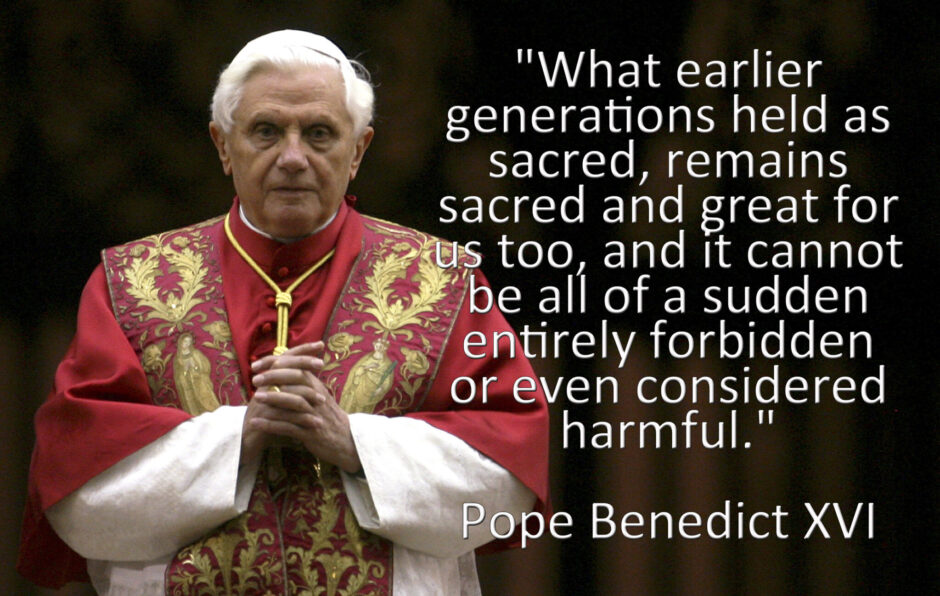
In the second part of an interview with Crux, Leo XIV spoke to the issue of the Traditional Roman Rite. HERE
Here’s the relevant part (my emphases and comments)
Q: Regarding the study group on liturgy, what is being studied? How much of the reason for establishing this was related to divisions surrounding the Traditional Latin Mass, for example, or issues such as the new Amazonian rite?
My understanding of what the group came out of is primarily from issues that have to do with the inculturation of the liturgy. How to continue the process of making the liturgy more meaningful within a different culture, within a specific culture, in a specific place at any given time. I think that was the primary issue.
There is another issue, which is also another hot-button issue, which I have already received a number of requests and letters [about]: The question about, people always say ‘the Latin Mass.’ Well, you can say Mass in Latin right now. If it’s the Vatican II rite there’s no problem. Obviously, between the Tridentine Mass and the Vatican II Mass, the Mass of Paul VI, I’m not sure where that’s going to go. It’s obviously very complicated. [I don’t understand why it is complicated. There are different Rites celebrated in the Latin Church. Which one is more venerable and, over time, successful than what is now the traditional Roman Rite? There are people all over the place who desire it. Why is this hard?]
I do know that part of that issue, unfortunately, has become – again, part of a process of polarization – people have used the liturgy as an excuse for advancing other topics. It’s become a political tool, and that’s very unfortunate. [If I had a chance to ask a question, I would ask among whom most of the polarization in the Church is coming from. How is the desire for the TLM “political”? In my experience, people desire the TLM not because of some “political” agenda, but rather because of the content of its prayers, the reverence with which it is celebrated as well as, increasingly, the community with others who attend.] I think sometimes the, say, ‘abuse’ of the liturgy from what we call the Vatican II Mass, was not helpful for people who were looking for a deeper experience of prayer, of contact with the mystery of faith that they seemed [?] to find in the celebration of the Tridentine Mass. Again, we’ve become polarized, so that instead of being able to say, well, if we celebrate the Vatican II liturgy in a proper way, do you really find that much difference between this experience and that experience? [The answer is “YES”. Indeed there is quite a dramatic difference. However, this difference must be experienced. You can’t make a decision about this based only on what those who dislike the traditional liturgy have said. In fact, mostly they are the polarizers and ideologues who don’t want to talk things over.]
I have not had the chance to really sit down with a group of people who are advocating for the Tridentine rite. There’s an opportunity coming up soon, and I’m sure there will be occasions for that. But that is an issue that I think also, maybe with synodality, we have to sit down and talk about. It’s become the kind of issue that’s so polarized that people aren’t willing to listen to one another, oftentimes. I’ve heard bishops talk to me, they’ve talked to me about that, where they say, ‘we invited them to this and that and they just won’t even hear it’. They don’t even want to talk about it. [Wait a minute… wouldn’t it depend on what it is to which bishops invited people?] That’s a problem in itself. It means we’re into ideology now, we’re no longer into the experience of church communion. [Let’s turn the sock inside out. What if the people who desire the TLM have invited the bishop and the bishop won’t come?] That’s one of the issues on the agenda. [We shall see what attention it receives.]
We shall have to wait for a while longer, it seems However, there are a few indications in this that Leo sees the issue through a lens of “politics”, how people get along or not. While it is good that people get along, it isn’t the highest goal. Moreover, who says that everyone must be in lockstep?




 Loading ...
























My TLM community has invited our bishop to join us numerous times over the years for processions and Solemn Masses and major feasts, etcetera… and nothing. The bishop never comes, never sends his regrets, never speaks a word. We’re left in silence.
Have you noticed that now we are the bad guys.
I, too, was troubled by the same passages upon which you commented. It almost sounds as though Pope Leo’s sources are the same outré “rad-trad” blogs and commentators that are alleged to have put PF’s nose so badly out-of-joint that he exhaled Trad. Perditores.
I was also wondering whether this had any reference to the reported plan by the PCED (ca. 2000) to push the “indult” world toward the 1965 Missal. While that was almost universally condemned as a non-starter, my recollection is that Michael Davies did in fact meet with the key figures and explained the objections of the FIUV and the “traddie” world in general. As you noted, it depends WHAT one is being “invited” to!
The good news is that he candidly admitted that he hasn’t heard “our” side of the story yet. To that end, my hopes are buoyed by the phrase that “There’s an opportunity coming up soon” – he may well be referring to the Summorum Pontificum Pilgrimage which would be a logical occasion for such a meeting – something to pray for!
I think that he is correct that it has become a political issue, but the reason is that the worship of God through the Holy Sacrifice of the Mass using the VO changes people and changes the priests who offer it. This change is not in the direction that liberals in the Church like. So to them it is political, everything is political because the essence of liberalism these days is force. The elderly priest who gave up everything to offer the VO where I became a Catholic told me, “There is no force here.”
While it is indeed true that getting along is not the highest goal, it is also true that Popes are human beings.
It is obvious that we ought to pray for the Pope; we really should. We should also, I think, ought to pray for those trads talking to the Pope when the talk he refers to does come. Even for things like using the right words, having friendly faces, and that sort of thing. Even if the Pope is a good Pope, and I think and hope he is: good Popes too have it easier to remain good Popes when they are not pushed to the edge.
It is definitely easier for me to be friendly to people when I have less stress in life in general, and they specifically don’t get on my nerves in particular. And coming to think of it, how much stress does a Pope have, even at the best of times. – As I said before: “Pope Leo is not Pope Francis. Do not make him.”
Yes, this was pretty deflating. Especially after the revelation that the entire Survey Report upon which TC was based turned out to be a complete fabrication. Either Pope Leo is so insulated that he has no idea what’s going on, in which case if he hasn’t managed to see through the nonsense after talking with folks like Cardinal Burke I’m not sure he’s ever going to make it, or he actually believes in the agenda of Pope Francis to stamp out the Vetus Ordo for the sake of unity and that all the Trads are mean and bad and political and polarizing.
This does not bode well.
The “complexity” is that his predecessor took a liturgical peace from Benedict and replaced it with a false enmity that bishops need to now have for their flock.
I question whether we could get someone who is canonically-minded to express the issue in a different manner than Leo’s present mental paradigm (if Burke has not already done so). There’s an even more basic issue with TC in its legality. It supposedly suppresses permissions given in Summorum when Summorum does not give permissions, but rather describes the legal reality that a rite cannot be forbidden that has not been suppressed, and that an apostolic rite cannot be suppressed.
The issue, then, should not focus around what we give to the mean and angry politicized trads, but more so, how do we undo the damage of a lawless document issued by a lawless papacy.
I suppose those early rumors about the Holy Father celebrating the Extraordinary Form in private are not true?
Hmmm, given how long he’s been away from the states it makes me wonder if his “political view”’if the TLM comes from what he’s seen on the outside (media, “influencers” etc).
He’s not viewing it though the lenses of an “American” as we all are in a sense from that comment.
Overall, Roarte has a good tweet that I am in agreement with, and we shouldn’t overreact like
Some have
Dear Vir Qui Timet Dominum,
to be fair, the very question of how do we undo the damage of a lawless document issued by a lawless papacy, as you so nicely put it, is a very very complicated one.
How, that is, without doing a full-scale condemnation that effectively or even litterally declares Pope Francis to have been a tyrant. That is a very complicated question. Pope Leo, I gather, does not either wish to give the impression to be doing so, or do so. He thinks, I daresay, he is somewhat bound to his predecessor (who in addition made him cardinal) and owes a certain piety, etc. How, under these constrains, still undo Traditionis custodes (this of course is my formulation, rather probably he wouldn’t as yet put it this bluntly; what we can reasonably hope, I think, is that he really does think Pope Francis was too harsh and Popes should be nicer to Catholics) really is a complicated question.
Oh yes, mightn’t we sometimes wish that the injustice is blown away by thunderous authority, full with complete apologies plus then at least the same amount of force directed against the real enemies. Do I not know it. – But then if we are being reasonable (although, quoting the narrator of a well-known around here children’s audioplay series called “Bibi and Tina”, “reasonable! Who in all the world likes to be reasonable”),
the posthumous wish of the late Fr Hunwicke does have a lot to go for it: The last thing we need is A Next Pope who offers us a reversed mirror-image of [Pope Francis] and his failings. We can do without any kind of Peronism. We’ve had enough taking-of-revenge to last a very long time. I hope for a Pope who understands the Gamaliel Principle; who realises his own limitations. I do not desire to see anybody persecuted … not even ‘liberal’ fellow-Catholics with whom I strongly disagee.
There is not yet any indication that this hope would be unfulfilled (though we deserved it not).
There is, of course, every indication that Pope Leo will not be “going Pope-Francis” against Pope Francis’s party. So, if that’s what somebody hoped for, the hope probably will be unfulfilled for the time being.
My understanding is that Abp Lefebvre voted for Sacrosanctum Concilium, and endorsed some of the 1965 changes: Itinéraires vol 95 (July-August 1965)
He chose the Missal of 1965 for his seminary at Econe.
The issue of which Missal to use was debated at the first general chapter of FSSP, but not resolved. At the second general chapter the 1962 edition was imposed on all priests, but for a missa privata bishops (i.e. Lefebvre) were to use the 1965 seventh editio typica, since this permitted a bishop to celebrate as though he were a simple priest.
The text of Itinéraires vol 95 (July-August 1965) does not seem to be available except for a short section in translation by Yves Chiron.
Father, you raise some good questions and your comments are spot on.
Leo’s comments on homosexuality and women’s ordination were equally horrifying.
It’s incomprehensible how anyone could have any hope or place any trust in Leo at this point. “Ooooh, well maybe there’s a glimmer of hope for an improvement in opportunities for the TLM!!” Have you been paying attention to who he has been meeting with or who he has been appointing to positions of authority in the church?
I don’t have any theological degrees after my name but I have many decades of simple observation of people saying one thing and meaning another.
We. Don’t. Need. Permission. To. Be. Catholic. At any time or place the TLM is valid in heaven. It’s only invalid here on earth with heretics.
Pope Leo is 3 years younger than me. On his Wikipedia profile, it is stated that he was an altar server in grade school. As I served 4 years in grade school, 4 in high school in Illinois, he would have not only attended the Mass in Latin but also memorized the Latin Mass responses. He would have experienced the changes to the Mass, seemingly weekly, after a year or two serving the TLM. By the time he attended the preparatory seminary, almost all parish Masses in Illinois were in English.
During that time period, institutions sprang up such as CTU (Catholic Theological Union) in 1968, a liberal graduate school next to the protestant University of Chicago. Pope Leo would have been in 7th or 8th grade. Horizontal worship as opposed to vertical worship.
The “spirit” of VCII was in full swing at that time period and it appeared, through family travels, that local parishes were “enthralled” with it. While parishes offered study groups to attempt to understand the meaning of the VCII documents (my parents participated and I observed a few) these were small groups, perhaps 1% of the parish and no priest in attendance. I remember the major controversy was what was happening to the Mass locally, by the pastor, and what the documents stated.
One would have to suppose that Pope Leo heard the questioning of those opposed to such changes. Especially if he heard them returning from the prep seminary. Personally, I hold little hope of any changes. The only intervention, it appears, would have to be Divine.
Dear mbarry,
Leo’s comments on homosexuality and women’s ordination were equally horrifying.
How in the world?
I can see that there may be a concern that needs to be adressed w.r.t. the TLM, fine; but as for his comments w.r.t. women‘s ordination and homosexuals, how on Earth are they anything other than plain right, let alone horrifying?
As for not needing permission to be Catholic, well that‘s in itself true, but we‘ve got lives to live, and life under popes like Francis is hard. We do remember that, don’t we? However theoretically unnecessary his permission would be. The life of the Christian is not supposed to be a battle with the Church. It is supposed to be a battle against evil on the Church‘s side. It is also supposed to be the veiled beginning of heavenly glory. The phrase „Kingdom of Heaven“ in the Gospels mean the Church.
And if someone (I don’t think that would be me) is bold enough to say „I‘m strong enough, I can take it“ – well, you can, but others might not. And what about those who aren‘t Catholic to begin with, especially if conversion is a real possibility, how to convince that that obeying to Pope is a good thing? I hear Pope Francis was a huge stumbling-block for Charlie Kirk, for instance…
Perhaps his Holiness should brush up on Cardinal Ottaviani’s intervention (and predictions) before casting blame on people polarizing the issue.
https://www.catholictradition.org/Eucharist/ottaviani.htm
How, I wonder, might all of us who had a long-ish good exclusive experience of “the Vatican II liturgy [reverently celebrated in Latin, ad orientem] in a proper way” but now have an fair number of years’ constant experience of the 1962 Missal/Liber Usualis manage to testify such that we might be heard/read that indeed we “really find that much difference between this experience and that experience”, very much in favor of the 1962?
You can’t change doctrine. Any implication that it can be changed by first changing attitudes is just what I said it is: horrifying.
Take 10 minutes and read Chris Jackson’s latest substack article on this topic.
https://substack.com/home/post/p-173998722
If you don’t have a substack account, a very good summation can be found on Mark Docherty’s page here:
https://nonvenipacem.org/2025/09/19/its-over-trad-inc/
Leo’s response should have been ‘Hell no, doctrines don’t change.’ Horrifying.
His holiness in this interview only confirmed what many of us have suspected and feared. He is either indifferent or doesn’t care. [Confirmed? I don’t think it confirms anything.] He has granted Cardinal Burke permission to celebrate the Tridentine Mass very soon in St. Peters. Would that have happened under Francis. No. Is this good. Yes. Pope Leo could do two things, in rather swift succession, that would calm his “right flank” on this issue. Cardinal Roche and Cardinal Fernandez could be found other jobs and vacate their current jobs. Jobs where they have both been openly hostile to faithful Catholics that love and cherish the Tridentine Mass. But this comes back to a larger issue that Leo is beating around in the interview. This IS NOT about celebrating the mass in Latin. The Tridentine Mass is in Latin but it is about the liturgical action that the Tridentine includes vs the Novus Ordo which does not. As you state Fr. Z this is NOT that hard of an issue to deal with. Pope Leo need do only two things. 1) Abrogate TC. [Is that likely?] This must be formally abrogated not ignored. So it can be cast onto the Ash heap of history once and for all. 2). Affirm Summorum Pontificum. The left will simply lose their ecclesiastical minds and clutch their pearls. [Which is probably why he won’t do it that way. He is probably going to take a political approach.] But what would those two actions actually achieve? It would end a period of strife, disharmony and put an Armistice to the reactivated Liturgy Wars that TC reignited. The affirmation of SP would just allow the access to the Tridentine Mass, out in the open, without open hostility from Bishops towards their own clergy and flocks. A return in many cases to the Status Quo. Allowing the Tridentine Mass the breathing room it deserves and is entitled to will allow for its own organic growth. Put the NO next to the Tridentine and there is NO doubt which of the two is more reverent and prayerful. History and Our Lord will then be the ultimate judge as to which is more appropriate. What cannot continue though is the current Status Quo. The Current disharmony, acrimony, bishops punishing their priests and their own flocks for only wanting to have the mass celebrated in a form that worked for centuries in a very reverent and prayerful manner. This House Divided cannot stand in a constant liturgy war footing. [The problem is that it isn’t divided 50/50… or even 70/30….] While it can exist in harmony together. It currently has part of the Church at war with another part of the Church with no end in sight. May the Holy Spirit guide Pope Leo in this regard and grant him wisdom to see the Pastoral way forward.
It is highly ironic that Pope Leo is so ignorant of the TLM and the people who adhere to it. He is willing to dialog with drug pushers, prostitutes, communists, Zionists like the President of Israel, but not with Catholics who want to be faithful to Christ! [He just said he is open to that.] Same for Pope Francis exponentially! Hopefully his ignorance with be cleared up soon. It also shows how uncharitable he is, and Pope Francis before him, to believe hearsay and calamny instead of following scripture and meeting one on one (or with an envoy) with the person with whom the pope has a disagreement. Pope John Paul II gave that opportunity to Hans Küng!! The objection to calling it the “traditional Latin Mass’ is ridiculous since it is simply short hand for the Mass of the Council of Trent. The New Mass in Latin is not the traditional Latin Mass. Why was Kirk murdered? Because he dared to dialog and reason with those with whom he had disagreements! In the Church socipathic thinking is so rampant among the heiracrchy and priests. These men are unable to handle conlfict or disagreement. They do not know what to do when others disagree with them without resorting to hatred, violence and ultimately exile of those with whom they disagree. This happens in families commonly, especially in families where divorce happens. Kirk’s Socratic method was successful in defusing much of the antagonism. The bishops’ ‘dialog’ is addressing the choir and there is no real conflict between the groups with whom the bishops want to talk.
I do think the complicatedness refers to how hearts and nerves are frayed and twitchy (alas, that English does not have the wonderful Spanish verb crispar), so any decision/move will be met with very strong and unwarranted reaction, and with a whole lot of reading into it. Which if this interview is anything to go by, he’s right.
In that line, the politics/political tool reaches not just intra Church politics, but secular politics and I think it’s disingenuous to pretend this is not the case. And it is a matter that goes beyond principles and non-negotiables. It’s not nice to talk about the internal politics of another country, even if it is a world power that affects everybody else, so I’ll make this as short and as not-opinion as I can: these days one opens Rorate Caeli’s Twitter feed, and has to waddle through MAGA posting that occupies about half of what they talk about. Because of the way US politics are baked, there’s a tendency to a black and white mentality that is exhausting to me (and I assume many others across the globe). I can find both MAGA and Democrats repulsive. It’s not even hard, if you ask me. I sympathize that way with what Leo is saying here: I’d really like for our liturgical and doctrinal preoccupations to be separate from secular party politics, wherever they are getting entangled. If nothing else, it diffuses our focus.
Polarization, synodality, dialogue: traditionalists have their rightful grievances. I won’t deny that. But I’d be lying if I said that my support for their cause, as a person who has always been on the Ratzingerian camp of “reform was needed, but what we got is not *it* – reform of the reform” is a matter of truth and justice… and I have to remind myself of it often in my interactions with traditionalists online and IRL. Because if it was a matter of personal sympathy, it would be very, very hard. I do not claim that my anecdotal experience represents every person and group out there, but it is real experience nonetheless. Putting aside occasions like that time I was making small talk with a man whose wife was expecting their third child, and upon wishing him a girl after two boys, he replied, dead seriously “Absolutely not! I didn’t know you were a feminist!”, I have met with a pattern of gratuitous antagonizing. It can be very comforting to imagine that the only people in the Church are the good traditionalists and the bad extreme progressives bent on destroying them (with a side of pretending that clown masses and the like are the NO norm and such). The reality is that there is a bunch of people in several degrees in the middle that are also striving for holiness, who also suffer under bad and unkind bishops, who are also trying to expand God’s kingdom and they don’t deserve to be kicked or treated with condescension. It’s not only uncharitable to mistreat/antagonize the ones who can be your allies, it’s also strategically stupid. Charlotte’s TLM community does not deserve the treatment it got from their current bishop. It’s also true that their demands for a TLM only parish for them on the 2022 synod responses reeked of “we don’t want to mix with the riffraff”, however unintended that might have been, and their comments about their *then* bishop in it were also rather… unkind.
(Side note: someone speculated that the bishops’ invitation Leo was referring to might be, for example, about refusals to participate in chrism masses. Which is perfectly in line with SP dispositions.)
The blame game ultimately leads nowhere. An eye for an eye, the world goes blind. Leo’s invitation to dialogue is two sided by the obvious reason that you need two parties or sides at least to have a conversation. And that conversation needs to be productive, and to be productive people need to reach agreements, and to reach agreements one needs to recognize common ground and good in others. This is not easy, but I think it’s necessary, and refusing to engage until the other side does keeps things in a standstill. Keep inviting bishops and priests and laity to traditional stuff! Interest yourself as well in worthy causes of charity and mercy outside of the traditionalist guetto! Even if you don’t win your brother, on the day of judgement, Christ, the Judge who knows all, will reward you.
On another aside: I understand why the comment about there not being much difference between a reverent NO and a TLM can be upsetting (and I recognize I don’t really have a pony in that race, because my own sensibilities lean Eastern Catholic), but I’d like to highlight what Leo is describing as the “proper way” of doing the NO, which is no small potatoes.
I agree I don’t get what’s hard.
I suppose what is “hard” would be the fall out from the progressives who desire the end of the TLM. They tend not to be pleasant when challenged. [To put it mildly.]
RE: What if the people who desire the TLM have invited the bishop and the bishop won’t come?
Our parish, which is a TLM-only parish here with the permission of the bishop, has been in our diocese for 15 years. We have yet to have even an auxiliary bishop come to do Confirmations. We invite him every year, and every year he graciously grants our pastor authority to do the honors. At this point, we’ve had ~1000 youth who have been confirmed without an Ordinary.
In 15 years, we’ve had a bishop visit us 3x – the first to consecrate the altar. We had a 10-year gap with no visit; the current bishop didn’t visit until he’d been the Ordinary for 4 years and we had to ask him to come. We’ve had expansion plans for our chapel on his desk coming on 4 years, and he hasn’t said one word to our priests about them beyond that they were received.
It is beyond disheartening that we are treated as ugly step-children. We don’t even get the courtesy of crumbs.
It is worth considering that the excerpts published by Crux are, in fact, e x c e r p t s , and that we may be missing relevant context. If we compare the printed excerpt of the first part of the interview with its video source ( https://cruxnow.com/vatican/2025/09/in-interview-with-crux-correspondent-pope-talks-ukraine-synodality-polarization-world-cup ), we see there are large chunks of the conversation that did not make it into print, as well as minor words omitted, words out of order, etc. I’m not suggesting that Crux would have deliberately distorted what the pope said, but there may be some interesting differences of nuance.