13 December was the darkest day – with the least sunlight – of the old Julian calendar. In the Gregorian calendar (which corrected the “drift” in the Julian calendar), the shortest day, the Winter Solstice, is 20/22 December. This year 21 December.
Today in the Gregorian calendar used by the Catholic Church is the feast of St. Lucy, whose name from the Latin lux, for “light”, reminds us who dwell in the still darkening northern hemisphere that our days will soon be getting longer again.
Lucy will usually be depicted in art with a lantern, or with a crown of candles, or – most commonly – with her own eyes on a platter.
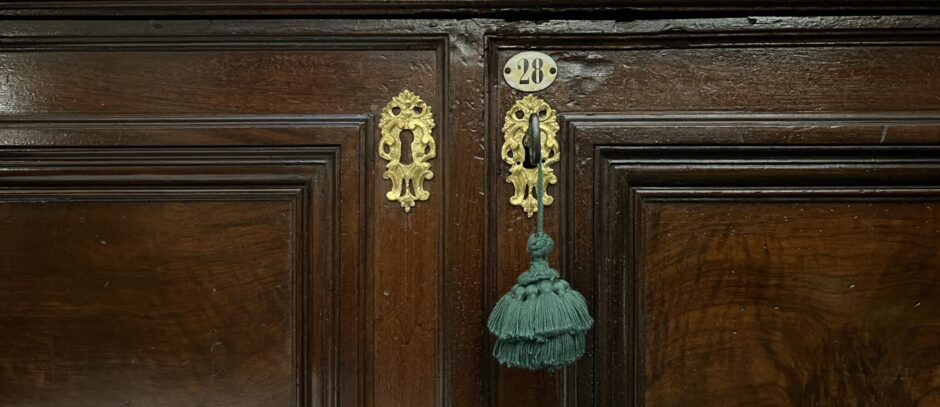
This photo is from the Church of St. Lucy in Rome. It is just around the corner from my place. It’s bells ring clearly even when my windows are closed.

Some accounts have Lucy slain by having her throat thrust through with sword.
Other accounts say that to protect her virginity she disfigured herself by cutting her own eyes out and sending them to her suitor, a plot likely to discourage him.
St. Lucy is therefore the patroness of sight.
St. Lucy shows up fairly often in Dante’s great Divine Comedy. She is first in the Inferno. It is Lucy who asked Beatrice to help Dante. In Purgatory the eagle that bears Dante upward in a dream is actually Lucy who is bearing him to the gate of Purgatory. Eagles, of course, are “eagle-eyed” and see very well. In the Paradiso she is placed directly across from Adam in the Heaven of the Rose. She can gaze directly at God.
St. Lucy was something of a patroness for Dante and that he was devoted to her because, as we glean from various works, he may have had a problem not just with his eyes but also struggling with sins of the eyes.
Remember, dear readers, you cannot unsee things. Don’t go looking for things on the internet or elsewhere which can do nothing but wound your soul unto spiritual death and the degradation of your humanity. Protect children too.
This week coming we have Ember Days, which in Advent come after the Feast of St. Lucy. Do you remember the little mnemonic poem? “Lenty, Penty, Crucy, Lucy”, or else “Fasting days and Emberings be / Lent, Whitsun, Holyrood, and Lucie.”
Ember Wednesday will be the Missa aurea.
In the meantime, let’s have a look at Lucy’s Collect in the Ordinary Form since her Collect in the Usus Antiquior isn’t all that interesting.
This prayer was not in the pre-Conciliar editions of the Missale Romanum. It is based on a prayer in the ancient Gelasian Sacramentary for St. Felicity (VIIII KALENDAS DECEMBRIS).
Intercessio nos, quaesumus, Domine, sanctae Luciae virginis et martyris gloriosa confoveat, ut eius natalicia et temporaliter frequentemus, et conspiciamus aeterna.
First, you will have immediately caught the elegant hyperbaton, the separation of intercessio and the adjective waaaay down the line that goes with it, gloriosa.
There is also a nice et… et construction.
Confoveo is “to warm, foster, cherish assiduously” It is a compound of foveo which essentially is “to be hot, to roast”. It obviously deals with heat, flame, light. This is a good word for this time of year in the northern hemisphere (unless you are in, say, Florida).
Conspicio is “to look at attentively, to get sight of, to descry, perceive, observe”. We are obviously dealing the seeing and sight. This word should ring mental bells for the throngs of you readers who attended Holy Mass in the Novus Ordo celebrated in Latin. Conspicio is in the Collect for the 3rd Sunday of Advent, used in a an extremely clever way juxtaposed to exspecto. They share a common root. But I digress. Anyway, conspicio, I am informed by Blaise’s dictionary of liturgical Latin (in French) has an overtone of seeing invisible realities through visible things. As Augustine in Gen. ad Man. 1,6,10: invisibilia enim ipsius a creatura mundi, per ea quae facta sunt, intellecta conspiciuntur (cf Rom 1:20) “ce qu’il a d’invisible depuis la création de monde se laisse comprendre et voir par les chose (visibile) qu’il a faites”.
Frequento, is “to visit or use often, to gather in numbers, to celebrate”. It is used for the gathering of people for liturgical worship.
Natalicia refers to birthdays. In the Christian adaptation of this word, we are always referring to the saints being “born” into heaven.
LITERALLY:
May the glorious intercession of Saint Lucy, virgin and martyr, strongly support us, we beseech you, O Lord, so that we may both celebrate her birthday into Heaven in time and also behold eternal things.
I am perplexed about what to do with eius. Should it carry over into both parts of the et… et…? Hence, “so that we may both celebrate her ‘feasts’ in time and also behold her eternal (‘feasts’)”. Dunno.
OBSOLETE ICEL (1973):
Lord, give us courage through the gracious prayers of Saint Lucy. As we celebrate her entrance into eternal glory, we ask to share her happiness in the life to come.
Here is the usual clunky parataxis we know so well from the dreadful obsolete translation. As usual, the translation is dumbed-down. Do you see anything of the concept of vision? Sight? Is there anything in there that harks to the time of year?
Can you believe that some people want this back?
CURRENT ICEL (2011):
May the glorious intercession of the Virgin and Martyr Saint Lucy give us new heart, we pray, O Lord, so that we may celebrate her heavenly birthday in this present age and so behold things eternal.
We are obviously much closer to the Latin in this new version. Also, that behold at the end is consoling. Obviously they went with the easier reading of the Latin.
Perhaps you might say a prayer today to St. Lucy, that she will intercede with God and implore Him, for us in the vale of tears, to open the eyes our Church leaders, for they often close their eyes to the obvious and look away when forced to blink.
BTW… St. Lucy is mentioned in the Roman Canon. There is a lovely little book about the female saints of the Roman Canon
With Glory and Honor You Crowned Them: The Female Martyrs of the Roman Canon by Matthew Manint
US HERE





 Loading ...
























Father I try in my incomplete way to pray the office especially during advent and lent.
It is the office of the novus ordo, so the prayers in the breviary I have, are still from the 1970’s.
I guess I could use the online version of the office but I hate abandoning the written breviary as I much more like holding a book than a cell phone or computer.
Any thoughts?
More on the Julian calendar that is very interesting. The creation the image of Our Lady on the tilma of Juan Diego occurred on Dec 12 1531 (on the Julian calendar!). Hence we celebrate the feast of Our Lady of Guadalupe on Dec 12th. But by our current reckoning (ie Gregorian calendar) the date was Dec 22, 1531-ie the winter solstice- the darkest day of the year. The natives believed the days became shorter because their sun god descend to the underworld facing adversity and his rebirth at dawn symbolized hope & renewal. They believed sacrifices were required to nourish their sun god and provide him with strength to ensure his rebirth on the next morning.
The image of Our Lady-a pregnant virgin with the many signs of royalty & divinity- was the true bearer of hope & divinity.