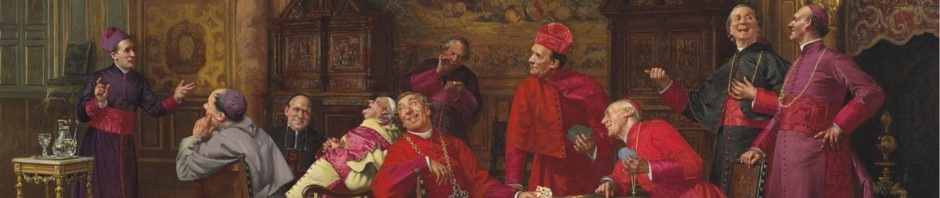
I bring to your attention two pieces worthy of your precious time.
First, at Crisis there is an essay by Fr. John Perricone
“Why Every Catholic Is a Traditional Catholic (Or Should Be)”
Perricone argues that the contemporary Catholic Church faces a crisis of language, culture, and doctrine because a radical ideological project has systematically corrupted the meaning of fundamental terms, most dangerously, “Tradition.”
Drawing on George Orwell’s critique of political language, he asserts that when words are manipulated away from their historical meanings, human cognition and communal coherence unravel, opening the door to cultural and ecclesial chaos. This manipulation is going on in the Church. The term “Tradition”, once understood as the unbroken transmission of the Apostolic faith and practice, has been redefined by modern theologians and ecclesiastical actors in ways that detach it from the faith’s perennial content and forms. Perricone contends that the assault on “Tradition” is both intellectual and symbolic, since the Church’s liturgical, artistic, linguistic, and devotional expressions historically embody and transmit Tradition’s truths. To undermine these symbols (especially sacred liturgical worship) is to undermine Tradition itself. He maintains that true Catholic fidelity consists in embracing the sacred deposit of faith and the practices that have conveyed it throughout the ages, holding fast to the doctrines, liturgy, and devotions that have shaped Catholic life and identity. In this sense, Perricone insists, every Catholic who genuinely adheres to the infallible teachings and ancient forms of the faith is, by definition, a Traditional Catholic, because to be otherwise is to abandon authentic Catholic Tradition and, ultimately, to cease being truly Catholic.
This describes well why I sometimes use catholic for, for example, some infamous Jesuits and certain writers at the Fishwrap, et alibi.
Next there is a piece at Imprimis/Hillsdale
“Recovering the Lost Art of Diplomacy”
The writer, A. Wess Mitchell, argues that diplomacy is a central instrument of strategic statecraft, essential for great powers to survive and gain advantage amid competition. True diplomacy is defined not by formalities or idealistic international governance but by concrete outcomes, primarily constraining the power of adversaries and reducing threats that cannot be resolved by force alone. After the Cold War, the United States allowed traditional diplomacy to atrophy, favoring military technology, economic sanctions, and global-institution idealism; this reflected erroneous assumptions on both the left (that institutions can transcend conflict) and the right (that military preponderance alone secures security). The contemporary international environment, marked by renewed great-power competition over territory, influence, and resources, demands a revival of classical diplomacy’s core function: matching national means to ends through negotiation, coalition building, and balance of power. Effective diplomacy, Mitchell contends, increases strategic flexibility, limits hostile accumulation of power, and helps avoid wars beyond a nation’s capacity. Rediscovery of these skills, he insists, is vital to national strategy in an era of renewed geopolitical rivalry.
Great military history references, too!
It would be interesting to use the article as a lens to view the present conflict between the SSPX and the Holy See, seemingly a clash between an inflexible reading of the Deposit of Faith (with little desire to consider positively things written after 1962) versus rigid canonical positivism along with ecclesiastical amnesia (the devaluation of anything that happened before 1963).
Using Mitchell’s piece as a lens, the present standoff between the SSPX and the Holy See is a failure of ecclesial diplomacy on both sides. Diplomacy, Mitchell argues, succeeds when adversaries constrain each other’s worst impulses and negotiate outcomes that avoid destructive rupture. It fails when principles are elevated above the art of sustainable coexistence.
The SSPX has publicly reaffirmed its intention to proceed with unauthorized episcopal consecrations on 1 July 2026 despite Vatican warnings that such acts would constitute a decisive rupture of ecclesial communion and incur automatic excommunication under canon law. This is where rigid canonical positivism comes in. The Holy could choose not to impose censures, which would be the best way forward. But that’s unlikely with this crew in Rome. From the Society’s perspective, the consecrations are framed as necessary to ensure continuation of traditional ministry in what it deems a post-Conciliar crisis of doctrine and liturgical identity. Its superior general rejected Vatican proposals for renewed doctrinal dialogue that made suspension of the consecrations a condition of talks.
I find that approach to be too narrow.
Talking with the Holy See costs nothing and could, in fact, gain what they want. Not guaranteed, of course. But nothing ventured nothing gained. The Holy See, after all, proposed a structured theological dialogue aimed at identifying minimum conditions for full regularization. I won’t say “full communion” because that’s a nonsensical term. Finding common ground in the minimum conditions is what has been going on in the Church for two millennia of Councils called to discuss matters of grave importance.
There is a kind of zero-sum defense on one side and, on the other, institutional inflexibility with a strong dash of ecclesiastical amnesia if not downright negationism.




 Loading ...
























Thank you for this with these!
I just read with interest the English translation of a Spanish X post by Dr. Mn. Jaime Mercant Simó, “a diocesan priest of Majorca—a doctor of Thomistic philosophy and law, professor at the Center for Theological Studies, and director of the diocesan library”, posted on 26 February on the FSSPX News site as ‘Professor from the Diocese of Majorca on the Consecrations – “Neither Schism nor Sin”’.
Thank you for pointing out these articles. I read them with interest. But
I do wonder how great power foreign policy can give us insight into the FSSPX issue, unless, perhaps, the Vatican sees them as a rival great power? If they do, then they must be afraid of the possible growth of traditional institutions in the Church. But in a world in which many countries have religious freedom, oddly enough, this freedom prevents the Vatican from crushing traditional groups as they can just go about their business waiting for the Vatican to either go ahead and renounce traditional Catholic moral teaching or come to its senses and actually sanction clergy that promote immoral practices.
To me the piece by Father Perricone suggests that liberals want to crush tradition in the proper sense of the word because it stands in the way of the changes liberals in the Church want to make. One way liberals have done this is by making obedience to the Pope or the local ordinary (at least in practice) the greatest good. Hence, many conservative critics of the FSSPX compare them to Protestants and the German synod of bishops because all three are not obeying the Pope which is (somehow) also the most important tradition. This conveniently ignores that only one of these three believes the Mass is a sacrifice and the consecrated bread is the body soul and divinity of our Lord Jesus Christ. Since God is “Charity”, I think we need to consider what St Martin de Porres said to his superior after being upbraided for taking care of a sick man during a plague: “I am sorry, I did not know the precept of obedience is more important than that of Charity.” Making obedience more important than charity implies love of man is more important than love of God.
By the way, in Karen Hall’s book about Paul Mankowski, Sound of Silence, there is a discussion of communion in the hand that supports Father Perricone’s argument.
I’m an unreconstructed ossified manualist. If you consecrate a bishop without permission you are excommunicated, end of. You cannot have bishops without a see or accountability. And you cannot reserve to yourself the conscience rights to decide what is or isn’t the true Catholic faith. The SSPX are behaving more and more like Donatists here, and while Fr Z is correct that diplomacy is the better path, if it takes the Augustinian path then so be it.
Diplomacy! It is back at least in the USA.
As President Trump laments about the ongoing wars..All these beautiful bodies being destroyed. He uses Our Military strength and Tariffs (not a tax, look it up in Black’s Law dictionary) to stop wars diplomatically. Also as it says in the book “THE ART OF WAR”, Keep your friends close and your enemies closer.
SSPX has centuries of tradition and Dogma along with more Vocations and Catholics praying the Mass than just about any Novus Ordo Parish.
I sometimes think , maybe it is about the Vatican not getting the money.
The real temptation amongst all this folderol is for me is to just stop caring entirely what other people say or think. I’m at the point where I don’t care which bishop or cardinal says “they’re in schism” or “excommunicate ’em” (and I sure as heck don’t care what any internet commenter has to say about it, even if they have their own podcast or NC Register column). Nobody seems to address any of the actual problems creating the crisis in the Church today – they just say, “Unless they obey, they deserve what they get, end of story.”
Meanwhile, I’m trying to figure out how to get Confirmation for my daughter in the traditional form in a diocese where the bishop and all the priests are standing as absolute obstacles between my child and the sacrament. They don’t care why we want it. They don’t care about our Faith, our convictions, or anything at all (apart from talking about how great illegal aliens are and how bad deportation is). I’m still stuck getting kicked out of my own parish one Sunday a month for absolutely no reason whatsoever except for the fact that the bishop continues to punish Catholics who love the Vetus Ordo. He doesn’t care. He doesn’t talk to us. He doesn’t listen to us. He doesn’t respond to our letters. He just doesn’t care.
Point out that Pope Benedict supported the Vetus Ordo. They don’t care. Point out that it’s irrational to condemn our own sacred traditions and history. They don’t care. Point out that this has been the source of liturgical grace for countless saints throughout history. They don’t care. Point out that the liturgical reforms go against the documents of Vatican II. They don’t care.
But if I ask one of the SSPX bishops, he will give us Confirmation, even though we’ve never been a part of the SSPX.
So to all those who feel it’s important they speak up about how much they want the SSPX to get excommunicated . . . well, it’s Lent. So I shouldn’t say what I’d like to say. But I’m at the point where I just don’t care.