In addition to Boxing Day, and the day good King Wenceslaus went out, it is the feast of St Stephen. I hope all your snow is neat and crisp and even.
St. Stephen’s feast has been celebrated this day since the earliest centuries of the Church’s life.
We are also in the Octave of Christmas. Octaves are mysterious. For Holy Church time is suspended so that we can rest in the mystery of the feast. In her wisdom, Holy Church “stops” her clock so that we contemplate the mystery of the feast from different angles, through different lenses.
St. Stephen reminds us of the consequences of discipleship.
He is usually depicted surrounded by people who are beating him to death with rocks.
Today, agents serving the “mystical body of Satan” – witting and unwitting – use Fishwrap, Amerika, and Twitter/X to do that.
As I said, there are consequences of discipleship.
Are you ready for consequence in the days remaining to you? Consequences can be more or less dramatic. I think we need to get our heads into mental places wherein we can imagine even dire consequences.
I also congratulate all the members of the Archconfraternity of St. Stephen! This is a guild of altar boy that started in England. The first chapter ever outside of England was at my home parish of St. Agnes, in St. Paul. In the sacristy there was a letter from the Archbishop of Westminster approving the chapter and each year on this day the new boys were enrolled.
I am enrolled! Just after I entered the Church.
May all liturgical service at the altar be reverent, competent and… male.
In your goodness, please offer a prayer for the repose of the soul of Fr. Reginald Foster, OCD, who died on Christmas Day in 2020.
Foster was a Carmelite if Holy Hill, WI, Latinist for many Popes in Rome, and teacher/mentor for countless students.
As I wrote back in the day, I owe Reggie a terrific debt for the gift of his knowledge of the Latin language that he passed on and good years of friendship. He was a rara avis if ever there was one, simultaneously jovial and irascible. He was one of the smartest, keenest minds I’ve ever known.
He said a lot of things that shocked people and wasn’t in the least the picture of the cleric. I think that a lot of the time, he said things to shock because he was a little bored. He had 1000MHz more brain speed than any one in the room, and a virtually photographic memory. If he got on your case about something, holy angels help you. However, he was astonishingly kind. When I was studying with him in Rome during one of the really intense summer courses for advanced students I had a tumble and badly injured my ankle. Foster came to visit me every single day… bringing homework sheets – the legendary LUDI DOMESTICI.
Fr. Foster could veer from curmudgeon to Samaritan in an instant, and he could be both at the same time. Many were the times I spotted him in Rome sitting on a curb with a homeless guy or giving him his sandwich out of his briefcase. Affable and gruff. Chipper and brusque. And I found that, once you got past the first layer of the encounter and he relaxed a bit, the man truly was a priest down to his nails. He suffered at the hands of his order and ecclesiastics and he was not happy at all about certain clerical doings.
Foster was, of course, for years in Rome writing Latin for the Holy See and also teaching. Thousands of priests passed through his “experiences” and, today, when we read important documents of pontiffs past, we are often reading Reggie’s Latin.
In his last years he had physical ailments, which were not entirely not his fault.
I will pray for my old friend, whom I’d known since the early ’80s, and I commend him to Our Lady of Mount Carmel.
The Burning Babe
by St Robert Southwell, S.J., martyr (1561–1595)
As I in hoary winter’s night stood shivering in the snow,
Surpris’d I was with sudden heat which made my heart to glow;
And lifting up a fearful eye to view what fire was near,
A pretty Babe all burning bright did in the air appear;
Who, scorched with excessive heat, such floods of tears did shed
As though his floods should quench his flames which with his tears were fed.
“Alas!” quoth he, “but newly born, in fiery heats I fry,
Yet none approach to warm their hearts or feel my fire but I!
My faultless breast the furnace is, the fuel wounding thorns,
Love is the fire, and sighs the smoke, the ashes shame and scorns;
The fuel Justice layeth on, and Mercy blows the coals,
The metal in this furnace wrought are men’s defiled souls,
For which, as now on fire I am to work them to their good,
So will I melt into a bath to wash them in my blood.”
With this he vanish’d out of sight and swiftly shrunk away,
And straight I called unto mind that it was Christmas day.
Many thanks to anyone who has sent an item from my wishlist. I try to send a note, when I am able. Amazon has made it harder to do that. Sometimes, they don’t include gift slips. Once, the slips had an email. Now they have a Q code, which doesn’t lead to a page where you can send a note. If I have not had an email or registration from you, I am stuck.
Hence, today, thanks to KS for the nice comments about the ADVENTCAzTs and for the reliquary. I will put your name on the base underneath so I will remember you.
Just to help you keep perspective on who is naughty and who is nice.
Special Christmas present from the Vatican (Cardinals Roche and Viola)- it was announced that the popular 1:30 pm Latin Mass at St. Anthonys in El Segundo, CA, which drew Catholics from all over Los Angeles. will end in 2025.
For years I’ve posted about this. It was/is a custom for centuries before Mass begins to sing the Kalendas, the solemn announcement of the birth of the Savior at Prime.
Since Prime isn’t being sung in many places, and since we need to have these good customs in far greater use, sing it before Midnight Mass in the Vetus Ordo. The Novus Ordo too. Why not?
In the proclamation, the birth of Christ follows a list of important events, set points in history, which therefore puts the birth of Christ into the context of the history of salvation, beginning with the Creation of the world and culminating in the Nativity.
In the ancient world there was no standard calendar. One way to pinpoint events was to say what else was going on at the time according to other reckonings of time. The overlap of the dates would then give you the desired result, like a chronological Venn Diagram. The overlapping of the dates of the events cited in the Proclamation results in an accurate dating of the Nativity, that is 3/2 BC. There is good scholarship that reinforces 3/2 BC and cleans up a dating error for the year of Herod’s death.
The older Roman Martyrology has the notation for the Modus Ordinarius. It is rather like the “prophecy tone” and you raise the pitch at certain places.
There is a fancier rendering which is provided by Cappella Gregoriana Sanctæ Cæciliæ olim Xicatunensis. HERE
Here’s what the Kalendas sounds like more or less, if you can stand my singing.
The eighth Kalends of January. The 24th Moon. In the 5199th year from the creation of the world, when in the beginning God created the heavens and the earth; In the 2957th year from the flood; In the 2015th year from the birth of Abraham; In the 1510th year from the exodus of the people of Israel out of Egypt under Moses; In the 1032nd year from the anointing of David as King; In the 65th week according to the prophecy of Daniel; In the 194th Olympiad; In the 752nd year from the foundation of the city of Rome; In the 42nd year of the reign of the Emperor Octavian Augustus; In the 6th age of the world; While the whole earth was at peace, Jesus Christ, Eternal God and Son of the Eternal Father, desiring to hallow the world by His most merciful coming, having been conceived of the Holy Ghost, and once nine months passed after His conception, was born of the Virgin Mary at Bethlehem of Judah, made Man. The Birth of our Lord Jesus Christ according to the flesh.
Keep in mind there is also on Epiphany the singing of the announcement of the moveable feasts for 2023, the Noveritis, “Let y’all know”, which does change quite a bit from year to year for obvious reasons.
And now the other part.
From a priest reader…
QUAERITUR:
Dear Fr. Z,
Happy Ember Day. I suppose you are about to post the Kalendas for Christmas. I have a related question that perhaps you would like to address.
Do you know how the date for the creation of the world was derived? It is quite a bit shorter than the patriarchal timeline of the Biblical genealogy based on the Masoretic/Vulgate. And far shorter than the SP/LXX/Byzantine.
I am interested for a number of reasons. The Jews seem to have had prophecies, such as in the Talmud, that the Messiah would come after 4000 years. And also that the world would end after 6000, with prophecies of the Messiah as well. Some early Christians accepted this.
I have been very much enjoying reading the complete Ignatius Study Bible. But their notes for Genesis dismiss all the lifespans of the patriarchs. I don’t see why. Fr. Ripperger has aligned himself in the past with the Kolbe Center, which teaches young earth creationism. He seems to think it is possible anyway.
I just don’t understand how the Kalendas date could be about 600 years off. Why wouldn’t they just add up the dates from the Vulgate?
Thanks go out to a couple more of you who moved from Continue To Give over to Zelle for your donations. I really appreciate it. The sooner the better for the rest!
Yesterday’s Holy Mass was offered for my benefactors.
Please remember me when Christmas shopping online and use my affiliate links. US HERE – WHY? This helps to pay for health insurance (massively hiked for this new year of surprises), utilities, groceries, etc.. At no extra cost, you provide help for which I am grateful.
In churchy news…
Fishwrap is having a spittle-flecked nutty about Pres. Trump’s appointment of Brian Burch (of CatholicVote) as Ambassador to the Holy See. HEH… er um… HERE. Moreover, there is a sustained whine about women “rethinking their relationship to the church” – yes, small c. TDS is clearly on display, but it’s more than that. This one exemplifies much of what is aberrant in Fishwrappery. HERE. Another, is Madame Defarge’s hissy attack on Edward Pentin and Diane Montagna for writing about papabili cardinals. HERE
Some years ago a cardinal of my acquaintance told me that because Francis didn’t call the cardinals together in consistories, they didn’t have an opportunity to get to know each other. That was a way to control and to manipulate regarding a future conclave. This piece by Sandro Magister addresses that. HERE
Fr. David Nix has an interesting round-up about whether or not Russia has been consecrated to the Immaculate Heart of Mary in the way that MARY wanted Russia to be consecrated. You can guess the conclusion. Interesting information compressed together. HERE
This prayer was in the ancient Gelasian Sacramentary and other sacramentaries. It survived in edited form in the Novus Ordo on Thursday of the 1st week of Advent.
Excita, quaesumus, Domine, potentiam tuam, et veni: et magna nobis virtute succurre; ut, per auxilium gratiae tuae, quod nostra peccata praepediunt, indulgentia tuae propitiationis acceleret.
Praepedio means “to entangle the feet or other parts of the body; to shackle, bind, fetter”, and therefore “to hinder, obstruct, impede”. Something is placed “before” (prae) the “foot” (pes), which makes you stumble. We never stumble using the thick Lewis & Short Dictionary which shows that prae-pes means also “swift of flight, nimble, fleet, quick, rapid”. To the Latin ear, just hearing prae-ped…sparks an interesting tension of opposing concepts. During Advent we are being constantly given images of movement, of rushing swiftly to a goal: venio (“come”), suc-curro from curro, (“run”), accelero….
A LITERAL VERSION: Rouse up Your power, O Lord, we beseech You, and come: and hasten to aid us with your great might, so that, through the help of Your grace, what our sins are hindering the indulgence of Your merciful favor may make swift.
“What our sins are obstructing/hindering”.
I’ve written about this prayer before, and in depth. It is striking how a jewel sparkles as you move it. So too this prayer with repetition sparks new thoughts.
I play chess, if you haven’t noticed. When preparing to move, chess players look for checks, captures and threats. You look to see if pieces are hanging, if your move will weaken squares. You check your opponents position for loose pieces. Etc. When you a shooting pool, you might have to flick a piece of lint off the table before your shot. Golfers will clear away a twig or leaf. Musicians and soldiers and athletes do drills. Competitive sailors make sure their hulls are clean and smooth.
Why? They want a successful outcome.
A gardener prepares soil and a Christian does penance, works of mercy and prays.
Agere sequitur esse applies also to being a Christian, true Christians actually what the Christian character calls for: imitation of the Lord and of the saints in faith, hope and love.
Why? Because it is stamped into our souls in baptism and sealed into place with the Holy Spirit.
“What our sins are obstructing/hindering”.
It was, I think – without double-checking – in the Imitation of Christ we read that if we could reform in ourselves, firstly, our principal faults and then, year by year, our other self-identified vices or defects, we would be heading toward holiness.
In curling, the sweepers remove from the passage of the stone any snow or chips and they create a slight layer of water from their friction to help the stone or turn the stone. They want to hit their mark. Lawyers review the evidence and arguments. Cooks do their prep and put everything out in the right place.
As Advent comes to its close, can you sense Christ is rushing towards you?
Will we hasten him to us by clearing the path of obstacles for His rushing feet, bringing peace and reward?
Will our sins hasten His more violent coming, with correction and then separation?
We must smooth His path, remove the obstacles.
When the Lord comes, He will come by the straightest path … whether we have straightened it out or not. Our sins make His path crooked.
“What our sins are obstructing/hindering”.
Check your parishes for their schedule and GO TO CONFESSION!
Today’s Holy Mass, for this 4th Sunday of Advent, will be offered a 1700h EST for my benefactors, those who send regular or occasional donations and items from my wishlist.
I ask you also to keep me and also my mother in your daily prayers.
I am inexpressibly grateful to you all.
Posted inSESSIUNCULA| Comments Off on Mass for Benefactors – 4th Sunday of Advent
A continuation of our look at the O Antiphons for these last few days before Christmas…
LATIN: O Rex gentium, et desideratus earum, lapisque angularis, qui facis utraque unum: veni, et salva hominem, quem de limo formasti.
ENGLISH: O King of the gentiles/nations and their desired One, the cornerstone that makes both one: come, and deliver man, whom you formed out of the mud.
Scripture Reference:
Revelation 15:3
Psalm 118:22
Isaiah 28:16
Matthew 21:42
Mark 12:10
Luke 20:17
Acts 4:11
Ephesians 2:20
I Peter 2:6
Relevant verse of Veni, Veni Emmanuel:
O come, Desire of nations, bind,
In one the hearts of all mankind;
Bid Thou our sad divisions cease,
And be Thyself our King of peace.
During Advent, the Voice of the Word, the greatest man born of woman, St. John the Baptist calls for us to prepare the way for the Lord who is coming. The Lord is coming by the straight path, whether we have straightened it or not.
The Baptist’s message has it its core his own mission statement: He must increase, I must decrease.
In life we experience many different forms of “straightening” and “decreasing”.
Chief among them is rejection, with the pain that comes with it.
The King who is coming sacramentally and liturgically at Bethlehem teaches us how to empty ourselves and how to endure the emptying which comes from the vicissitudes of our fallen state, our face to face and heart to heart meetings with cruelty, malice and indifference.
Allow me to riff on a word or two. Let’s take limus… mud.
In English when we “mud” something, we use a kind of cement. To “lime” something is to put a sticky covering on it. Ezekiel describes the walls that are limed with mud. The Jews in Egypt made bricks from mud and Nahum describes making bricks of mud to strengthen walls. The Lord used mud of saliva to heal a blind man. Of course we human beings were made by God from the mud, sometimes described as mud’s opposite, dust. Hebrew aw-fawr’ means, “clay, earth, mud:—ashes, dust, earth, ground, mortar, powder, rubbish.”
Limus is, ironically, something which falls apart like dust and which sticks things together like cement. Christ, when He comes as Liberator, will free everyone to do as he pleases. Some will be blown like dust in their self-liberation. Others will freely stick to Christ like cement, and in Him be truly free.
Christ is the connector.
He is the cornerstone in the antiphon, which is an allusion to the cornerstone that was rejected. In Acts 4 Peter, filled with the Holy Spirit, preached about the stone that builders rejected. Peter repeated what he heard Christ quote, Ps 118, one of the great Hallel psalms, about the stone rejected by the builders winding up being the corner stone. Ps 118 is one of the six Psalms which were recited at Pesach, Shavuot, Sukkot, on Shemini Atzeret and Simchat Torah, and on the eight days of Hanukkah. Peter uses the image again in 1 Peter 2. Everyone would have recognized the reference. But Peter goes on saying: “But you are a chosen race, a royal priesthood, a holy nation, God’s own people, that you may declare the wonderful deeds of him who called you out of darkness into his marvelous light.”
In Ephesians 2:20 Paul has Christ as akrogoniaios – keystone, cornerstone. A cornerstone describes also a keystone, the sort of stone that caps an arch and, by its presence, holds the other stones in their proper places. A corner stone connects and holds together two walls. Christ holds together Jews and Gentiles, that is “everyone”. Holy Church, built on a Rock, is like a temple of living stones, limed and anointed with Christ, our mud mudded by and mortared to Christ. Those who are mud limus are cemented down in Him and we are truly free to be who we are. Those who chose the dust limus are blown away, atomized on the wind, never to with anything or anyone.
In calling Christ the King of the nations, gentiles, we have a reference to the Passion and to the Second Coming. As old Simon saw the Light of the Gentiles in the Infant Christ, we shall see the Light of the Son in glory in the Second Coming. Also, remember that when Christ was wroth that people had taken over a section of the Temple for commerce, etc., His anger stemmed from the fact that they had taken the Courtyard of the Gentiles. But the coming of the gentiles to find the Messiah was one of the signs that Christ’s mission was ready for its fulfillment in the Passion. When the Jews and gentiles joined in this way, “the day” was at hand when He would set us free from our sins.
Shall we hear the monks of Le Barroux? This was recorded in 2018, when 22 Dec fell on a Sunday. Hence, because they are incensing the altar during the Magnificat, etc., which takes a while they repeat the antiphon. Not a problem, of course!
Posted inADVENT, WDTPRS| Comments Off on WDTPRS – 22 December – O Rex Gentium: Mud or dust?
Please remember me when shopping online. Your use of my Amazon affiliate link is a major part of my income. It helps to pay for insurance, groceries, everything. Thanks in advance.
“This blog is like a fusion of the Baroque ‘salon’ with its well-tuned harpsichord around which polite society gathered for entertainment and edification and, on the other hand, a Wild West “saloon” with its out-of-tune piano and swinging doors, where everyone has a gun and something to say. Nevertheless, we try to point our discussions back to what it is to be Catholic in this increasingly difficult age, to love God, and how to get to heaven.” – Fr. Z
The most evident mark of God’s anger and the most terrible castigation He can inflict upon the world are manifested when He permits His people to fall into the hands of clerics who are priests more in name than in deed, priests who practice the cruelty of ravening wolves rather than the charity and affection of devoted shepherds.
Merelin on YOUR URGENT PRAYER REQUESTS: “Please pray that my husband will get a full-time job by St. Joseph’s feast day, March 19th. May God bring…”
Anneliese on YOUR URGENT PRAYER REQUESTS: “To be healed of multiple sclerosis. I know I’m supposed to persevere and unite my suffering with Christ’s but this…”
Federated Computer… your safe and private alternative to big biz corporations that hate us while taking our money and mining our data. Have an online presence large or small? Catholic DIOCESE? Cottage industry? See what Federated has to offer. Save money and gain peace of mind.
“Until the Lord be pleased to settle, through the instrumentality of the princes of the Church and the lawful ministers of His justice, the trouble aroused by the pride of a few and the ignorance of some others, let us with the help of God endeavor with calm and humble patience to render love for hatred, to avoid disputes with the silly, to keep to the truth and not fight with the weapons of falsehood, and to beg of God at all times that in all our thoughts and desires, in all our words and actions, He may hold the first place who calls Himself the origin of all things.”
Everyone, work to get this into your parish bulletins and diocesan papers.
Your support is important. Thanks in advance.
To donate monthly I prefer Zelle because it doesn't extract fees. Use
frz AT wdtprs DOT com
Donate using VENMO
GREAT BEER from Traditional Benedictine Monks in Italy
Good coffee and tea. Help monks.
CLICK and say your daily offerings!
A Daily Prayer for Priests
I use this when I travel both in these USA and abroad. Very useful. Fast enough for Zoom. I connect my DMR (ham radio) through it. If you use my link, they give me more data. A GREAT back up.
Help support Fr. Z’s Gospel of Life work at no cost to you. Do you need a Real Estate Agent? Calling these people is the FIRST thing you should do!
They find you a pro-life agent in your area who commits to giving a portion of the fee to a pro-life group!
Don’t rely on popes, bishops and priests.
“He [Satan] will set up a counter-Church which will be the ape of the Church because, he the devil, is the ape of God. It will have all the notes and characteristics of the Church, but in reverse and emptied of its divine content. It will be a mystical body of the anti-Christ that will in all externals resemble the mystical body of Christ. In desperate need for God, whom he nevertheless refuses to adore, modern man in his loneliness and frustration will hunger more and more for membership in a community that will give him enlargement of purpose, but at the cost of losing himself in some vague collectivity.”
“Who is going to save our Church? Not our bishops, not our priests and religious. It is up to you, the people. You have the minds, the eyes, and the ears to save the Church. Your mission is to see that your priests act like priests, your bishops act like bishops.”
“The modern habit of doing ceremonial things unceremoniously is no proof of humility; rather it proves the offender's inability to forget himself in the rite, and his readiness to spoil for every one else the proper pleasure of ritual.”
- C.S. Lewis
This blog has to earn its keep!
PLEASE subscribe via PayPal if it is useful. Zelle and Wise are better, but PayPal is convenient.
A monthly subscription donation means I have steady income I can plan on. I put you my list of benefactors for whom I pray and for whom I often say Holy Mass.
In view of the rapidly changing challenges I now face, I would like to add more $10/month subscribers. Will you please help?
For a one time donation...
To donate monthly I prefer Zelle because it doesn't extract fees. Use
frz AT wdtprs DOT com
As for Latin…
"But if, in any layman who is indeed imbued with literature, ignorance of the Latin language, which we can truly call the 'catholic' language, indicates a certain sluggishness in his love toward the Church, how much more fitting it is that each and every cleric should be adequately practiced and skilled in that language!" - Pius XI
"Let us realize that this remark of Cicero (Brutus 37, 140) can be in a certain way referred to [young lay people]: 'It is not so much a matter of distinction to know Latin as it is disgraceful not to know it.'" - St. John Paul II
Grant unto thy Church, we beseech Thee, O merciful God, that She, being gathered together by the Holy Ghost, may be in no wise troubled by attack from her foes. O God, who by sin art offended and by penance pacified, mercifully regard the prayers of Thy people making supplication unto Thee,and turn away the scourges of Thine anger which we deserve for our sins. Almighty and Everlasting God, in whose Hand are the power and the government of every realm: look down upon and help the Christian people that the heathen nations who trust in the fierceness of their own might may be crushed by the power of thine Arm. Through our Lord Jesus Christ, Thy Son, who liveth and reigneth with Thee in the unity of the Holy Ghost, God, world without end. R. Amen.
PLEASE RESPOND. Pretty pleeeease?
The "sign of peace" during Mass in the Ordinary Form...
I dread it as it approaches and think of ways to avoid it. (36%, 9,555 Votes)
I tolerate it. (35%, 9,195 Votes)
I hate it so much I won't go to Mass where it is done. (12%, 3,205 Votes)
I like it and am happy to do it. (11%, 2,955 Votes)
I don't care one way or another. (6%, 1,696 Votes)
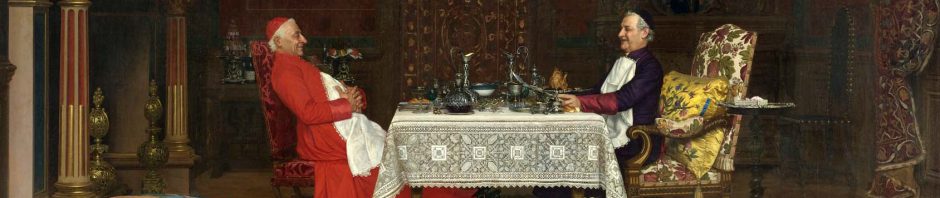
 In addition to Boxing Day, and the day good King Wenceslaus went out, it is the feast of St Stephen. I hope all your snow is neat and crisp and even.
 In your goodness, please offer a prayer for the repose of the soul of Fr. Reginald Foster, OCD, who died on Christmas Day in 2020.


 In chessy news…
  A continuation of our look at the




 Loading ...
























