The Roche Report, ‘Traditionis custodes’, and Permanent Revolution

Do you remember all the way back to the dark year of 2023?    Newly minted Cardinal Fernandez of the DDF vowed in an interview that he was not a “Soros spy infiltrated in the Church.”

Hamlet 3.2.245

According to Crux:

[Fernandez] also emphasized the importance of another charge given him by Francis, which is to ensure that all Vatican departments are in alignment with the “recent magisterium.

“It can happen that answers are given to certain theological issues without accepting what Francis has said that is new on those issues,” Fernández said. “It’s not only inserting a phrase from Pope Francis, but allowing thought to be transfigured with his criteria. This is particularly true for moral and pastoral theology.

[…]

I must ensure that both the documents of the dicastery and those of others ‘accept the recent Magisterium.

The “recent magisterium”?

“thought… transfigured with (Francis’) criteria”?

I was immediately reminded of Mao Thought which stressed the importance of contradictions.  That is, if there is a goal, there are contradictions.  But there will always be contradictions, which means that revolution must be continuous.

Continuous revolution is slightly different from the other side of the Communist horror of Marxist-Leninism which had the principle of “permanent revolution”.  What might be an example of Mao Thought, translated into the “current magisterium” which is transfigured by new criteria?  For example, as resulted from Amoris laetitia the defense that “lived experience” shows that requiring sexual continence in an adulterous marriage as the basis for possible reception of Communion (scandal being avoided) is really just an impossible ideal that people can’t be expected to attain.  Hence, we have to transform the teaching about reception of Communion in light of today’s lived experience.   This is like the Mao Thought idea of “from the masses, to the masses,” namely, drawing from their experiences, and leading us to new understanding.

If you go to wiki and look for a definition of the Marxist concept of “permanent revolution” the long article opens with this distilled passage:

Permanent revolution is the strategy of a revolutionary class pursuing its own interests independently and without compromise or alliance with opposing sections of society.

Let’s replace some terms.

  1. revolutionary class = progressivist promoters of discontinuity who require a positivistic reinterpretation of all doctrine, worship and praxis in light of their particular “spirit of Vatican II” ideology.
  2. opposing sections of society = those who maintain continuity with tradition in worship, doctrine and praxis.

Permanent revolution is the strategy of  _1.__ pursuing its own interests independently and without compromise or alliance with _2.__.

A main point of “permanent revolution” as well as Maoist “continuous revolution” is that there is no compromise with those whom you have designated as the opposition (whether they are actively opposing or not).  Once you have targeted them as standing in the way, you pursue your goal relentlessly and with no possibility of compromise.

Everyone on both sides suffers in this scenario.   Trotsky, who was a proponent (not the first) of permanent revolution, is said to have said: “You may not be interested in war, but war is interested in you”.  Even if you desire peace, the pervasive nature of conflict driven by others means it will eventually involve or affect you.   Ask the faithful in Charlotte.

In this time of seeming permanent revolution no one can be a bystander.

The concept of permanent revolution provides a useful interpretive lens for understanding the internal logic of the The Roche Report, even though the term itself is never used.

The Roche Report (HERE) portrays liturgical history as a process of continual reform. Stability is treated as inherently suspect. Hijacking Ratzinger, by defining tradition primarily as movement (“a living river”) that must keep flowing, it disqualifies settled liturgical forms from enjoying lasting normative authority. What results is a functional analogue to permanent revolution. Reform is not ordered toward consolidation, reception, and repose.  Reform is presented as an ongoing necessity intrinsic to fidelity to the “spirit” of the Council.  Those are my “”, because it is impossible to express that sort of reform as intrinsic fidelity to the letter of the Council.

Within this framework, resistance to further change is recast as pathology.  In the Roche Report the equivalent is “if you disagree or have questions, you don’t have the correct ecclesiology“.   If you cling to your outdated liturgy, you are against the current magisterium and the new ecclesiology which is imbued with the spirit of Vatican II  and transformed by Francis’ criteria.

In the former Soviet Union and in some sectors of the Church today, resistance to the official line coming down from The Whatever High Atop The Thing is tantamount to mental illness.  The Soviets called it “sluggish schizophrenia”.  You would be institutionalized.   After all, the Soviet system was clearly the best possible and quite simply flawless. To resist it was a sign that you were mentally ill.  Today, anyone who resists what is clearly the most incredible and miraculous Second Pentecost for the Church must be a dissident who, for the sake of unity, must be dealt with by being pastorally “un-personed”, to borrow a notion of Rawls.   Rawls wasn’t a Marxist, but his ideas about consensus tangentially intersect.

Once you eliminate the naysayers, you have consensus.

Solitudinem faciunt, pacem appellant.

Because language needs to be fluent – fluent faster than language usually flows – they had to get rid of non-evolving Latin.  Now, as the East Germans did with their dictionaries, they can freely start redefining terms.  For example “sound tradition” is allowed to exist only insofar as it authorizes new reform, while “legitimate progress” becomes the criterion by which tradition is judged. The logic is circular: tradition must change in order to remain tradition, and any appeal to continuity that limits reform is dismissed as backwardism and ossification. As in permanent revolution, stability appears not as an achievement but as a failure of nerve.

This helps explain why the Roche Report – and those whom it echoes – cannot admit the possibility that the post-Conciliar reform itself might be subject to critique.

If reform is structurally ongoing, then to question a reform is not to engage in discernment, but to resist the revolution.

Hence the move to redefine disagreement as an ecclesiological defect rather than a theological or historical argument.

Unity, in this schema, is secured not by shared inheritance, but by universal submission to the latest authorized stage of reform.

Hence, force.

Read this way, Traditionis custodes functions not as a truly pastoral intervention than as a consolidation measure via brute force. It suppresses traditional liturgical forms because they represent a counter-principle, namely, that the liturgy can reach a state of normative maturity and stability.

In that sense, the Roche Report reflects the same logic as permanent revolution: reform must be permanent, critique must flow in only one direction, and the possibility of a stable tradition standing in dialogue with the post-Conciliar reform is excluded in advance.

Hence, the overturning of Summorum Pontificum.

Hence, the need to restore something like Summorum Pontificum.

Hence, the mad scramble to prevent anything like Summorum Pontificum.

Hence, The Roche Report put into the hands of all the cardinals: dezinformatsiya.

Posted in Francis, Liturgy Science Theatre 3000, Save The Liturgy - Save The World, SESSIUNCULA, SUMMORUM PONTIFICUM, The Coming Storm, The Drill, Traditionis custodes, What are they REALLY saying? | Tagged ,
13 Comments

The text Card. Roche gave the other Cardinals about the TLM, ‘Traditionis custodes’ and “unity” during the recent consistory: an examination of “The Roche Report”

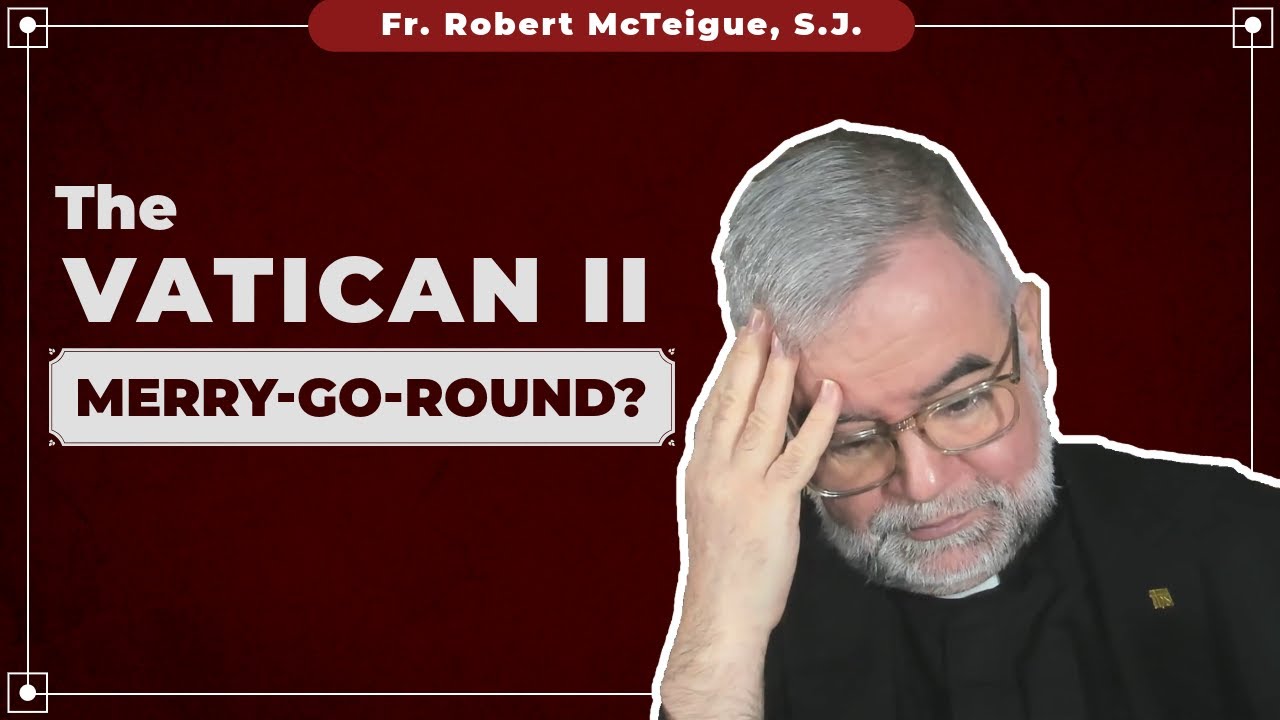
When Leo called the consistory, there were several proposed agenda items.  Fr. McTeigue aptly describes what happened.

[T[hey were going to talk about lots of things and then they talked about not as many things as the things they were supposed to talk about. And they did a lot of listening, but not very much talking. And maybe things will get accomplished. But what really stood out was Pope Leo saying, “You know what we need? You know what we really, really need? You know what’s going to fix everything? We’re going to have a new catechesis on the Second Vatican Council. Isn’t that exciting?

That’s going to do it!  More formation!  We’re saved!

If you have to keep talking about formation about what the Council really said… after 60 years… maybe there’s something not quite right with the subject rather than the method.

One of the things they were going to talk about, but didn’t, was liturgy.  I’m sure the issue of the TLM was lurking in the background.  They didn’t talk about it, in the end.  Which, come to think about who would have been doing the talking, maybe it was better that way.  However, speaking of lurking – maybe panicking – in the background, Card. Roche preemptively gave the cardinal participants his own paper on the TLM.   Diana Montagna got it and put it on her Substack.

Shall we have a look?  Let’s call it the “Roche Report” in juxtaposition to the famous “Ratzinger Report”

First, here in bare bones is what he wrote:

Roche situates the Second Vatican Council’s liturgical reform within a long history of what he thinks is organic liturgical development, arguing that reform is intrinsic to the Church’s life and fidelity to Tradition. Drawing on Sacrosanctum Concilium, Benedict XVI, and Pope Francis, he maintains that authentic tradition and legitimate progress are inseparable: without reform tradition ossifies, while progress without tradition becomes destructive novelty. He says that the Council’s reform, grounded in theological, historical, and pastoral study, sought fuller participation in the Paschal Mystery as the foundation for ecclesial unity and missionary renewal. He attributes failures in implementation to inadequate formation, not to the reform itself. Roche concludes that ecclesial unity requires exclusive use of the reformed liturgical books promulgated after Vatican II. The 1962 Missal is permitted only as a limited concession, since the post-Conciliar rites alone express the Roman Rite’s lex orandi.

Ehem.

Here’s Roche’s full English text – The Roche Report – which he distributed.  I transcribed it from the images posted by Diane. HERE  That’s the untouched text.  There might be a few typos or oddos.

Now let’s look closer.  My emphases and comments.


EXTRAORDINARY CONSISTORY (January 7-8, 2026)

Liturgy: careful theological, historical, and pastoral reflection “that sound tradition may be retained, and yet the way remain open to legitimate progress” (SC 23).

LITURGY

Card. Arthur Roche

1. In the life of the Church, the Liturgy has always undergone reforms. From the Didache to the Traditio Apostolica; from the use of Greek to that of Latin; from the libelli precum to the Sacramentaries and the Ordines; from the Pontificals to the Franco-Germanic reforms: from the Liturgia secundum usum romance curiae to the Tridentine reform; from the partial post-Tridentine reforms to the general reform of the Second Vatican Council. The history of the Liturgy, we might say, is the history of its continuous ‘reforming’ in a process of organic development. [A rather sweeping conclusion.  He has conflated two categories.  Historical development was very slow, unselfconscious and received rather than engineered.  This is not at all the same as deliberate, programmatic reconstruction undertaken during and after the Council. The mere fact that the liturgy has changed over time does not establish that every form of change is of the same species or legitimacy. Organic growth and manufactured reform are not interchangeable categories.  Roche has started with smoke and mirrors.  The rest will eventually devolve into use of force.]

2. Saint Pius V, in facing the reform of the liturgical books in observance of the mandate of the Council of Trent (cf. Session XXV, General Decree, chap. XXI), was moved by the will to preserve the unity of the Church. The bull Quo primum (14 July 1570), with which was promulgated the Roman Missal, affirms that “as in the Church of God there is only one way of reciting the psalms, so there ought to be only one rite for celebrating the Mass” (cum unum in Ecclesia Dei psallendi modum, unum Missae celebrandae ritum esse maxime deceat).  [The invocation of St. Pius V is funny. Quo primum was not an act of creative reform in any way comparable to the post-Conciliar reform.  It was a juridical consolidation intended to protect the Roman Rite from doctrinal corruption and local, arbitrary variants during upheavals of the Protestant Revolt. Its logic was conservative and preservative, not reconstructive. To cite it in support of a radical reworking of rites, prayers, and calendar is to misunderstand its intent.  He is not, perhaps, as clever as he thinks.]

3. The need to reform the Liturgy is strictly tied to the ritual component, through which — per rites et preces (SC 48) — we participate in the paschal mystery: the rite is in itself characterised by cultural elements that change in time and places.  [And…?]

4. Besides, since “Tradition is not the transmission of things or words, a collection of dead things” but “the living river that links us to the origins, the living river in which the origins are ever present” (BENEDICT XVI General Audience, 26 April 2006), we can certainly affirm that the reform of the Liturgy wanted by the Second Vatican Council is not only in full syntony with the true meaning of Tradition, but constitutes a singular way of putting itself at the service of the Tradition, because the latter is like a great river that leads us to the gates of eternity. (ibid.). [Another cleverboots citation: the Pope who issued Summorum.  Roche leans on Benedict’s image of tradition as a “living river.”   However, he interprets this metaphor in a way that detaches the river from its banks.  If tradition is defined primarily as movement, then resistance to change can always be dismissed as stagnation. What is missing is a serious account of material continuity. The actual preservation of texts, gestures, ritual structures, and theological emphases that constituted the Roman Rite for centuries. A river that no longer follows its historic course, or whose source has been reengineered, is not simply “living”.  It is redirected.]

5. In this dynamic vision, “maintaining solid tradition” and “opening the way to legitimate progress” (SC 23) cannot be understood as two separable actions: without a “legitimate progress” the tradition would be reduced to a “collection of dead things” not always all healthy; without the “sound tradition” progress risks becoming a pathological search for novelty, that cannot generate life, like a river whose path is blocked separating it from its sources. [The repeated appeal to Sacrosanctum Concilium 23 creates an appearance of balance, but the equilibrium is asserted rather than demonstrated. The decisive question is not whether tradition and progress should coexist in principle, but whether the reforms enacted after the Council meet the Council’s own criteria. (HINT: THEY DON’T.) Massive textual excisions, the creation of new Eucharistic Prayers, the effective abandonment of Latin, the reorientation of the priest, and the near-total replacement of the historic offertory prayers represent qualitative ruptures, not incremental progress. These changes effected what one can legitimately argue is a different rite of Mass.]

6. In the discourse to the participants in the Plenary of the Dicastery for Divine Worship and the Discipline of the Sacraments (8 February 2024), Pope Francis expressed himself thus:

“Sixty years on from the promulgation of Sacrosanctum Concilium, the words we read in its introduction, with which the Fathers declared the Council’s purpose, do not cease to enthuse. [Whom do they enthuse, again?  Frankly, I think most young people today have very little interest in Vatican II and those a little older are weary of having it shoveled down our throats.  And, think about watching Francis at Mass or anything liturgical other than the Pachamama Garden Rite: would you describe him as “enthused” by liturgy?] They are objectives that describe a precise desire to reform the Church in her fundamental dimensions: to make the Christian life of the faithful grow more and more every day; to adapt more suitably to the needs of our own times those institutions which are subject to change; [NB] to foster whatever can promote union among all who believe in Christ; [So, change liturgy to reach out to Protestants?  That’s exactly what happened in the 60’s.  How has it worked?] to reinvigorate that which serves to call all to the bosom of the Church (cf. SC I). [Here I wish to remind the reader that it was Benedict XVI who brought large numbers of Anglicans into union with Rome via Anglicanorum coetibus, a project which required a careful harmonizing of Anglican elements in liturgy.  And that Pope, a Pope of true Christian unity who didn’t say things like “God wills different religions” issued Summorum Pontificum.  Just sayin’.] It is a task of spiritual, pastoral, ecumenical, and missionary renewal. And in order to accomplish it, the Council Fathers knew where they had to begin, they knew there were particularly cogent reasons for undertaking the reform and promotion of the liturgy” (Ibid.). It is like saying: without liturgical reform, there is no reform of the Church.”  [It’s like saying WHAT I HAVE BEEN WRITING FOR DECADES.  And I have been right: the key is preservation of tradition not compelled conformity.  We are our rites!  ]

7. The liturgical Reform was elaborated on the basis of “accurate theological, historical and pastoral investigation” (SC 23). [Yeah.. everything but common sense, not to mention neglect of what the Council Father’s in fact voted for!] Its scope was to render more full the participation in the celebration of the Paschal Mystery for a renewal of the Church, the People of God, the Mystical Body of Christ (see LG chapters I-II), perfecting the faithful in unity with God and among themselves (cf. SC 48). [How’s that going?] Only from the salvific experience of the celebration of Easter, the Church rediscovers and relaunches the missionary mandate of the Risen Lord (cf. Mt 28, 19-20) and becomes in a world torn by discord, a leaven of unity. [Now he is becoming unctuous.  He’s heard Pope Leo emphasize “unity”, so now he works it in.  There’s another term for this, too.]

8. We ought to also recognize that the application of the Reform suffered and continues to suffer from a lack of formation, and this urgency of addressing, beginning with Seminars to “bring to life the kind of formation of the faithful and ministry of pastors that will have their summit and source in the liturgy (Instruction Inter oecumenici, 26 September 1964, 5)  [Here’s what they always return to: the claim that the failures of the reform are due primarily to inadequate formation functions as a catch-all defense that insulates the reform from falsification. After more than half a century, across continents and generations, the persistence of liturgical instability, doctrinal flattening, and loss of the sense of the sacred suggests structural problems rather than merely pedagogical ones. A reform that requires perfect formation to avoid collapse, yet consistently produces dysfunction even among the well-trained, speaks for itself.  You can’t get around the results.  One the other hand, what was with the massive growth of the TLM after Summorum?  Hmmm.]

9. The primary good of the unity of the Church is not achieved by freezing division but by finding ourselves in the sharing of what cannot but be shared, as Pope Francis said in Desiderio desideravi 61: [Roche repeatedly identifies unity with exclusive adherence to the postconciliar books, treating the older Roman Rite as, at best, a tolerated anomaly. This reverses the traditional Catholic understanding of unity, which historically accommodated multiple rites and usages within doctrinal communion. The assertion that unity can be achieved only by suppressing a venerable liturgical form ignores the Church’s own lived experience prior to the twentieth century and reduces unity to ritual monoculture.]

“We are called continually to rediscover the richness of the general principles exposed in the first numbers of Sacrosanctum Concilium, grasping the intimate bond between this first of the Council’s constitutions and all the others. For this reason we cannot go back to that ritual form which the Council fathers, cum Petro at sub Petro, felt the need to reform, approving, under the guidance of the Holy Spirit and following their conscience as pastors, the principles from which was born the reform. [Gratis asseritur… You know… if you take a road and you realize it is not taking you to a good place, is it better blithely to keep going or to go back and make a course correction?] The holy pontiffs St. Paul VI and St. John Paul II, approving the reformed liturgical books ex decreto Sacrosancti OEcumenici Concilii Vaticani II, have guaranteed the fidelity of the reform of the Council. For this reason I wrote Traditionis custodes, so that the Church may lift up, in the variety of so many languages, one and the same prayer capable of expressing her unity. [Cf. Paul VI, Apostolic Constitution Missale Romanum (3 April 1969) in AAS 61 (1969) 222]. As I have already written, I intend that this unity be re-established in the whole Church of the Roman Rite.” [Good, persuasive arguments and lack of adherence to the facts about what happened after the Council leaves only one course of action for those obsessed more with eliminating the past than authentic ecclesial communion: FORCE.]

10. The use of liturgical books that the Council sought to reform was, from St. John Paul II to Francis, a concession that in no way envisaged their promotion. [“[B]y virtue of my Apostolic Authority I decree the following: … c) moreover, respect must everywhere be shown for the feelings of all those who are attached to the Latin liturgical tradition, by a wide and generous application of the directives already issued some time ago by the Apostolic See for the use of the Roman Missal according to the typical edition of 1962.” – St. John Paul II, Ecclesia Dei adfflicta, 6.] Pope Francis—while granting, in accordance with Traditionis Custodes, the use of the 1962 Missale Romanum—pointed the way to unity in the use of the liturgical books promulgated by the holy Popes Paul VI and John Paul II, in accordance with the decrees of the Second Vatican Council, the sole expression of the lex orandi of the Roman Rite. [The conclusion rests heavily on Traditionis custodes, presented as the necessary juridical expression of ecclesial unity. Yet its credibility is weakened by the unresolved question of its foundation.  Thank again to Diane Montagna and testimonies from bishops indicate that the document’s justification, namely, widespread episcopal concern over rejection of the Council, was based on a selective or tendentious reading of the survey responses. If the diagnostic premise is flawed, the resulting legislative remedy cannot claim moral or pastoral inevitability. Put another way, purgamentum init, exit purgamentum.]

11. Pope Francis summarised the issue as follows (Desiderio desideravi 31):

“[…] If the liturgy is ‘the summit toward which the activity of the Church is directed, and at the same time the font from which all her power flows,’ (Sacrosanctum Concilium, n. 10), well then, we can understand what is at stake in the liturgical question. It would be trivial to read the tensions, unfortunately present around the celebration, as a simple divergence between different tastes concerning a particular ritual form. The problematic is primarily ecclesiological. I do not see how it is possible to say that one recognizes the validity of the Council — though it amazes me that a Catholic might presume not to do no — and at the same time not accept the liturgical reform born out of Sacrosanctum Concilium, a document that expresses the reality of the Liturgy intimately joined to the vision of Church so admirably described in Lumen gentium […]”.  [Oh, dear. This paragraph turns on an equivocation: it identifies assent to an ecumenical council with assent to every reform later attributed to it. SC 10 defines the liturgy as the Church’s “summit and source”. It does not render all post-Conciliar implementations irreformable! The argument therefore moves illegitimately from a doctrinal principle to a historically contingent outcome. By recasting the dispute as “primarily ecclesiological,” the text again misstates the issue. The question is neither aesthetic preference nor rejection of Vatican II, but whether the reform as enacted conforms to the Council’s own criteria (e.g., organic continuity, restraint in change, and fidelity to received forms). The claim that the reformed books necessarily embody the ecclesiology of Lumen gentium is asserted, not demonstrated. Councils articulate principles but their application proceeds through fallible human judgment. To deny this is to collapse council, reform, and implementation into a single, untouchable act of authority.  Finally, the suggestion that one cannot affirm the Council while questioning the reform is a category error. Catholic tradition has always permitted critical evaluation of disciplinary reforms in order to safeguard Tradition itself. Fidelity to Vatican II requires discernment, not uncritical acceptance of every post-Conciliar product.]

Rome, 8.01.2026


The The Roche Report’s claim that the Novus Ordo represents organic development stands in tension with the judgment of one of the most significant theological voices of the twentieth century, Joseph Ratzinger, who described the post-Conciliar liturgy as “a fabrication, a banal product of the moment”.  This critique arose from a concern that the reform replaced a received rite with a constructed one, assembled by committees and justified ex post facto by appeals to history and pastoral need. A rite produced in this manner cannot easily be squared with the Church’s prior understanding of liturgical tradition as something received, not made.

Roche attempts a coherent and compelling narrative.  However, its coherence depends on redefining key terms such as reform, tradition, unity, and legitimacy, in ways that predetermine the outcome. When examined critically, the evidence before our eyes viewed with the lens of common sense suggests that the liturgical crisis cannot be reduced to failures of formation or implementation. Rather, the scope, method, and assumptions of the reform itself remain on the table. If these foundational questions are not addressed, appeals to authority and unity risk functioning less as instruments of communion than as mechanisms for foreclosing legitimate theological and historical debate.

All they are left with, really, is dezinformatsiya and sheer force.


Posted in Liturgy Science Theatre 3000, Pò sì jiù, Save The Liturgy - Save The World, The Drill, What are they REALLY saying? | Tagged
22 Comments

Terrific from Fr. McTeigue! “Are we there yeeeeet?”

YouTube thumbnailYouTube icon

Posted in HONORED GUESTS, The Drill, Vatican II | Tagged
10 Comments

Daily Rome Shot 1525

Today’s Wordle: 4

Welcome registrant:

Mr.

Please remember me when shopping online and use my affiliate links.  US HEREWHY?  This helps to pay for health insurance, utilities, groceries, etc..  At no extra cost, you provide help for which I am grateful.

White to move and mate in 4

I must…

Posted in SESSIUNCULA |
3 Comments

Your Sunday Sermon Notes – Holy Family (TLM) & Baptism of the Lord (NO) 2026

Too many people today are without good, strong preaching, to the detriment of all. Share the good stuff.

Was there a GOOD point made in the sermon you heard at your Mass of obligation for this Sunday, Holy Family (TLM) & Baptism of the Lord (NO).

Tell us about attendance especially for the Traditional Latin Mass.

Any local changes or (hopefully good) news?

A taste of what I offered at 1 Peter 5 this week:

[…]

The group with whom Joseph and Mary traveled is called a ???o??? (synodía) a company “together on the road”. The word itself speaks of “walking together”. The irony is sharp. In fact, just as the “walking together” of Luke 2 lost Jesus, so it seems that the “walking together” of the last few years may have done the same.

In any event Jesus is not “walking together” at that moment. He sets aside ordinary human expectation in order to be found where He must be found. Only when He is “about His Father’s (business)” does He rejoin them. Quaerite primum regnum Dei (Mt 6:33) takes flesh here as a priority that disrupts even the holiest of human bonds.

Having sought Jesus in all the wrong places, Joseph and Mary find Jesus in the Temple, the central place of worship and sacrifice which was the microcosm of the universe for the Jews.  They found Him in the place of worship, not the markets and byways.  It is as if this moment, counted among both the Sorrows of Mary and Joyful Mysteries, is shouting at us today that our best path to Jesus is not in endless process but rather in sacred liturgical worship received from our loving forebears.  We are our rites.  When our pastors remember this, then we shall see what happens.

[…]


Posted in Sermons | Tagged
6 Comments

WDTPRS – Baptism of the Lord (Double Dipping)

baptism-of-christ-1483 Perugino

On the SIXTH of January, Epiphany, we prayed liturgically with the three mysteries of the Lord’s life revealing Him as divine: the adoration of Jesus by the Magi, the changing water to wine at Cana, and His baptism by John in the Jordan River.

In the reform after the Council, the mystery of the Lord’s Baptism (as revealing His divinity) celebrated at Epiphany was teased out, I suppose to put greater emphasis on the Lord’s baptism as a model for our own baptism.

The Novus Ordo Feast of the Baptism of the Lord (which closes the Christmas season in the Novus Ordo), is now placed on a Sunday. In the pre-Conciliar calendar it had, with some exceptions, a commemoration on 13 January… the octave day of Epiphany, which is appropriate.

John the Baptist helped us into our Advent preparation for Christmas by reminding us to straighten the paths of our lives for the coming of the Lord.  It is fitting that we meet the Baptist again at the end of the Christmas season.

John announced the coming of the Messiah and now he points us to the Messiah.  This was when the Baptist told his disciples to follow Jesus, saying “He must increase, I must decrease” (John 3:30).

In His baptism by John, Christ foreshadows what He would do later: He descends into the waters of the Jordan (death and the tomb) and rises out of them again (resurrection).

Christ had no need of John’s baptism.  Being perfect and sinless Jesus had nothing to repent.

Dodekaorton Baptism 1547_Dionysiou_Mt_AthosInstead, His submission to baptism shows all humanity the way to our salvation.

Christ’s baptism reveals how we must die and rise to our sins in the sacrament He instituted at the Jordan.   By receiving John’s baptism the Lord was solemnly revealed to be divine by the Father’s voice and the descent of the Holy Spirit, and He sanctified the waters for our baptisms.  He instituted the sacrament.

Baptism is the starting point of all saving and actual graces we receive as Christians.  Baptism confers on us an indelible character, almost like a branding mark of Christ’s Lordship in and over us.  This is the foundation of our spiritual lives.  Christ’s humility orients us in the right direction for our lives as baptized Christians.

He must increase, we must decrease.

We find two collects for today in the 2002 Missale Romanum.  The first is of new composition for the post-Conciliar Novus Ordo and the second is from the 1962MR on 13 January, the Commemoration of the Baptism of the Lord.

COLLECT (2002MR):

Omnipotens sempiterne Deus,
qui Christum, in Iordane flumine baptizatum,
Spiritu Sancto super eum descendente,
dilectum Filium tuum sollemniter declarasti,
concede filiis adoptionis tuae, ex aqua et Spiritu Sancto renatis,
ut in beneplacito tuo iugiter perseverent.

baptism_christApart from the obvious references to the events at the Jordan, there are echoes of Scripture here (cf. Is 42:1-4, 6-7; Is 61:1-2; Rom 8:15; Eph 1:3. 5-6). According to the illuminating Lewis & Short Dictionary the later Latin adverb sollemniter, from the adjective sollemnis, refers to all that which is performed according to the proper customs and forms usually in a ritual religious context.  Thus, it mostly means grand and “ceremoniously” but also in an ordinary way, so long as it is the “customary” way.  The form of the verb declarasti is again “syncopated” (declaravisti).  Spiritu…descendente is our old friend the ablative absolute and it takes its time from the perfect declarasti.   Iugiter, ultimately from iugum (a “yoke” for horses or cattle), means “continuously” as if one moment in time is being “yoked together” with the next, and so on.  The substantive beneplacitum is from the late, ecclesiastical verb beneplaceo (“to please”), found in the Latin Vulgate and in authors such as St. Ambrose of Milan (+397).

SLAVISHLY LITERAL TRANSLATION:
Almighty eternal God,
who as the Holy Spirit was descending upon Him,
solemnly declared Christ, baptized in the Jordan river,
to be Your beloved Son,
grant that the children of Your adopting, reborn from water and the Holy Spirit,
may continually persevere in your good pleasure.

CURRENT ICEL (2011):
Almighty ever-living God,
who when Christ had been baptized in the River Jordan,
and as the Holy Spirit descended upon him,
solemnly declared him your beloved Son,
grant that your children by adoption,
reborn of water and the Holy Spirit,
may always be well pleasing to you
.

The ICEL version isn’t too far off the mark today, probably because this rather chatty prayer pretty much tells a story and the syntax is fairly straight forward.

COLLECT 2 (2002MR):
Deus, cuius Unigenitus
in substantia nostrae carnis apparuit, praesta, quaesumus,
ut, per eum, quem similem nobis foris agnovimus,
intus reformari mereamur.

This prayer is far less wordy than the newly composed collect.  The language here is denser and more “theological”.   Note the contrast between two pairs of words.  First, the adverbs intus, “on the inside, within”, contrasted with foris, “from without” (this is literally, “outside the doors”, so it refers to what you see from the outside).  Next, the noun substantia, a theological word “substance”, that which we really are in and of ourselves apart, or “beneath” in a sense our outward appearances or “accidents”, contrasts with the adjective similis, “like, resembling, similar”.  There is another theological concept, “form”, contained within the passive infinitive reformari.  Human beings are composed of “matter” (our fleshly bodies) and “form” (our immortal, rational souls).  The sacraments have matter and form: for example, in baptism water (matter) and the Trinitarian words spoken while pouring the water (form), in the Eucharist bread and wine (matter) and the words of consecration by an ordained priest (form), in penance the confession of sins (matter) and the absolution from the priest (form).

SLAVISHLY LITERAL TRANSLATION:
O God, whose Only-begotten,
appeared in the substance of our flesh, grant, we beg,
that we may merit to be reshaped inwardly
through Him, whom we recognize is like us outwardly.

CURRENT ICEL (2011):
O God, whose Only Begotten Son
has appeared in our very flesh,
grant, we pray, that we may be inwardly transformed
through him whom we recognize as outwardly like us
.

Giotto_Scrovegni_BaptismThe Latin prayer’s meaning hinges on the effects of baptism. 

Through the words of the formula for baptism and the outward pouring of sensible, visible water, there is an invisible and inward effect of grace in the soul.

By baptism we are inwardly conformed or “shaped” so that we can be a proper temple of the Holy Spirit and recipient of graces as holy member of the Body of Christ, the Church.  By taking up not just part of but our complete human nature – body and soul – our “flesh” in shorthand, into an indestructible bond with His divinity, the Second Person became one like us in all things but sin.

Our baptism is the first step of being more and more reformed and shaped according to His image, a process which will continue for eternity in heaven.

In this life it is our task to make sure that our outward life, our words and actions, are fully consistent with and show forth clearly the inward reality of Christ in us.

This but one of the lessons we receive from Jesus’ humble submission to a baptism at the hands of John in the Jordan for which He had absolutely no need.

The main concept underlying the primary Collect, and this feast, would have to be our spiritual adoption and new status in the Holy Spirit as the children of God, brothers and sisters of Christ having the same heavenly Father.

In our baptism and by living the faith we profess we enjoy the indwelling of the Holy Spirit, indeed the indwelling of the Triune God (cf. John 14:23).

This indwelling begins with the humble reception of a “character” or “owner’s mark” on our souls, which although it is a sign of God’s Lordship over us actually sets us free from the bondage of sin.   He adopts us as His own making us sons and daughters, not slaves.  When the Holy Spirit dwells in us, we can address God with reverential awe intimately as “Abba” (Mark 14:36), rather than with the abject fear of a slave for a hard master.

God does more for us than freeing us from sin and making us His adopted children.

He also makes us co-heirs with His eternally Only-Begotten to a divine inheritance.

As co-heirs we can be admitted also to the joys of heaven which Christ, our brother in our humanity, has in perfect possession with His resurrection and ascension to the Father’s right hand (cf. Romans 8:34).

Once we were slaves of sin and the enemies of God (Romans 5:10-11).

Now we are sons and daughters with a (re)birthright to inherit.

Our humanity, in Christ, already enjoys this while all of humanity still awaits the fulfillment of this promise.

God now hears our prayers as He hears His confident children, not fearful strangers.


Posted in Christmas and Epiphany, WDTPRS |
4 Comments

WDTPRS: Orations of the TLM Feast of the Holy Family


We are in Epiphanytide. As you know, Epiphany is from a Greek term for “manifestation”. The Feast was especially important in the ancient Eastern Churches. Traditionally it celebrated especially three manifestations of the divinity of Christ, namely, the Adoration of the Magi (frankincense being a symbol of divinity), the Lord’s Baptism by John (the bridge between the Lord’s private life and His public ministry when the Father’s voice was heard), and the Wedding at Cana (His inaugural public miracle). In the Roman Church on Epiphany the antiphon for Vespers mentions these three mysteries, each introduced with “Hodie…today”:

We honor this holy day decorated with three miracles: today the star led the Magi to the manger; today at the marriage wine was made from water; today Christ deigned to be baptized by John in the Jordan that he might save us. Alleluia.

In the first part of the Season of Epiphany, these three miraculous events are teased out for their own liturgical reflection: On 6 January Epiphany, the Magi – at the octave, 13 January, the Lord’s Baptism – on the 2nd Sunday after Epiphany, the Wedding at Cana which in John 1 and 2 is “octave” of the Baptism.

In the Vetus Ordo for this Sunday we celebrate the Feast of the Holy Family. In the Novus Ordo, this Sunday would be the Feast of the Baptism of the Lord.

The 20th century the Czech-born liturgical writer Fr. Pius Parsch (+1954), a Canon Regular of Klosterneuburg Abbey in his multi-volume The Church’s Year of Grace, writes that the Feast of the Holy Family was intended to improve family life in the wake of World War One.   The 1570 editio princeps does not have the feast of the Holy Family.  I believe devotion to the Holy Family really took off in the 17th century, especially in French speaking regions.  Pope Leo XIII seems to have introduced the feast for Canada in 1893 and Benedict XV gave it to the whole Latin Church in 1921. Before that, this Sunday was associated with the Octave of Epiphany, which was rashly suppressed along the way. One thing that ties the older Mass formula with Holy Family in the Vetus Ordo is that they both have for the Gospel reading the episode in Luke 2:41-52 about the finding of the Lord in the Temple.

COLLECT (Holy Family – 1962MR):

Domine Iesu Christe, qui Mariae et Ioseph subditus, domesticam vitam ineffabilibus virtutibus consecrasti: fac nos, utriusque auxilio, Familiae sanctae tuae exemplis instrui; et consortium consequi sempiternum.

Subdo, which according to the thick Lewis & Short Dictionary is “to bring under, subject, subdue”, gives us subditus, a, um, “subject”.  Consortium comes from the preposition cum (“with”) and sors (“any thing used to determine chances”).  Sors is further applied to offices that are gained by the casting of lots and methods like drawing straws.  It means, then, “fate, destiny, chance, fortune, condition, share, part.”    It thus means also a “community of goods” and by extension “fellowship, participation, society.”

A consortium is a situation in which you have “cast your lot” with a group.  You share a common outcome or fate.  At the end of the Roman Canon we hear consortium when we pray to participate in the reward given to great martyrs.  Consequor is “to follow, follow up, press upon, go after, attend, accompany, pursue any person or thing.” It also means, “to follow a model, copy, an authority, example, opinion, etc.; to imitate, adopt, obey” and “to reach, overtake, obtain”.  Consequently, it follows, consequor means “to become like or equal to a person or thing in any property or quality, to attain, come up to, to equal.”

Exemplum is first and foremost “imitation, image, portrait; transcript, copy” and then it is in legal terms a case or cause to be imitated or followed in our behavior, a “precedent”.

LITERAL TRANSLATION:

O Lord Jesus Christ, who, while subject to Mary and Joseph, consecrated domestic life by unutterable virtues, cause us, by the help of them both, to be instructed in the examples of Your Holy Family, and to attain eternal fellowship.

Our prayers today taken all together present themes of imitation and instruction: exemplum… instruo… imitor… consequor.

SECRET (Holy Family – 1962MR):

Placationis hostiam offerimus tibi, Domine, suppliciter deprecantes: ut, per intercessionem Deiparae Virginis cum beato Ioseph, familias nostras in pace et gratia tua firmiter constituas.

This prayer was revised somewhat but largely retained in the Novus Ordo for the Feast of the Holy Family.  The newer version to my mind gives a bit more emphasis to St. Joseph.  However, this is not an ancient prayer as far as I can tell.

Placatio means “a pacifying, appeasing, propitiating” especially of the immortal gods.  In our prayer today we might choose a word like “atonement” or even “reconciliation.”  Deprecor is not just “to pray”, but “to pray earnestly.”  Firmiter is the adverb of firmus and can be “firmly, steadily, lastingly, powerfully.”  Because of the beseeching tone of the prayer and the concept of intervention, I will use the word “powerfully.”   When you, gentle reader, go through this vocabulary you might try substituting some of the alternative meanings to see how that will affect the prayer.  You will see why translating the liturgy is not an easy task and why we must pray for all involved.

LITERAL TRANSLATION:

We offer You this sacrifice of appeasement, O Lord, humbly in earnest prayer, so that, by the intercession of the Virgin Mother of God with blessed Joseph, you may establish our families powerfully in grace and peace.

We hear this prayer spoken by the priest, our mediator with God and alter Christus, at the moment our offerings (spiritual and material) are on the altar in anticipation of the divine act of transubstantiation.  All we are and all our hopes and desires should be united with the frail hosts, the still wine.  What we receive in return, particularly through making a good Holy Communion, allows us to fulfill our vocations in the world and transform it around us.  It is fitting that we should use the language of bowing, implicit in suppliciter (from supplex, formed from supplico (sub-plico – plico being “to fold; double up”).  We must use the physical posture of bowing down, folding ourselves face down before God, folding and bend our knees to beg Him to form and shape our families.  As the family in general goes, so goes society.  But what do we find in prosperous countries?  Legal abortion, growing legalization of euthanasia, same-sex marriages, high divorce rates, young women disposing of newborn infants in garbage cans, scientific experimentation on living human beings, the dreadful prospect of cloning.  The concept of the family is breaking to pieces.  It is good to pray that God might be appeased.

POSTCOMMUNIO (Holy Family – 1962MR):

Quos caelestibus reficis sacramentis, fac, Domine Iesu, sanctae Familiae tuae exempla iugiter imitari: ut, in hora mortis nostrae, occurrente gloriosa Virgine Matre tua cum beato Ioseph; per te in aeterna tabernacula recipi mereamur.

The Novus Ordo retains the first part of this prayer, though it is shifted to address God the Father, rather than the Son, and the last part eliminates the discomforting reference to death.

The verb occurro means “to run up to, run to meet”.  The word tabernaculum in ancient Roman religious language is a tent outside the City were the auspices were observed before holding a comitia. In the Old Testament book of Numbers a tabernaculum is the “meeting tent”.  In liturgical language it seems interchangeable with habitaculum or mansio.  I think we have an echo here of Luke 16:9: “And I say to you: Make unto you friends of the mammon of iniquity: that when you shall fail, they may receive you into everlasting dwellings (recipiant vos in aeterna tabernacula)” (Douay).

LITERAL TRANSLATION:

O Lord Jesus, cause those whom You are restoring by the heavenly sacraments to imitate the models of the Holy Family without ceasing, so that, in the hour of our death, as the glorious Virgin Mother rushes with blessed Joseph to meet us, we may merit to be received by You in the eternal dwelling place.

Today’s imitation vocabulary underscores that we are not without help in his life. We are part of a family, earthly and heavenly, already realized but not yet fulfilled. Christ chose to participate in a family when He began to save us and teach us who we are. Great work goes into the noble vocation of being a member of a family. We must imitate and practice the exempla offered us in the Holy Family, the lives of our extended heavenly family of saints, the good efforts of people around us. By imitation and practice we develop virtues. We build ourselves, with God’s help, into holy individuals and families, and thereby we begin to prepare eternal dwelling places. Those who have religiously oriented families know this. So do those who do not have families. Often they know this with the bitterness of loneliness. Perhaps you could extend your family bond around someone you know who has no one else.

Our proximity to Christmas and Epiphany urges us to consider the Divine Infant King’s little manger crib of rough wood.  The wood of the manger foreshadows the wood of His saving Cross.  His self-emptying was a sacrifice which made His saving Sacrifice possible.  He cast His lot with us.  As He was dying, Our Lord guided His Mother, a widow about to lose her only Child, to a new family bond with John, about to be orphaned in a spiritual sense by His Lord’s death.  Christ bound them together into a new family, a family of charity, a family of Blood, though not of blood: “And from that hour the disciple took her into his own home.” (John 19:27 RSV).

This is a Christian imperative. These are Christ’s saving exempla to be imitated.

Posted in SESSIUNCULA |
1 Comment

Daily Rome Shot 1524

Card. Burke prepares to vest for Pontifical Mass on Epiphany at The Parish™.

Wordle: Fail

Please remember me when shopping online and use my affiliate links.  US HEREWHY?  This helps to pay for health insurance, utilities, groceries, etc..  At no extra cost, you provide help for which I am grateful.

Some chessy news…

In the Tata Steel tournament in Calcutta, one of the most discussed moments yesterday arose in my guy Wesley’s So’s round 6 game against Praggnanandhaa. With a second remaining on the clock, Pragg stopped play because he could not immediately locate a queen to promote his pawn. Under the regulations, So was entitled to claim a win. Instead, Wesley offered a draw.  Afterward, So explained that his Pragg intended to promote but panicked when no queen was available – he reached for a rook even though there was a queen next to the clock – and stopped the clock to summon the arbiter. So added that he prefers to win games over the board rather than by technical claims. That decision, together with the way Wesley publicly gives praise to Christ when he wins, is why he remains my choice in these matches. He could have taken the full point. A gentleman and a sportsman, he offered a draw.

And, speaking of chess…

And a video about cats… which is what the internet is for… and ancient Rome, because after all men think of ancient Rome several dozen times a day.

Black to move and mate in 4.

NB: I’ll hold comments with solutions ’till the next day so there won’t be “spoilers” for others.

Posted in SESSIUNCULA |
8 Comments

NCReg: Minnesota Diocese Gives ‘Ad Orientem’ Worship a Shot

I’m a bit pressed for time today, but you should at least see this if you haven’t yet.

At NCReg

Minnesota Diocese Gives ‘Ad Orientem’ Worship a Shot

THERE’s a headline to make you put down your coffee and sit up straight.

[…]

Over the past year, Bishop Daniel Felton of the Diocese of Duluth has provided guidance for nine diocesan parishes to regularly celebrate Mass ad orientem on a trial basis after local pastors made the request.

And at least in some of the parishes, the results seem to be bearing fruit.

[…]

Since ad orientem is assumed in the rubrics, permission shouldn’t be needed… but… hey…

And this seems appropriate… HERE

Posted in Liturgy Science Theatre 3000, Save The Liturgy - Save The World, Turn Towards The Lord |
6 Comments

We are our rites… “In some way or another”, I guess.

From Ed Pentin at the National Catholic Register:

Liturgy Sidestepped at Pope Leo XIV’s First Consistory? [With my emphases and comments.]
Cardinals choose evangelization and synodality as key topics, disappointing those who expected the liturgy to be a central theme [’cause it’s only the “fons et culmen”, right?  No?  Am I wrong?] after recent restrictions on the traditional form of the Roman rite, but the Holy Father later insists the liturgy remains a “very concrete” issue that still needs to be addressed. [Some concrete is more concrete than others.]

ROME — Some cardinals and faithful who have a devotion to the traditional Roman rite have expressed concern that the liturgy appears to be sidelined in the extraordinary consistory currently underway at the Vatican after the cardinals voted to give priority to other issues on the agenda[What does that say about those cardinals?  One the other hand, given who those cardinals probably are, do we really want THEM involved in liturgical discussions?]

In his opening address to the consistory yesterday, Pope Leo XIV reaffirmed to the cardinal participants that they will have the opportunity to “engage in a communal reflection” on four themes already pre-announced to be on the meeting’s agenda. [2+2=…?…3?]

Those topics, he said, were Pope Francis’ 2013 apostolic exhortation Evangelii Gaudium “that is, the mission of the Church in today’s world,” Praedicate Evangelium, the late pope’s apostolic constitution reforming the Roman Curia; the Synod and synodality “as both an instrument and a style of cooperation” and the liturgy, “the source and summit of the Christian life.”

But Leo added that “due to time constraints, and in order to encourage a genuinely in-depth analysis, only two of them will be discussed specifically.”

The cardinals were then asked to make clear which two of the four they would want to be specifically debated and, according to Vatican spokesman Matteo Bruni, “a large majority” decided the topics would be “evangelization and the Church’s missionary activity drawn from rereading Evangelii Gaudium,” and “the Synod and synodality.”  [I just had a flash of an image of hundreds of Korean overly-decorated military unison applauding a pre-determined course.] The Pope later thanked the cardinals for making the choice, adding: “The other themes are not lost. There are very concrete, specific issues that we still need to address.”

Bruni told reporters at a press briefing Wednesday evening that the 170 cardinals taking part were divided into 20 groups, which were then divided into two blocks. Eleven groups consisted of cardinals in Rome including curial cardinals and those who have concluded their service and are no longer electors. The remaining 9 groups were cardinal electors of local churches (archbishops and bishops of dioceses), cardinal electors who are nuncios and cardinal electors who have concluded their service but remain electors due to being under the age of 80.

Bruni said that “for reasons of time,” the cardinal secretaries of the second block had the job of reporting back the decision of the cardinals. “They had three minutes to explain the work done within the groups and the reasons that led to the choice of the two themes.”  [three minutes… is this serious?]

The Holy Father had made clear in his opening address that it was his preference to hear back from the second block as he does not usually receive advice from those cardinals. “It is naturally easier for me to seek counsel from those who work in the Curia and live in Rome,” he said.

But the decision not to make the liturgy a key theme was disappointing to some cardinals and traditional faithful.

The liturgy has long been a particularly sensitive issue, and especially to traditional-minded Catholics following recent sweeping restrictions on the older form of the Latin rite during Pope Francis’ pontificate. These faithful experienced the restrictions not as a mere disciplinary change but as a judgment on their fidelity, spirituality and ecclesial belonging, which many have described as deeply wounding and divisive.

The popular Italian traditional website Messa in Latino, wrote Jan. 7 that it had contacted some anonymous but important cardinals who all said they were “discouraged and disappointed” about the relegation of the liturgy as a discussion topic.

In comments to the Register Jan. 8, the website’s editor Luigi Casalini asked: “To whom did the Pope delegate this choice, and according to what criteria were these cardinals of the nine local churches selected in order to remove — in effect — two topics?” He also wondered “why cardinals sensitive to the issue” appear to have “made no attempt to lobby” for the liturgy to be included as a core topic of discussion, “even before the consistory.”  [Because that sort of cardinal isn’t like the other sort of cardinal.  They don’t instinctively use the tactics of the left.]

The consistory, he added, “appears to be in perfect continuity with the Synods and the thought of Francis”[Hence] a reference to how recent synods were silent on the traditional liturgy.

Speaking to journalists Wednesday, Bruni tried to offer some reassurance. “The other two themes will still be addressed in some way, because mission does not exclude the liturgy,” he said. “On the contrary, in many ways it does not mean exclusion. It means that they will still be addressed within the others or in some other way.” [In other words, it isn’t going to be discussed.  This VatiSpeak is getting worse.]

He added: “As the Pope said and as he noted in both his opening and closing speeches [on Wednesday], the themes cannot be separated from each other, because in mission and evangelization there is liturgy.” [You need a microscope to spot it in modern notions of mission and evangelization… but I assure you, it’s in there!  In some way or another.]

Casalini said he was looking ahead to the two free discussions today to see “whether the topic of the liturgy will be taken up again.”  [I think I’ll go back to playing chess now.]


Posted in Liturgy Science Theatre 3000, Our Catholic Identity, Save The Liturgy - Save The World, What are they REALLY saying?, You must be joking! | Tagged
16 Comments