Pentecost Thursday: No joy in “dustville”

Pentecost Thursday.

The Roman Station is St. Lawrence outside the walls, which is where it was in the Easter Octave on Wednesday.

In the Gospel from Luke 9, Jesus sends the Apostles out with authority to heal and cast out demons. In the Epistle from Acts 8, Deacon Philip is in Samaria doing the same.

For the rest, the remaining Mass propers are like those of Pentecost Sunday.

I note in the Epistle, “And the crowds with one accord gave heed to what was said by Philip… So there was great joy in that city.”

I note in the Gospel, “And whatever house you enter, stay there, and do not depart from thence. And whosoever will not receive you – go forth from that town, and shake off even the dust from your feet for a witness against them.”

A common thread here is docility and acceptance of the Good News.

Where there is acceptance there is healing.

Where there is not, there is no joy in “dustville“.

The Lord Himself established the attitude that the Apostles (bishops and priests today?) should have.

In Latin, “étiam púlverem pedum vestrórum excútite in testimónium supra illos“. The Greek says, “kai koniortos“. In Greek, kai is a conjunction, a copulative like “and”.   It is also a form of karate associated with a particular kind of snake practiced in the Receda area of L.A. where the vampires pass by on Ventura Boulevard. Sometimes I just want to see if anyone really reads this stuff.  However, kai, the Greek particle, not the karate, can also lend greater force to what follows, which is how we get that Latin etiam that comes into English as ” don’t just leave that town but even shake the dust off your feet”. Leave it and forget it and the dust – whence all of them were made and to which they will return – will remain there as a reminder of what they lost: life, joy.

When dust is in the picture, something is up. Or rather, down.

This points to consequences for all of us when we reject something from God.

What pops into my mind is the rejection of a vocation.

For example, say someone has a vocation to marry, but… won’t. That person will be restless. Say someone doesn’t have the vocation to marry, but… does… and then abandons the marriage. Sorry, can’t do that.

Say the same about religious life or about priesthood.

Yes yes, there are ways to deal with “being in the wrong place”.

In canon law there is acknowledgement that marriages at times don’t work. The innocent one of the couple could in, for example, cases of infidelity, adultery, seek a separation from the other (not divorce, mind you).  Canon Law even states that the bishop can be involved in this decision.  This can be misunderstood by the poorly informed as asking a bishop to grant something so there can be a civil divorce, which clearly is a misunderstanding of the law: bishops aren’t going to be involved in divorces. Or they shouldn’t be. Similarly, there are paths for clerics to be relieved of the obligations of the clerical state.

However, both of these are exceptions and exceptions are … well… exceptions. They, by definition, are not the norm.

In most cases the better path forward is to bear the crosses that flow from the obligations one has chosen, that come from choosing that fork in the road rather than the other, and apply oneself with humble perseverance for the sake of saving one’s soul.

Life is short and eternity is long.

This pretty much flies in the face of the squishy messaging in certain documents with infamous footnotes that present the hard aspects of vocations as nearly impossible “ideals” that no one can be expected to be able to reach. Hence, there ought to be even greater and multiple paths “out” of whatever hard situation one finds oneself in.  It’s a manifestation, I think, of a Christian-lite, one without the Cross, and maybe a dose of … wokey confusion about reality.

It is an aspect of fallen human nature to tend toward the easy path and to avoid the crosses life brings. We should be wary of this tendency. I do NOT mean that must always choose the way of greater suffering. But I think it is good to double-check oneself, even to consult, to determine what God wants.

Going back to Luke 9, when the Lord sent the Apostles out with His authority, He also told them not to take those things along by which they could possibly make a living or easily obtain creature comfort: they were to rely only on “the sending” … which was from Jesus alone. That probably entailed hunger and thirst during their mission. Not to mention anxiety and danger.

It was a harder path. But it was one which brought them their joy later.

It also provided an opportunity for people to be generous to the Apostles, in gratitude for their instruction, healing and the life of freedom as children of God.

Posted in Liturgy Science Theatre 3000, Our Catholic Identity |
7 Comments

Daily Rome Shot 1028

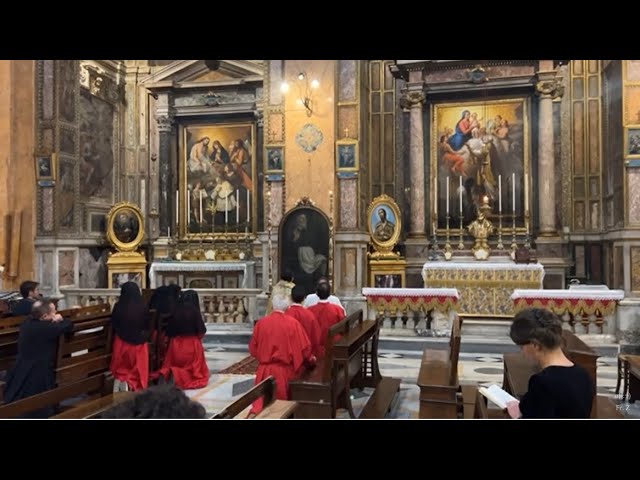
Today is the Feast of St. Giovanni Battista de Rossi, who was at Ss. Trinità dei Pellegrini in Rome (my adoptive parish). He was entombed beneath the altar of one of the side chapels for a long time, until a church was built on the periphery of Rome. His body was translated. However, the side chapel and tomb are still sacred and relics, by the fact that the saints body was there.

Thanks to PS for the donation via Zelle.  Zelle doesn’t provide any email contact for you, so… thanks!

Welcome registrant:

Hickory Bow

Please remember me when shopping online and use my affiliate links.  US HERE – UK HERE  WHY?  This helps to pay for health insurance (massively hiked for this new year of surprises), utilities, groceries, etc..  At no extra cost, you provide help for which I am grateful.

White to move and mate in 2.  There’s more than one way to skin the black king.

NB: I’ll hold comments with solutions ’till the next day so there won’t be “spoilers” for others.

Posted in SESSIUNCULA |
1 Comment

23-25 May – Triduum for the Feast of St. Philip Neri – Litany and Prayer of Card. Baronio

At my adoptive parish in Rome, where St. Philip Neri estabished the historically important Archconfraternity of the Pilgrims and Convalescents, it is time for the Triduum before the Saint’s feast day, 26 May. Therefore, the Litany of St. Philip is sung and the prayer penned by Card. Baronio is recited.SS

If you want to follow along and participate at a distance, use the booklet in this zip file. HERE

YouTube thumbnailYouTube icon

Posted in Saints: Stories & Symbols, SESSIUNCULA | Tagged
Comments Off on 23-25 May – Triduum for the Feast of St. Philip Neri – Litany and Prayer of Card. Baronio

Pentecost Wednesday: Peter’s shadow

Pentecost Wednesday: Ember Day

Another Octave ramble which might have a couple of surprises.

Back in the day, 5th c or so, Pentecost was enriched with an Octave, thus extending the festal character of the great feast. For a while they were bumped.

In the 11th c. St. Pope Gregory VII, Hildebrand*, reinstated them while keeping the festive tone of the Octave.

If the Octave of Pentecost can be abolished for the Novus Ordo calendar, it can be reinstated, just as John Paul II reinstated “Prayers over the people” during Lent.

If the Ember Days can be de facto suppressed through lack of interest and ignorance, they can be reinstated through education and pursuit.

Oh Lord, please send us another Hildebrand?

Consider what Gregory VII’s approach to “Eucharistic consistency” (or is it “Eucharistic coherence”…)  might be.

Consider what Gregory VII would do about prelates who waffle on morals, who do nothing about schlock worship, etc.

Today’s Roman Station is St. Mary Major, the place traditionally for scrutinies of candidates for ordination.  Ember Saturdays were traditionally days for ordinations.

If I had my way, we would call some back for scrutinies!  In my day in Rome, before ordination to the diaconate and to the priesthood we had pretty thorough “scrutinies”.  We went around a big room from table to where there was a priest scrutineer who would interrogate us about the material of which he was an expert.  These guys were usually professors from the Pontifical Universities.

Because this is an Ember Day, we have, first, two readings from Acts 2 and Acts 5, with a “Flectamus genua” for good measure, and then a Gospel pericope from the Bread of Life discourse in John 6.

Acts 2 relates the descent of the Holy Spirit and then Peter’s preaching with the conversion of many. Peter talks about the wonders people will see.

Acts 5 opens with the sad case of Ananias and Sapphira. Later the Apostles are imprisoned, but angels let them out. When the big shots started to freak out, Gamaliel counseled patience to see if what the Apostles were doing was from God. In this reading, the Apostles work many signs, many cures. Even Peter’s shadow cured. Many believed.

A few points spring to mind, in no special order.

First, Gamaliel counseled patience.  If what the Apostles were doing was from God, it would endure and produce good things.  If it was not, that would become clear.

Would that today our Whatevers High Atop The Thing would have even a hair’s breadth of such wise patience when it comes to something that really doesn’t need to prove itself because it already had a track record of centuries.

The Vetus Ordo has a track record and the Novus Ordo does not.  Rather, the Novus Ordo’s incipient track record isn’t that impressive.

Ratzinger said, way back in the day, and I’ve been saying this for decades, that the two rites (that’s what they are, let’s not kid ourselves) should be freely offered in the best way, most faithful way possible, side by side.  People will show us the way forward.

But … progressivists, you see, the catholic Left, liberals (from the Latin “free”, meaning for a liberal you are only “free” to agree with liberals), are afraid of freedom when it comes to that which stands as a bulwark against erosion of doctrine and – wait for it – morals.  There is nothing to fear from the Vetus Ordo and the people who want it, unless, that is, you fear large, happy, devout families with many children who participate in the life of the Church, which they love.

Second, Peter’s shadow healed.   This struck me as I said Mass in the presence of relics.

The association with holiness, and with the mediated power of Christ, is so mighty that it can effect miracles of healing.  A part of a saint’s body or a possession that was a often used and decorous (such as clothing, a writing pen, a holy image or book, a rosary or chalice), and appropriate object which come into contact with them, are considered relics.  Miracles can be effected through them.  Peter’s shadow healed!

The power of mediation should ever be in our minds.  John was the voice and Christ the Word.  “He who hears you hears me”.  “Whose sins you forgive, they are forgiven…”.  The priest says, in persons Christi, “This is my Body…”.

Next, Peter’s shadow healed because of his association with and commissioning by the Lord, Light from Light.  It is vitally – in the literal sense of that word – important to stay close to the Light source.   Holy Church is a Light house for us, as well as the Barque it directs.  The farther we get from the light source, the weaker it gets and and fuzzier the shadow or beam.  TRADITION keeps us close to the light source.   Hence, Tradidi quod et accepi. 

To attack Tradition is to attack Christ and His Church.  It is suicidal to attack within the Church those who are attracted to Church’s Tradition.

In addition, the Mass texts today shift to different themes. Pentecost and Monday and Tuesday (before Ember Days) all contained protection from harm by the enemy.

Something about the Descent of the Spirit has always twitched at my mind. Acts 2:1 says “they were all together in one place”. But there were quite a few believers at the time, at least 120. All in one place? The upper room wasn’t big enough. BUT… this is the Feast of Weeks, Shavuot!

They were not in the Upper Room.  They were in the TEMPLE.

Males were to go to the Temple for the Shavuot – Pentecost – spring harvest festival celebration involving the wave offerings in the Temple of the harvest fruits, loaves baked from the first sheaves.  The Temple was certainly “big enough” for all the disciples.  And that is where they were!   Acts 2:2 says a wind came (the Holy Spirit) and “filled the house”, Greek oikos. Oikos can be house, of course, but it can also mean any building, including the Temple, the house of God (Matthew 21:13; Mark 11:17; Luke 19:46; John 2:16f, (Isaiah 56:5, 7); cf. Luke 11:51; Acts 7:47, 49).

Remember what we read at the end of Luke 24:50-53 and the account of the Ascension of the Lord?

Then [Jesus] led them out as far as Bethany, and lifting up his hands he blessed them. While he blessed them, he parted from them, and was carried up into heaven. And they returned to Jerusalem with great joy, and were continually in the temple blessing God.

They were continually in the Temple. Why? Among other reasons, Shavuot. When Acts says they were in the “house”, they were in the Temple.  Jewish festivals looked back to historical events and they looked forward to something yet to be fulfilled.  Shavuot looked back to the descent of God on the mountain in the fiery presence cloud, shekinah, when God gave the Decalogue, the Ten Commandments.  Shavuot looked forward to the return of the fiery “presence cloud” to the Temple which had departed with the destruction of the first Temple.  That’s Pentecost: Shavuot fulfilled.  The first fruits this time being the 3000 baptized.

What happens after the mighty wind and tongues of fire? A huge crowd hears Peter’s sermon. Where was that? In the Temple. When did it take place? At 9:00 in the morning. Remember the line about drunkenness?

This was the 3rd hour of the morning and the time of the tamid, the sacrifice of the first of the two daily lambs.

To baptize all those people they would have needed a place with a lot of water. There was such a place nearby, pools for ritual cleansing before going to the Temple.

I am reminded of Ezekiel 6:26:

“A new heart I will give you, and a new spirit I will put within you; and I will take out of your flesh the heart of stone and give you a heart of flesh.”

A new SPIRIT I will put within you. I will take away this TEMPLE of STONE and give you a TEMPLE of FLESH.

This took place in the Temple which lost the glory cloud of fire of the presence of God. The presence of God as fire returns and settles not in the Holy Holies where the Ark was, but rather on the New Ark, Mary and on the Apostles and, through baptism in the hearts of the new believers, new Temples of the Holy Spirit.

In the Introit of today’s Mass we pray: “O God, when You went forth at the head of Your people, making a passage for them, dwelling in their midst…” A reference to the fire cloud that led the people.

In the Collect we pray something that echoes that image of the guiding freedom-bringing fire: “May the Paraclete Who proceeds from You, enlighten our minds, we beseech You, O Lord, and guide us to all truth, as Your Son has promised.”

In the Second Collect, remember it is an Ember Day with two first readings, we get this. See if it doesn’t bind together my thoughts, above:

Grant, we beseech You, almighty and most merciful God, that the Holy Spirit may come to dwell in us, graciously making us a temple of His glory.


*Coincidently, today, 22 May, is the same day in 1073 when Gregory, who was Rome’s archdeacon at the time he was proclaimed Pope first by popular acclaim and then due election, was ordained to the priesthood.  In that year 22 May was the feast of Pentecost.

Posted in SESSIUNCULA |
4 Comments

Daily Rome Shot 1027

Please remember me when shopping online and use my affiliate links.  US HERE – UK HERE  WHY?  This helps to pay for health insurance (massively hiked for this new year of surprises), utilities, groceries, etc..  At no extra cost, you provide help for which I am grateful.

BIG discounts now

Thanks to ML, JFH, and MT for switching from PayPal to Zelle for donations.

Welcome new registrant:

Haynahninahni

In chessy news… not much.  Our OTB club played against another town’s OTB club yesterday.  We won, by two matches. I lost to a very strong player and fought my way back from a losing position for a draw.

Click and join!

At chess.com I read that for “Titled Tuesday” (a weekly online tournament including only players with titles like International Master, Grand Master, etc.) Faustino Oro with 9.5 outperformed world #1 Magnus Carlsen, #2 Fabiano Caruana and #3 Hikaru Nakamura who all had 9.0.  Faustino is 10 years old.

White to move and mate in 2.

NB: I’ll hold comments with solutions ’till the next day so there won’t be “spoilers” for others.

Priestly chess players, drop me a line. HERE

Support the sisters!  Get stuff!

Do yourself a favor.

Posted in SESSIUNCULA | Tagged
2 Comments

Pentecost Tuesday

Tuesday in the Octave of Pentecost.   Another little ramble.

The Octave has Roman Stations. As the last two days honored St. Peter at churches bearing his name, one would expect now that St. Paul, the Apostle to the Gentiles should be acknowledged with a trip to St. Paul’s outside the walls. However, because – as I can attest at the very moment I am writing this – it is blazing hot in the sun at this time of year – the Station was fixed at the important St. Anastasia, a church of the imperial court in the Greek and Byzantine section of the City near the markets and below the Palatine Hill.

The Octave was developed in Rome when there was strong Greek, Byzantine presence. So, it makes a measure of sense that the Introit would be from a Greek apocryphal book 4 Esdras.

In Acts 8 we read that Saul was still ravaging the Church, even going house to house and dragging people off to prison. Deacon Philip, in Samaria, was preaching and exorcizing and healing: remember that curing illness went hand in hand with exorcism. Philip baptized, but it was necessary for Apostles, Peter and John, to come to confer the Holy Spirit.

This is when a certain Simon tried to buy the power to confer the Holy Spirit, thus giving rise to the term “simony” for the selling and buying of spiritual goods. Then in Acts 8 Deacon Philip gets a directive from an angel to go find the Ethiopian Eunuch, thus giving rise to the great image found in the traditional blessing of vehicles. Thereafter, Philip gets whipped away by the angel to Azotus, bringing chapter 8 to a close.

Notice that yesterday Mass ended with a prayer for protection against the fury of enemies. The chapter of Acts we hear from today doesn’t begin with the first verses, but people knew their Scripture well. They knew what was going on in Acts 8 and that Saul was ravaging the Church.

We just learned that Nigeria Muslim terrorists killed over 50 people in an attack on a church during Mass on Pentecost Sunday.

As bad as that is, what is worse is the active erosion by priests and bishops of the church in the belief and practice of sound Christian morals on the part of their flocks. It is one thing to slay the body. It is another to endanger the soul.

Good shepherds?

Curiously, there is a good shepherd parable in the Gospel. In the traditional lectionary for Mass, there are various “Shepherd Masses”, as it were, and they pop up around the beginning of new seasons, for example, Monday after the 1st Sunday of Lent, Second Sunday after Easter, third Sunday after Pentecost. The Gospel today is from John 10.

Our Lord says today, ““Truly, truly, I say to you, he who does not enter the sheepfold by the door but climbs in by another way, that man is a thief and a robber;…”

I can’t help but think that those who put together the ancient Lectionary (0f the Vetus Ordo Mass) knew the context of Acts 8 and Simon and his “simony”. The Gospel concludes with the ominous: “The thief comes only to steal and kill and destroy; I came that they may have life, and have it abundantly.”

Again, the emphases on an enemy at this happy time of the Octave.

The Collect today:

Adsit nobis, qu?sumus, Dómine, virtus Spíritus Sancti: quæ et corda nostra cleménter expúrget, et ab ómnibus tueátur advérsis.

Let the power of the Holy Spirit be present within us, O Lord: that It may graciously cleanse our hearts and guard us from all adversaries.

Guard us.

That’s what a good shepherd does. A good shepherd protects the sheepfold, gives them good water, good pasturing for nourishment.

Before Christ ascended He said He would send not just an advocate, a parakletos, but another parakletos. A parakletos is someone who stands by you, protects you under fire, counsels and guides, in fact shepherds you through perils. Christ is the 1st parakletos and the Holy Spirit is 2nd, showing how the work of the Trinity is present in each of the Persons, though for our understanding it is “teased out”.

Pray for an abundant outpouring of the parakletos on your priests and bishops, perhaps even to covert the hearts and illumine their minds so that they leave their enervating appearance of action in the Church and move to concrete work consonant with the Tradition handed down to us by true men of action in our forebears.   Pray for a softening of the rigidity of hatred for the ways of our forefathers especially in liturgical practice.

Posted in SESSIUNCULA |
3 Comments

Daily Rome Shot 1026

Once in the thousands, there are still some 500 “maddonelle” in the City.

Please remember me when shopping online and use my affiliate links.  US HERE – UK HERE  WHY?  This helps to pay for health insurance (massively hiked for this new year of surprises), utilities, groceries, etc..  At no extra cost, you provide help for which I am grateful.

I played OTB in a rather informal tournament against another club. Our club won, in spite of my best efforts. Brief bragging rights, I guess. We will have to travel to them next time.

Meanwhile, white to play. Mate in 2.

NB: I’ll hold comments with solutions ’till the next day so there won’t be “spoilers” for others.

Priestly chess players, drop me a line. HERE

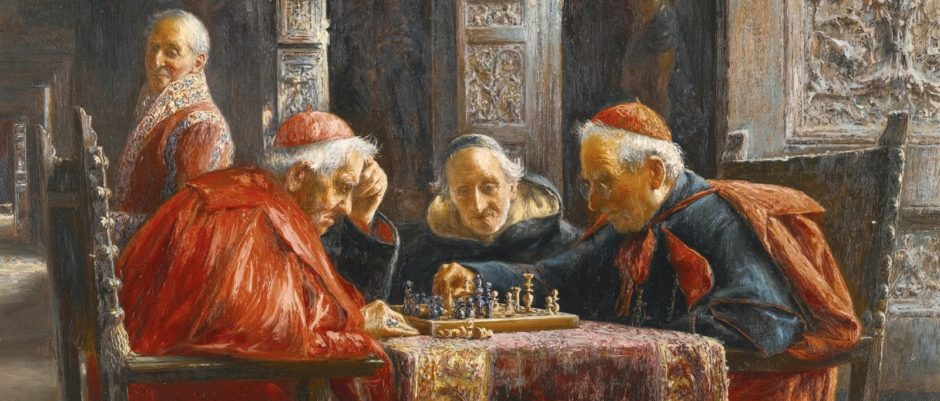
In chessy news, you may have heard of chess boxing (a round of boxing and then chess between rounds). Now there is chess bull riding. Chess bull riding is not bullet with trash talk. Well… there isn’t actually chess bull riding yet, but there ought to be. It seems that in a recent publicity spot, a couple of bull rivals were shown playing chess.

I don’t know how it would be possible to combine rodeo and chess, but I’d watch. I have loved rodeo since I was a little shaver.

These cowboys are on chess.com, it seems.   So am I and so should you be!    Use my link.

Posted in SESSIUNCULA |
1 Comment

Pentecost Monday – several reasons to weep


Let’s have a look at the Collect for today’s Mass of Pentecost Monday.

COLLECT (1962MR):
Deus, qui Apostolis tuis
Sanctum dedisti Spiritum:
concede plebi tuae piae petitionis effectum;
ut, quibus dedisti fidem, largiaris et pacem
.

I found this prayer in the 8th c. Liber sacramentorum Gellonensis.

I like that elegant splitting of Spiritum Sanctum with dedisti.

Our trusty Lewis & Short reminds us that effectus, us, (efficio) means basically “a doing, effecting; execution, accomplishment, performance; with reference to the result of an action, an operation, effect, tendency, purpose”.  Blaise & Dumas offers that effectus has to do with the “realization of a prayer”.

LITERAL VERSION:
O God, who gave the Holy Spirit to Your Apostles,
grant to Your people the realization of their dutiful petition,
that you may bestow also peace
upon those whom you have given faith
.

What immediately jumps into my mind are the references to peace in the ordinary of the Mass and also in the moderm form for sacramental absolution.

Allow me to stretch to a connection, in view of the Roman Station.

Christ is our Lord and Liberator.  After His Ascension he sent our Counselor and Comforter.

Together, under the eternal aegis of the Father, the Son and the Spirit bring us from bondage to freedom, anxiety to peace.  We need not fear our judgment.

This is accomplished through the ministry and mediation of the Church.

As a People who are members of Christ’s Body the Church we approach God’s mercy with a sense of filial duty, petitioning both the immediate effect of Christ’s merits and also the long-term effect of heavenly peace.

In the words of the Church’s worship, Christ Himself strikes from our limbs the heavy chains of our oppression.

This is true “liberation theology”.  This is a cause of tears of joy.

Meanwhile, for another kind of tears, in the Novus Ordo today it is back to green.  No Octave of Pentecost. 

You know the now infamous story of Paul VI, which a friend of mine dubbed the

Feast of the Lacrimation of Paul VI.   

I wrote about it many times.  One example: HERE

That story has made the rounds, with embellishments.  I’m the source of that anecdote, recounted to me in Rome many years ago by a former papal MC, whose word I have no reason to doubt.

For more on those dark years…

For more on that era check these PODCAzTs:

093 09-11-16 40 years ago… Paul VI on the eve of the Novus Ordo
094 09-11-20 40 years ago… Paul VI on the eve of the Novus Ordo (Part II)
095 09-11-24 40 years ago… Paul VI on the eve of the Novus Ordo (Part III)

Here’s another reason to weep. 

There today in the Novus Ordo an optional Memorial of Mary, Mother of the Church.  Here is what we find at the at Vatican News for Pentecost Monday.  You can’t make this up.

Art by RUPNIK?

Posted in SESSIUNCULA |
2 Comments

CHARTRES PILGRIMAGE: Video stream of closing Mass on Pentecost Monday 2024

The Great Roman™ sent a shot…

I tuned into the live stream of the Mass and saw that one of the priests of the FSSP parish (my adoptive parish) in Rome is the deacon of the Mass.

Here is the video… still live as I write:

YouTube thumbnailYouTube icon

Posted in Just Too Cool | Tagged ,
4 Comments

Daily Rome Shot 1025: Symmetry and thanks

This image, friends, warms my beady black heart.

These are the vestments which some of YOU readers commissioned for Ss. Trinità in Rome.

All set up and ready for the priests in the mornings of the Octave of Pentecost.

Thank you again to

TP, MR, SS, KA, ML, AT

I hope for action shots, with the altars full.

Through May 27, save up to 25% see more below

In chessy news, Magnus Carlsen emerged victorious at Casablanca Chess 2024 with Hikaru Nakamura, followed by former champ Viswanathan Anand and Bassem Amin.  In other news, water is still wet.  The format was interesting.  It wasn’t interesting enough to hold my attention for more than a couple games in each day, not because the idea of the tournament wasn’t interesting, but mainly because one of the commentators was wasn’t interesting. Danya Naroditsky was the strong member of the team, with some humor and anecdotes and something in the voice which implied that he cared.  The highly talented Jan Gustafsson was as laconic and mellow as Tania Sachdev is verbose and irritating. Mind you, this has nothing to do with their chess knowledge! It’s their delivery. If those who produce these streams to entertain fans… and that’s their goal… they should take that into account. This new event needed an A team.

Please remember me when shopping online and use my affiliate links.  US HERE – UK HERE  WHY?  This helps to pay for health insurance (massively hiked for this new year of surprises), utilities, groceries, etc..  At no extra cost, you provide help for which I am grateful.

Meanwhile, white to move and mate in 2.

NB: I’ll hold comments with solutions ’till the next day so there won’t be “spoilers” for others.

With Memorial day a week away, to quote James Taylor, “summer’s here… I’ve got my cold beer…”. I recommend the beer from the monks of Norcia only a little chilled, not super cold like American beer (too cold… and you can’t taste it… which might be the point). Norcia beer, three kinds, is spectacular.

Meanwhile, I am preparing for an informal tournament between clubs from neighboring towns.  What to do?

Posted in SESSIUNCULA |
Comments Off on Daily Rome Shot 1025: Symmetry and thanks