Your Sunday Sermon Notes – Easter Sunday 2024

It is EASTER Sunday and the beginning of Paschaltide.

Was there a GOOD point made in the sermon you heard at your Sunday Mass of obligation?  Did you go to liturgies of the Triduum?

Did you GO TO CONFESSION?

Tell about attendance especially for the Traditional Latin Mass. I hear that it is growing. Of COURSE.

Any local changes or (hopefully good) news?

Here’s a taste of my longer thoughts over at the other place HERE

Posted in SESSIUNCULA | Tagged
17 Comments

Lighter Fare for the Easter Vigil

This just in…. cut from the Vatican video feed…

Another angle, from Eduard Habsburg’s twitter

I can’t decide.

Either the Borg have arrived or we have proof that the Vatican finally has an Amazon Prime account.

UPDATE… okay…

Posted in Lighter fare | Tagged
18 Comments

ROME 24/3– Day 10: Holy Saturday and the Harrowing of Hell

Sunrise, when? 05:54

Sunset, when? 19:36

Ave Maria? 19:00

Quiet day, as befitting Holy Saturday.  All is quiet in the Church as Christ’s soon to be reclaimed Body is in the tomb while His human fused divinity harrows Hell.

HEY! a*****.w****@erickson.com My email to you got kicked back!

Starting with some citations in the New Testament we started to pry open what came to be known as the “harrowing” or “raid” of hell, what Christ did between His death on the Cross and His resurrection.

Originally, the English word “harrow” has to do with preparing ground for tilling.  “Harrowing” involved drawing a kind of grate with downward spikes over the ground to break it up.    Here’s an image from a 16th c Book of Hours:

After the Council Trent was closed, the Roman Catechism was issued in 1566.  It was intended especially to shore up the fundamental doctrine of the clergy and be an aid for pastoral preaching.  I take my title for the columns I post at One Peter Five from Trent, which says that sermons should be giving “at least on Sundays”.  The Catechism explains with characteristic clarity the articles of the Apostle’s Creed and therefore what the “harrowing of hell” was and why Christ did it.  The Roman Catechism states that after His death Christ’s soul, in no way diminished, descended into hell in solidarity with man not to suffer, but to “liberate the holy and the just from their painful captivity, and to impart to them the fruit of His Passion.”  The Catechism then says, “Having explained these things, the pastor should next proceed to teach that …”, and here let me fulfill the Catechism’s directive,

Christ the Lord descended into hell, in order that having despoiled the demons, He might liberate from prison those holy Fathers and the other just souls, and might bring them into heaven with Himself. This He accomplished in an admirable and most glorious manner; for His august presence at once shed a celestial lustre upon the captives and filled them with inconceivable joy and delight. He also imparted to them that supreme happiness which consists in the vision of God, thus verifying His promise to the thief on the cross: This day thou shalt be with me in paradise.  […]  But the better to understand the efficacy of this mystery we should frequently call to mind that not only the just who were born after the coming of our Lord, but also those who preceded Him from the days of Adam, or who shall be born until the end of time, obtain their salvation through the benefit of His Passion. Wherefore before His death and Resurrection heaven was closed against every child of Adam. The souls of the just, on their departure from this life, were either borne to the bosom of Abraham; or, as is still the case with those who have something to be washed away or satisfied for, were purified in the fire of purgatory.

That sure reference work for the Catholic faith issued in 1997 in the Latin typical edition (1994 in French), the Catechism of the Catholic Church, covers this article of the Creed in par. 632ff.  The first meaning applied to this phrase was that “Jesus, like all men, experienced death and in his soul joined the others in the realm of the dead. But he descended there as Savior, proclaiming the Good News to the spirits imprisoned there” (632).  The place Christ went, the abode of the dead, biblical sheol, is where the none of the dead can see God, regardless of their wickedness or righteousness. Christ descended into sheol to liberate the righteous dead, not the damned.   Thus, the “the Author of life”, by dying destroyed “him who has the power of death, that is, the devil” (635).  Furthermore, as we read in an ancient Holy Saturday sermon in Greek (included in the Office of Readings of the Liturgy of the Hours),

He has gone to search for Adam, our first father, as for a lost sheep. Greatly desiring to visit those who live in darkness and in the shadow of death, He has gone to free from sorrow Adam in his bonds and Eve, captive with him – He who is both their God and the son of Eve.

This article of the Creed underscores Christ as the Second Adam, making right the damage worked by the First Adam in the original sin of our first parents.

It may be that element of ancient mythologies influenced the telling of this doctrine of the Apostolic Church.  Down through the centuries this idea of the “harrowing of hell” fueled the imagination of Christians and their theological reflection resulting in apocryphal “gospel” accounts, medieval mystery plays, and works of art such as Eastern icons.  There is something paradoxical in the core of the doctrine, namely, that our God, in an indestructible bond with our humanity, might go to hell, even if for a brief and specific mission.

In early Christian apocrypha, such as the Greek fourth century Acts of Pilate or the Latin medieval Gospel of Nicodemus there were imagined dialogues between the King of Glory, Christ, and the Prince of Hades, Satan.  In the medieval period, particularly from 13-16th  century England, there were performances of mystery plays, including of course the dramatic “harrowing of hell”.   Mystery plays were an important force in the revival of modern theatre.  The 13th century Aurea Legenda or Golden Legend compiled by Jacob de Voragine (+1298) includes the tale.   Dante in the Divine Comedy has Virgil give the poet an eyewitness account (Inf 4,52-63).

In Eastern iconic depictions of the mystery, you see the risen Lord in luminous garb, carrying a Cross, trampling broken doors.  He extends His hand, sometimes to an old man, Adam, or to others below in a cave or tomb-like grotto.  Sometimes we see Dismas, the Good Thief, to whom Christ promised salvation that very day as they were crucified together.  In renaissance frescoes and paintings the same themes continue, but often with the dramatic addition of irritated devil onlookers, probably echoes in paint of the mystery plays common to the era.

Through the ages up to our own day in the Easter vigil liturgy in the Eastern Churches, Catholic and Orthodox, a sermon known simply as “The Easter Sermon” attributed to St. john Chrysostom (+407) is read, often with dialogue-like participation of the congregation (not “assembly”).  Here is an excerpt:

Let no one fear death, for the Death of our Savior has set us free.
He has destroyed it by enduring it
He destroyed Hades when He descended into it
He put it into an uproar even as it tasted of His flesh
Isaiah foretold this when he said
“You, O Hell, have been troubled by encountering Him below.
Hell was in an uproar because it was done away with
It was in an uproar because it is mocked.
It was in an uproar, for it is destroyed
It is in an uproar, for it is annihilated
It is in an uproar, for it is now made captive.
Hell took a body, and discovered God.
It took earth, and encountered Heaven.
It took what it saw, and was overcome by what it did not see.
O death, where is thy sting?
O Hades, where is thy victory?

The “harrowing of hell”, however it took place and however it may be depicted, is an doctrine of faith to which as Christians we give assent.  The central point of this article of the Creed is that the Christ in His atoning Sacrifice has free us from the eternal bonds of death in sin, liberated us from the fear of unavoidable everlasting separation from God.

Whether in our recitation of the Holy Rosary or during Holy Mass, every time you say “he descended to the dead” and in the newer version is “he descended into hell”, do so with hope in your heart and firm belief that Christ’s Sacrifice freed you from the inevitability of hell.

Alas this photo didn’t go so well since it focused on the screen.  However, these were about to become lunch.

Fit for a Holy Saturday.

The priests are ready for Good Friday.  So… I’m out of synch a little.  I’ve been busy.

Posted in SESSIUNCULA |
1 Comment

ROME 24/3– Day 9: Good Friday

On this Good Friday the sun arose at 5:55 and it will set at 19:35.

The Ave Maria bell is in its 19:00 phase.

There are 279 days left in the year.

The Roman Station is Santa Croce in Gerusalemme.

WELCOME REGISTRANT:
SconsinPatriot

ALERT: “Rita”, who sent a donation.  I have no email for you so I can’t send a thank you note.  In case you are wondering.

On the way to church yesterday for the solemn rites yesterday evening there was a lovely light, so hard to capture, strangely diffused in the air.   Rome is like that.

After the Mass there was the procession with the Blessed Sacrament to the altar of repose.

We then sang Tenebrae.

Here is the altar of repose after Tenebrae from a couple of angles.

Quite a few people stayed.


Posted in SESSIUNCULA |
Comments Off on ROME 24/3– Day 9: Good Friday

Good Friday 3 April AD 33? – Eclipses as Christ died on the Cross

This is definitely worth reposting.

The fellow who made the video about the Star of Bethlehem (a compelling argument, I might add), also did some research about what happened in the heavens on Good Friday.

Let’s break it down.

Passover begins on the 14th day of the Jewish lunar month of Nisan. Moreover, Passover begins at twilight, dividing 14 Nisan and 15 Nissan. The Gospels say the Lord was crucified on Preparation Day, a Friday.  14 Nisan 14 fell on a Friday Preparation Day, twice: 7 April AD 30 and 3 April AD 33.  Daniel in 444 BC prophesied (Daniel 9:21–26) that the Anointed one would be cut off in 476 years after the decree to rebuild Jerusalem: AD 33.

The Bible records that, at the time of the crucifixion and death of the Lord, there were signs, including a “blood moon” or lunar eclipse.

Only one Passover lunar eclipse was visible from Jerusalem while Pilate was in office. It occurred on 3 April 33.

On 3 April the Moon rose already in eclipse.  It rose the color of blood.  That means that the eclipse began before it rose, in the constellation of the Virgin (at the time of Christ’s birth there was a New Moon, in the constellation of the Virgin).

The eclipse started at 3 pm when Christ was breathing His last.

But remember that a lunar eclipse is a syzygy!

If there is an eclipse in one direction there is an eclipse in the other direction too.

If you were standing on the Moon during that syzygy of 3 April 33, you would see a total eclipse of the Sun.

The blotted Sun would be in the heart of the constellation of the Ram (cf. “the Lamb who was slain”).

You can try this out for yourselves.  Go to the online astronomy aid Starry Night.  HERE

Move your location to Jerusalem and then plug in the time of about 7 pm and date 3 April 33 and adjust your view to ESE.  You will see the Moon has just risen and there is a label for your Earth’s shadow.  The Moon had risen at about 6:30 pm in the totality of the eclipse. HERE

15_04_03_eclipse_Crucifixion_01

Click

With the daylight turned off, and the horizon removed, and then looking at an angle down through the Earth below the horizon, at 3 pm, you see the Moon and Earth’s shadow converging in Virgo.

15_04_03_eclipse_Crucifixion_02

Then you can switch to the view from the Moon!

You must adjust your view a little and turn yourself right with a few clicks.  But you will find it.  In the screenshot, below, you can see where Earth and Sun are in Aries. Since the Earth would be larger in the Moon’s sky than in this screenshot, the Sun would be in total eclipse.  Adjust for UTC + 3 hours to the right time in Jerusalem from 1500 to 1800. HERE

15_04_03_eclipse_Crucifixion_03

Click

In reading around the question a little more, I find that, using different date calculators, there are some problems of the day of the week.  Also, there are arguments for dating the Crucifixion to 1 April 33.  If that is the case, then the phenomena described above occur on Easter Sunday.  Much hinges on which calendar the Lord and His disciples were using for their own Passover meal, if the last Supper was a Passover meal (Joseph Ratzinger argued that it was a related sacrificial meal but not a seder.)

[Subsequently, I’ve found more and convincing arguments about calendar debate.  This debate revolves around a seeming contradiction between John and the synoptics.  Some say that Christ anticipated a meal so that He would die at the same time as the paschal lambs.  That is attractive.  But it is also not true.  His Last Supper was indeed the supper of the Passover, with the paschal lamb. The argument hinges on the fact that it was not only Passover time (and all the days that followed were also called “Passover”, as we say “Happy Easter” for days after Easter), it was going to be the sabbath, and so, in the time of Passover, was the “day of Preparation of the Passover” was really preparation for SABBATH that fell in that Passover “umbra”, if you will permit the pun.]

Definitive?  Not quite.  But it is not to be discounted that God, from all Eternity knowing exactly what would happen, set the heaven’s in motion in so precise a way that its signs would help us to understand the mysteries taking place, which were in other ways foreshadowed.   In the sacraments (a term interchangeable with “mystery” in many contexts), visible signs help us to understand that insensible graces and transformations are taking place.  If in the signs of the sacraments, why not too signs in the heavens?

Posted in Classic Posts, Just Too Cool, Linking Back, Liturgy Science Theatre 3000, Look! Up in the sky! |
7 Comments

CRISIS: Trad “recovery” conference!

All eyes are turning to S. Montana – a beautiful area to be sure – where tens of people might attend a special conference for those recovering from being traditional.   The Trad Recovery conference is for people who had bad experiences and therefore need some… I dunno… bucking up and a place to vent.  There is on the slate at least one kooky speaker.  The others I haven’t heard of. I’m sure they are nice.

At Crisis Dr. Janet Smith reposts with another conference proposal: for people disillusioned by the Church since the 1960s.

Of course such a conference would, as she observes, need a large sports stadium (or two) instead of a miniscule church in the middle of nowhere although a beautiful area to be sure.

Dr. Smith’s piece is funny.  She really takes the mickey out of the other thing.   She lists here own topics and break out sessions for those hurt by the modernist Church.

UPDATE:

As I think about this… only because comments prompt me, otherwise it is sort of forgettable… wouldn’t it be great if several hundred “glad-trads” signed up and attended? Just to add some cordial balance to the proceedings?

UPDATE:

From college students…

Posted in Lighter fare, Our Catholic Identity | Tagged
18 Comments

ROME 24/3– Day 8: Holy Thursday

Rome expected the sun to rise. This won’t always be the case. However, it did today at 05:57. Similar expectations await its setting at 19:34.

The cycle of the Ave Maria bell changes today to 19:00. It hops by quarter hours. However, sadly, no Ave Maria bell will sound where it is supposed to sound. It does at The Parish™.

The Roman Station for the Chrism Mass and for the Mass of the Last Supper is St John Lateran.  But, that’s not gonna happen, is it.   As I write this, the Chrism Mass is going on in San Pietro.  I tuned in for a moment.  The camera panned over the concelebrating priests in their infinite variety of street clothes sticking out over their chasubles and velcro closure albs with myriad meaningful stoles. The Mass vestments for the upper crust are 70’s Pedestrian Modern.  Think big, random chunks of colored glass in church windows, only without a lot of color.  They say: Nothing special here.   I understand that Francis read a sermon of over 2000 words.

That said, here is what the Ave Regina caelorum sounded like at the end of Palm Sunday’s Mass.

Last night before Tenebrae began, we had a good attendance, which increased as it went on.

Getting read for the Mandatum on Thursday evening in the sacristy.  Members of the Archconfraternity will have their feet washed.   There is a custom of drawing a coin from a bag.  The one who draws the different coin is cheerfully designated as “Judas” for the coming year.

The altar of repose reposes, awaiting its duties after the Mass of the Last Supper.

Something I saw on the way to lunch with priests for Holy Thursday.

Across the way is this madonella with St. Cajetan, founder of the Theatines.   The once mighty Theatines are now, alas, no longer heavy on the earth.

The magnificent lantern of Sant’Ivo.

Please remember me when shopping online and use my affiliate links.  US HERE – UK HERE  WHY?  This helps to pay for health insurance (massively hiked for this new year of surprises), utilities, groceries, etc..  At no extra cost, you provide help for which I am grateful. 

Meanwhile, white to move and mate in 2.  C’mon.  Everyone can get this one.

NB: I’ll hold comments with solutions ’till the next day so there won’t be “spoilers” for others.

 CLICK!

I am now a chess.com affiliate.   So, click and join!   Maybe we can build a fun and active Catholic Chess Club within Chess.com.

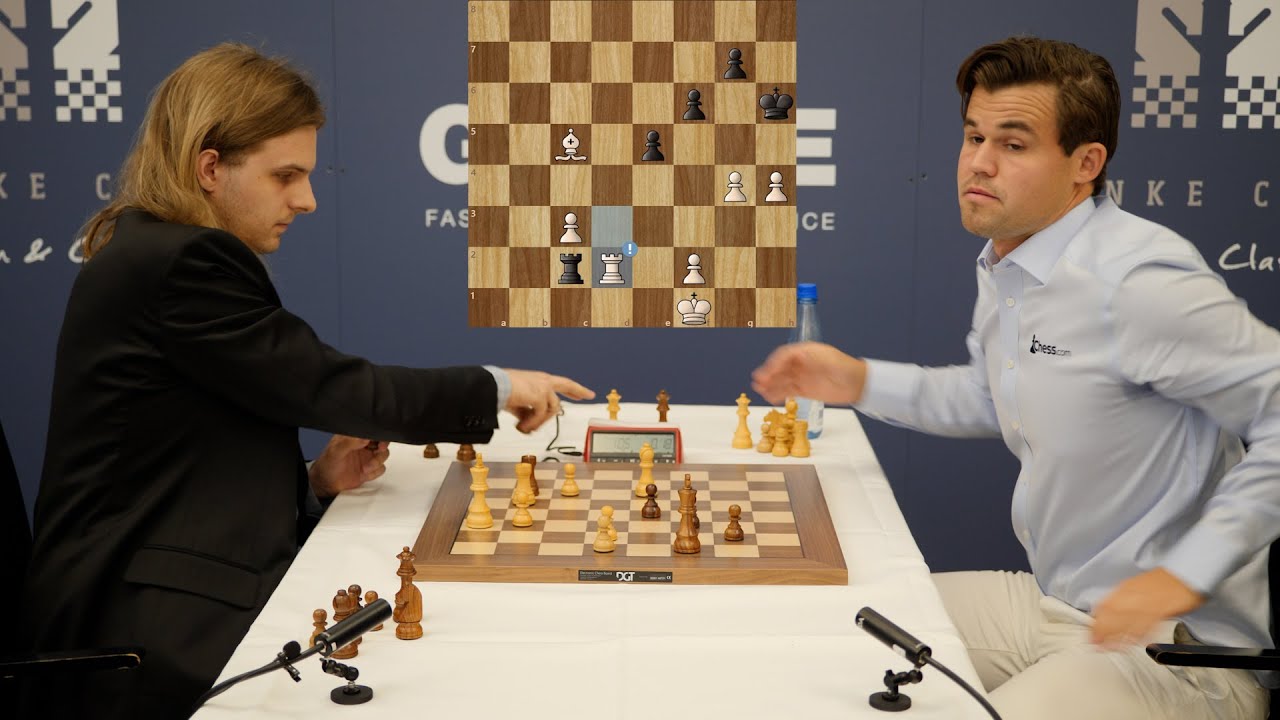
In chessy news, there is a tournament going on in Karlsruhe, Germany, the GRENKE Classic, which has been on hold for several years.  Richard Rapport is atop the standingswith a 1-point lead over Magnus Carlsen, Ding Liren and Vincent Keymer.   Yesterday Ding held with black against Magnus.

This is fun.  On chess.com’s “Bullet Brawl” 10-year-old FM Faustino Oro beat Magnus Carlsen.  This prompted waggish Anish Giri to tweet: “What’s all the hype, Carlsen would still probably beat him in a long classical chess match, especially if it’s 14 or 16 games.”

3:16 isn’t just in John.

UPDATE:

For lunch I was out to a nice place to eat with several priests, which itself was the main pleasure. Had we gone to stand around and eat slices of pizza, that would have been enough. It is such a pleasure to share their company.

I made lamb choices, due to the day.

Tagliolini with a ragu of lamb.

Then, more lamb with roasted potatoes.

Very nice.

Apartment flowers.

Posted in SESSIUNCULA |
2 Comments

WDTPRS – Spy Wednesday: The final prayers

Judas Vitrail_Cathédrale_de_MoulinsThe term “Spy” Wednesday is probably an allusion to Christ’s betrayal by Judas.

In the ancient Roman Church at the time of St. Pope Leo I, “the Great” (+461), there was no Mass during the day.  Instead, many of the feria days were without Mass.  There would be gatherings at “station” churches, however, where there would be vigils with preaching.  We have sermons of Leo the Great preached on several of these Wednesdays of the 6th Week, the day before the Triduum.   Mass would be offered at St. Mary Major in the evening, as if to entrust all that had been brought from Lent as well as everything upcoming to the Mother of God for its perfection.

This prayer was the Collect for this same day in the 1962 Missale Romanum. It was also in the ancient Gregorian Sacramentary in both the Hadrianum and Paduense manuscripts.

This is the final Collect before the Triduum.  It serves as a summation and a starting point.

COLLECT

Deus, qui pro nobis Filium tuum crucis patibulum subire voluisti, ut inimici a nobis expelleres potestatem, concede nobis famulis tuis, ut resurrectionis gratiam consequamur.

This is an austere prayer, a razor, cutting to the heart of the matter.

The impressive and informative Lewis & Short Dictionary informs us that patibulum (deriving from pateo, “to open, stretch out, extend”) is “a fork-shaped yoke, placed on the necks of criminals, and to which their hands were tied; also, a fork-shaped gibbet”. In turn, English “gibbet” means “an upright post with a projecting arm for hanging the bodies of executed criminals as a warning”.

The patibulum is “the stretcher”, and not in the carrying sense.

The verb subeo in its basic meaning is “to come or go under any thing” and by logical extension “to subject one’s self to, take upon one’s self an evil; to undergo, submit to, sustain, endure, suffer”. The L&S explains that “The figure taken from stooping under a load, under blows, etc.)” There are other shades of meaning, including “to come on secretly, to advance or approach stealthily, to steal upon, steal into”. Keep this one in mind.

Consequor is interesting. It signifies “to follow, follow up, press upon, go after, attend, accompany, pursue any person or thing” and then it extends to concepts like “to follow a model, copy, an authority, example, opinion, etc.; to imitate, adopt, obey, etc.” and “to reach, overtake, obtain”. Going beyond even these definitions, there is this: “to become like or equal to a person or thing in any property or quality, to attain, come up to, to equal (cf. adsequor).” I know, I know – mentio non fit expositio. Still it is helpful to make connections in the words, which often have subtle overlaps.

Remember that meaning of subeo, above?  There are shades of “pursuit” and “imitation” in the prayer’s vocabulary.

Finally, a gratia is a “favor” or “reward”, but we Christians hear in it God’s freely given gift to us which we don’t on our own merits deserve.

WDTPRS LITERAL TRANSLATION:

O God, who desired Your Son to undergo on our behalf the yoke of the Cross so that You might drive away from us the power of the enemy, grant to us Your servants, that we may attain the grace of the resurrection.

CURRENT ICEL:

O God, who willed your Son to submit for our sake
to the yoke of the Cross,
so that you might drive from us the power of the enemy,
grant us, your servants, to attain the grace of the resurrection
.

Judas TheLastSupperdetailBy our sins we are in the clutches of the enemy, who mercilessly attacks us.

Christ freed us from dire consequences of slavery to sin by His Passion.

The ancient Romans forced their conquered foes pass under a yoke (iugum), to show that they were now subjugated.

Their juridical status changed by that “going under”.

Christ went under the Cross in its carrying and then underwent the Cross in its hideous torments.

In his liberating act of salvation, we passed from the servitude of the enemy to the service of the Lord, not as slaves, but as members of a family.

We are not merely household servants (famuli), we are accorded the status of children of the master of the house, able to inherit what He already has.

So, there’s that Collect.

However, at the end of the ferial Masses during Lent and Passiontide we have also had a final final Collect in the guise of the Oratio super populum, the Prayer over the People.   This is the last oration of the Mass before the Triduum begins.  It lines up well with the Collect we looked at, above.

Réspice, quaésumus, Dómine, super hanc famíliam tuam, pro qua Dóminus noster Iesus Christus non dubitávit mánibus tradi nocéntium, et Crucis subíre torméntum:

Even more than the 2nd Collect from the Spy Wednesday Mass, above, this oration serves as a summing up of all of Passiontide as well as the stepping off point for the whole of the Triduum.  This oration will be repeated throughout the Triduum at the end of Tenebrae and in other moments such as in the much abbreviated, austere prayers at table for meals during the Triduum.

You already have the vocabulary notes for subeo, above.

Bl. Ildefonso Schuster writes of this terse prayer…

The Blessing over the people is so beautiful that the Church uses this collect during the three following days at the conclusion of each hour of the divine office: “Look down, we beseech thee, upon this thy family, for which our Lord Jesus Christ hesitated not to be delivered up into the hands of wicked men and to undergo the torment of the cross.” There is no better way of moving our heavenly Father to pity for us than by reminding him of the Passion of his only-begotten Son, and more especially of the immense love with which he loved us.
 

Posted in ADVENT, LENT |
2 Comments

ROME 24/3– Day 7: Oooops!

Sunrise: 05:59. Sunset: 19:33.

Ave Maria… still 18:45.  The 15 minute shift is coming up.

The Roman Station is Santa Maria Maggiore.

Welcome registrant:
Michael Joseph

Last night, the full Moon over the Campo de’ Fiori.  This is the full Moon after the Vernal Equinox.

A midday meal.  Bread, butter, anchovies.

Last night ossobuco at humble but reliably good place which hasn’t ever disappointed except when they are closed and I want to go there.

The altar of repose is ready.

Mass was celebrated for my monthly benefactors for whom I am so grateful.  I ask your prayers as well.

Please remember me when shopping online and use my affiliate links.  US HERE – UK HERE  WHY?  This helps to pay for health insurance (massively hiked for this new year of surprises), utilities, groceries, etc..  At no extra cost, you provide help for which I am grateful. 

There are slots available for the TLM pilgrimage in September if God wills (and few more sign ups).

Meanwhile, black to move and mate in 4.


1… Ng4+ 2. fxg4 Rf8+ 3. Ke3 Qf4+ 4. Kd3 Qd4#
NB: I’ll hold comments with solutions ’till the next day so there won’t be “spoilers” for others.

 CLICK!

I am now a chess.com affiliate.   So, click and join!   Maybe we can build a fun and active Catholic Chess Club within Chess.com.

In chessy news, there is a tournament going on in Karlsruhe, Germany, the GRENKE Classic, which has been on hold for several years.  It’s a double round-robin, with two rounds per day. Games are “fast-classical” time control, 45 minutes with a 10-second increment.  Yesterday, Magnus blundered against Richard Rapport, who then drew with Ding Liren.  Rapport is on top so far.

The oooops.

YouTube thumbnailYouTube icon


Posted in SESSIUNCULA |
3 Comments

ROME 24/3– Day 6: Quiet Day

Today sunrise was at 6:01. Sunset will occur at 19:32. Ave Maria 18:45 for a few more days.

The Roman Station is Santa Prisca on the Aventine Hill. Today in the Vetus Ordo we read the Passion according to Mark.

I’ve had a rather quiet day. I’ve been mostly at home, writing something for my weekly contribution at One Peter Five. Better to do it now than in the midst of the busy Triduum. Also, my right knee is killing me. This often happens in my first few days in Rome.  So, supper with friend tonight at a nearby solid place.

IVY REPORT: A couple days back I posted a shot of the ivy on the wall of the (pretty good) restaurant on the P.za della Quercia.  It’s coming in.

Not ivy at all, here’s a delightful little 1963 Fiat 500 Giannini.  The 1962 Missal was in force and things hadn’t gone totally nuts yet, but they were getting there.

Yesterday at the parish new members were inducted into the Archconfraternity of the Most Holy Trinity and the Pilgrims, including this time the first priest member in who know how many years who isn’t a member ex officio.  In the sacristy of the parish there are four large paintings showing the activities of the members, especially with St. Philip Neri the founder.  In this detail you see well the habit of the archconfraternity for lay members (right) and priests (left) which is a portrait of St. Joseph Calasanz, Universal Patron of all Christian popular schools in the world.

Membership in the Archconfraternity is open to practicing Catholics, lay men and women,  who are 18 years old, and in communion with the Roman Church. Residency in Rome is not required. Sponsorship by a current member is required.  Members enjoy also the indulgences granted to the Archconfraternity.  Requests for aggregation of a confraternity can be sent to the “mothership”.  Drop me a line.  NB: This is for already existing confraternities dedicated to the Trinity, the Blessed Sacrament, and works of mercy, not for individual membership.  That’s another thing.

Next…

“I know I can! I know I can!”.  On the way to the market for set up.

Thanks to readers, I have flowers.  A special shout to long-time reader Zephyrinus.

Meanwhile, black to move and mate in 3. Not all that hard. However, for bonus points, name the winning technique.

NB: I’ll hold comments with solutions ’till the next day so there won’t be “spoilers” for others.

CLICK!

I am now a chess.com affiliate.   So, click and join!   Maybe we can build a fun and active Catholic Chess Club within Chess.com.

In chessy news, Magnus said in a podcast that he thinks that either Fabiano Caruana or Hikaru Nakamura will win the upcoming Candidates tournament to challenge reigning Ding Liren for the title of World Champion.  Magnus is not playing. He also said, “I don’t particularly hope for anybody. I feel like anybody who is going to be classical world champion who is not me, is always going to be a bit weird.”

Sure will be.

Posted in SESSIUNCULA |
4 Comments