 “Days in Rome” Project – Easter 2024
The campaign is complete, but you can still donate anyway!
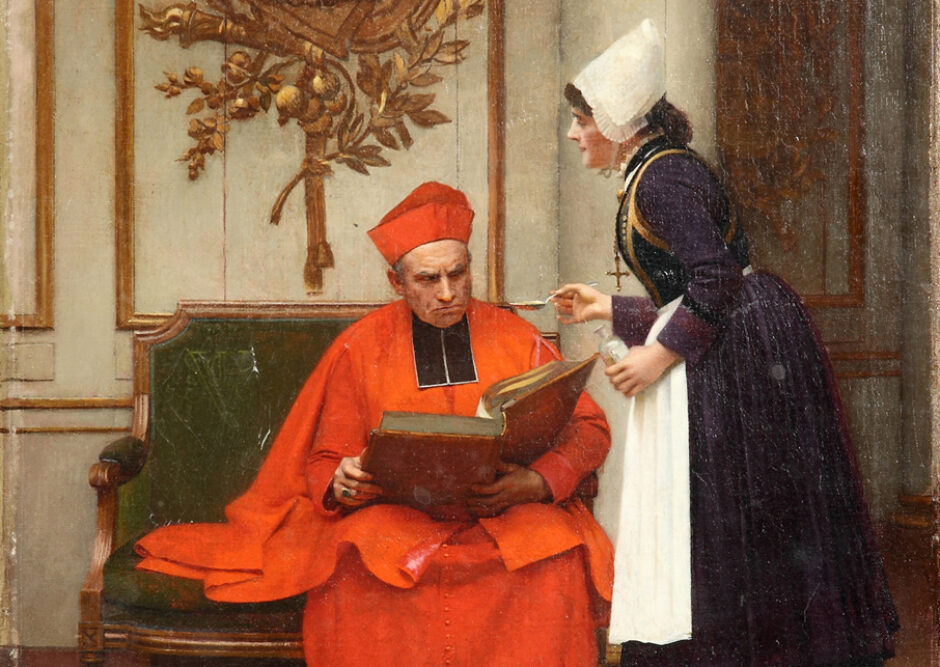
Too many people today are without good, strong preaching, to the detriment of all. Share the good stuff.
It is the 5th Sunday of Ordinary Time in the Novus Ordo and Sexagesima Sunday in the Vetus Ordo. The Roman Station is St. Paul’s outside-the-walls. We are back in purple for Sunday while the new-fangled Novus gets green.
We are now in pre-Lent. Those who attend the Vetus Ordo are never surprised by Lent.
Was there a GOOD point made in the sermon you heard at your Sunday Mass of obligation?
Tell about attendance especially for the Traditional Latin Mass. I hear that it is growing. Of COURSE.
Any local changes or (hopefully good) news?
I have a few thoughts about the orations in the Vetus Ordo for this Sunday: HERE
A taste:
Here Benedict refers to the reading of Scripture as an “art”, not just a method or a craft or a skill or a project. It needs the right “hermeneutic” or principle of interpretation, interpretive lens. In modern times, what came to be called a “hermeneutic of suspicion” developed in view of Scripture intended to challenge the plain reading of the texts, to force new interpretations to the fore. This pernicious approach resulted in someone, let’s say a Jesuit, reading the Bible and then spouting that what we read in Scripture about, let’s say homosexual acts, was wrong. Otherwise, there could be someone, let’s say, a German cardinal, who regarding Christ’s words about, let’s say marriage, concludes that if Christ wasn’t exactly wrong, He was right back then. This is now. Scripture has to be read differently, through the lens of our lived experience. Scripture means what it means and, surprise, it doesn’t mean what it means at the same time.
Please remember me when shopping online and use my affiliate links. US HERE – UK HERE WHY? This helps to pay for health insurance (massively hiked for this new year of surprises), utilities, groceries, etc.. At no extra cost, you provide help for which I am grateful.

Photo from The Great Roman™.
Welcome registrant:
Dr. M
At OTB yesterday I was awful. Simply awful. Also, Minnesota was robbed last night by the officials of two goals against Wisconsin. The video reviews were too iffy and the goals should have stood. So… not a great day from the sporting angle.
White to move and mate in two.

NB: I’ll hold comments with solutions ’till the next day so there won’t be “spoilers” for others.
Priestly chess players, drop me a line. HERE
Interested in learning? Try THIS.
If you have any kind of web presence, it’s time to consider
Really. Take a couple minutes to see what it is and consider what it means.
The traditional Benedictines of Le Barroux are making good wine from the ancient vineyards of the Avignon Popes. Help them by restocking your own supply.

 It’s 3 February 2024 and it is a Saturday. It’s the Feast of St. Blaise. Some time ago, I saw a movie called News of the World in which after the Civil War a former confederate officer ekes out a living wandering about reading newspaper stories from all over to people who pay a dime a head (which figures to about $2.50 now). The idea caught my imagination and here I am, a gazetteer. Gazette came into English through French but it’s origin is Italian, gazzetta, which is the name of the Venetian coin which paid for the first first Venetian newspapers in the 16th century.
Here is today’s audio “gazette” of Catholic and other things.
00:12 – Init –
1:15 – Catholic Trade Schools as an alternative
7:49 – Card. Burke’s sermon
15:00 – Feichtinger on Fiducia
26:21 – Kind gestures, unforeseen outcomes
32:05 – Sad news from Mars
29:50 – Exit
In the Bollettino today you will find a document, a “Note”, from the Dicastery for the Doctrine of the Faith … I’m still not used to that “dicastery” thing… why?… just, why? The Note concerns validity of the sacraments.
Before you panic, it doesn’t thrown matter and form out the door or say overly weird things (as it lately has done about blessings). In fact, it addresses the problem of priests throwing matter and form out the window in favor of their own creativity. It says that such changes “merita una pena esemplare… merits exemplary punishment” because doing so harms the faithful People of God.
Think about the harm a priest does over years of jacking around the form of baptism with his own amazing insights and alterations. Or a priest who so changes the form of absolution that he hasn’t validly absolved for who know how long.
I don’t think there is an English translation yet, but there will be very soon, I imagine.
Of course the document has a Latin name, “Gestis verbisque” but there is no Latin text in sight. Why? Just, why? Why can’t they get their act together and do this right, and in the right order? WHY?
I haven’t read the whole thing yet in Italian. A scan suggests that it isn’t dreadful. It’s longish and heavily footnoted.
Please remember me when shopping online and use my affiliate links. US HERE – UK HERE WHY? This helps to pay for health insurance (massively hiked for this new year of surprises), utilities, groceries, etc.. At no extra cost, you provide help for which I am grateful.

Hey! nick********@fuse.net – my thank you note was undeliverable. Change of email?
Meanwhile, white to move and mate in 2.


Click!
NB: I’ll hold comments with solutions ’till the next day so there won’t be “spoilers” for others.
Priestly chess players, drop me a line. HERE
Interested in learning? Try THIS.
Yesterday the Division I of the Chessable Masters continued. Alas, our guy Wesley So got knocked down to the lower bracket by Magnus. Unfortunately, he just ran out of time: there are different time controls – 10+2 instead of 15+3. Nepo went down, too. Today, Wesley (yay!) plays Puer (aka Alireza Firouzja). Nepomniachtchi let the Peruvian Jose Martinez checkmate him, which was a sportsmanlike gesture. Martinez will play young Denis “the Menace” Lazavik, who defeated Nakamura and Giri. In Division 2, Jeffrey Xiong beat Anish Giri and David Anton was bested by Levon Aronian. Division 3… big field, including Grischuk and Tabatabaei.
Today I have OTB. I feel a little sluggish today, so I don’t know what’s going to transpire.
Coffee is needed.
 Speaking of coffee… there’s a new one to try. I have a new coffee affiliate. I still have Mystic Monk, but after the hit job Voris did on them (and almost everyone else that wasn’t CM), people seem to have cooled toward them. I’ll still link to MM because they deserve a chance to keep building. I like monks who build stuff.
However here is another option that I’ll try for a while.
 I see that a few people bought some the other day. I look forward to your reviews. I have not tried it. They are sending me some, but it hasn’t yet arrived.
I’m negotiating right now with some folks who want to put some Catholic ads on the blog, over which I will have some control. I apologize in advance. It’s a little humiliating, but I need the income and, frankly, Catholic enterprises need the support. We can all benefit. Most of the things I push in these Rome Shot posts are favorite causes of mine. Some of the new ads will not be so well known by me, but the people organizing it are on our side. Let’s just say that the Fishwrap won’t be one of them.
Please remember me when shopping online and use my affiliate links. US HERE – UK HERE WHY? This helps to pay for health insurance (massively hiked for this new year of surprises), utilities, groceries, etc.. At no extra cost, you provide help for which I am grateful.

Simple Friday fare. The little clams are hard to get in these USA, but mussels are often pretty inexpensive, some squid, some shrimps, fresh herbs, tomatoes, good oil, garlic, a splash of white wine.
In chessy and churchy news, I saw that the 2024 45th Chess Olympiad will be in Budapest 10-23 September. I will be finishing up (if all goes well) with a traditional Mass pilgrimage in Poland and Prague on 6 Sept. It could be fun to hang out and catch some of the vibe of the Olympiad. I’ve always wanted to visit Hungary, Budapest in particular, and I’ve been slowly acquiring some basic Hungarian for that reason.
Click!
Yesterday, I saw some coverage of Chessable Masters 2024 Division Placement Stage via YT. Our guy Wesley So defeated the young German Vincent Keymer and then Sam Sevian. He is paired on Friday, today, with Magnus. GO Wesley! Beat the Norski! A very young Denis Lazavik ate Hikaru’s lunch, sending him to the lower depths where he must win and win and win in order to reenter the light. Nepo v. an also young Jose Martinez who is on an unusual tear. I would not be sorry to see Firouzja be impaled by Vladimir Fedoseev.
Meanwhile, white to move and mate in 2.

NB: I’ll hold comments with solutions ’till the next day so there won’t be “spoilers” for others.
Priestly chess players, drop me a line. HERE
Ceterum censeo Firouzja delendum esse.


 Today is the final “peak” arising from the liturgical cycle of Advent/Christmas/Epiphany. Today, called in the traditional way and according to the older Roman calendar the Feast of the Purification of the Blessed Virgin Mary, Holy Church would cease to sing the Marian antiphon associated with Christmas,
It is forty days since Christmas.
In the physical world, we in the Northern hemisphere are beginning to notice more and more the growing of the light of day. The seemingly endless darkness of the short days has finally in a noticeable way been attenuated. Today’s feast is also about light, in the broader symbolic sense.
This feast has its name from the Blessed Virgin, because the Law in Leviticus required her to go to the temple for purification after giving birth. The Lord did not need to be baptized by John in the river, for He had nothing to repent. Mary did not need purification, for she was spotless. But they desired to fulfill the Law. This feast also reminds us of the beautiful tradition of the “Churching” of women after childbirth, a special blessing given by the Church, which has alas fallen into desuetude. “Churching” was done in honor also of this moment in the life Christ’s Mother.
This is, however, really a feast in honor of the Lord: He is being offered to the Father in a foreshadowing of His greater Sacrifice for our salvation. The theme of offering, of sacrifice draws our eyes away from looking back at Christmas and Epiphany forward to the Passion and Easter.
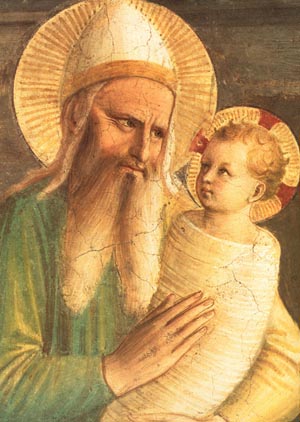 You remember the story from the Gospel, in Luke 2. Mary and Joseph come to the temple in Jerusalem to fulfill the Law. Firstborn males had to be dedicated to the Lord. The old woman Anna and the old man Simeon had the special grace from the Lord to have their dearest desires fulfilled before they died: to see the Messiah. It is in this moment that Simeon makes the prophecy about the sacrificial sufferings Mary will endure and he speaks his great Nunc dimittis, which Holy Church sings in the darkness at the end of the day for Compline.
In the traditional Roman liturgy today in larger churches there would be a special blessing of candles and a procession before Mass would begin. The chants sung for the rite contain many references to light. Also, a lighted candle is to be held during the reading of the Gospel and during the Roman Canon. The candle brings to mind also our baptism.
In a way, the faithful really ought to have candles at all Masses. But now, in High Masses, the “touchbearers” fulfill this role for the congregation. Remember that the next time you see the candles come in: that’s you up there.
Remember: Holy Church gives us candles so that we will use them. When I baptize, I suggest to people that they save the candle, with a label indicting what it is and who was there, the name of the priest, etc. Perhaps then they could save that candle against the day when, perhaps, it might be used as one of the candles on the altar for their wedding, or with a home Communion set, for when they need Last Rites. The candle you receive on other days of the year, the Vigil of Easter for example, or for Eucharist processions, could be burned in times of trial or danger, as when storms are coming or there is social upheaval. These candles remind us that we too out to be filled with light for others, in their darkness and difficulties, to see and be guided by.
Candles are beautiful symbols of our sacrifices. They are like living things. They eat and drink the wax from the bees, made collectively in association with sweetness. They breath air. They move in their flames as they flicker. They communicate to our eyes a beautiful light and give contrast to their surroundings by illumination. They burn out at the end of their span. So do we. They are consumed for the Lord in the liturgy. So should we be. We do all these things. And so, using candles in important times is a very wholesome and Catholic practice. Leaving one of these little candles in a Church, as a symbolic sacrifice of your prayers and petitions is entirely natural.
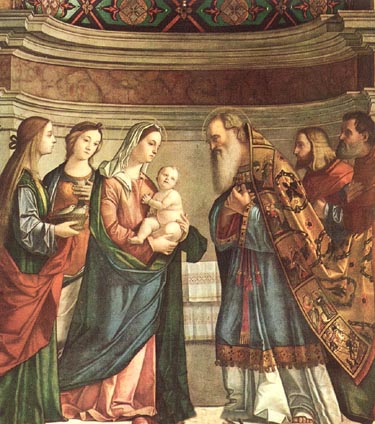 For Holy Mass on Candlemas we hear some splendid prayers. Let’s look at a couple.
Here is the third of several prayers recited by the priest for the blessing of the candles. In older days, the priest would be wearing a purple cope and would switch to white for Mass. By the time of the 1962 Missale Romanum all the rites are in white.
Domine Iesu Christe, lux vera, quae illuminas omnem hominem venientem in hunc mundum: effunde bene+dictionem tuam super hos cereos, et sancti+fica eos lumine gratiae tuae, et concede propitius; ut, sicut haec luminaria igne visibili accensa nocturnas depellunt tenebras; ita corda nostra invisibili igne, id est, Sancti Spiritus splendore illustrata, omnium vitiorum caecitate careant: ut, purgato mentis oculo, ea cernere possimus, quae tibi sunt placita, et nostrae saluti utilia; quatenus, post huius saeculi caliginosa discrimina, ad lucem indeficientem pervenire mereamur. Per te, Christe Iesu, Salvator mundi, qui in Trinitate perfecta vivis et regnas in saecula saeculorum.
R. Amen.
Daily Missal and Liturgical Manual (Baronius Press):
O Lord Jesus Christ, the true Light who enlightenest every man that cometh into this world: pour forth Thy blessing + upon these candles, and sanctify + them with the light of Thy grace, and mercifully grant, that as these lights enkindled with visible fire dispel the darkness of night, so our hearts illumined by invisible fire, that is, by the splendor of the Holy Spirit, may be free from the blindness of all vice, that the eye of our mind being cleansed, we may be able to discern what is pleasing to Thee and profitable to our salvation; so that after the perilous darkness of this life we may deserve to attain to neverfailing light: through Thee, O Christ Jesus, Savior of the world, who in the perfect Trinity, livest and reignest, God, world without end.
 There is an adage that sin makes you stupid. Note the connection between vice and blindness and darkness. The visible fire is not just a symbol of the indwelling of the Holy Spirit. It also signifies life properly lived, a fact seen by others.
At the beginning of the procession an wonderful antiphon is sung. Remember the Gospel. Mary would have been brought within, carrying the Lord, the Light of the World, and led to a place of sacrifice, the offering of her Firstborn. In the Churching of woman after child birth, they are met a the entrance to the church and then led forward.
Adorna thalamum tuum, Sion, et suscipe Regem Christum amplectere Mariam, quae est coelestis porta: ipsa enim portat Regem gloriae novi luminis: subsistit Virgo, ad ducens manibus Filium ante luciferum genitum: quem accipiens Simeon in ulnas suas, praedicavit populis, Dominum eum esse vitae et mortis, et Salvatorem mundi.
Adorn thy bridal-chamber, O Sion, and welcome Christ the King: with loving embrace greet Mary who is the very gate of heaven; for she bringeth to thee the glorious King of the new light: remaining ever a Virgin yet she bearest in her arms the Son begotten before the day-star: even the Child, whom Simeon taking into his arms, declared to the peoples to be the Lord of life and death, and the Savior of the world.
At Christmas we receive the Lord. At Candlemas we offer Him.
In addition to the theme of light functioning throughout the rite there is also another echo of Christmas and Epiphany. God meets man. God comes to us, and we go to Him. Today there is another meeting of God and man, expectant man, symbolized by Anna and Simeon. The hymn sung in the procession frames our meeting, our Encounter as the liturgy of the Greek East calls this say, in nuptial terms.
In the Mass itself, we have the
COLLECT (1962MR):
Omnipotens sempiterne Deus, maiestatem tuam suppliciter exoramus: ut, sicut unigenitus Filius tuus hodierna die cvm nostrae carnis substantia in templo est praesentatus; ita nos facias purificatis tibi mentibus praesentari.
This is an ancient prayer, going back at least to the 9th c. and is found Liber sacramentorum Romanae ecclesiae ordine excarpsus.

You will see what is happening quickly, if you are a student of Latin, by taking careful note of the ut in the second part, which leads to a subjunctive down the line. Also, there is a typical sicut…ita constuction, the ita part having the subjunctive result of the ut. There is a nice turn of phrase at the end, using a trop hyperbaton, whereby that tibi separates the two elements of the ablative absolute purificatis … mentibus. I also like that use of praesentatus… praesentari, a trope called, if memory serves, polyptoton.
The word maiestas is associated with gloria, a divine characteristic which transforms us who encounter it. Thinks of the transformation of Moses’ face after he met with the Lord in the tent or on the mount: he had to wear a veil because his face was too bright to look at. Also, Romans liked addressing people in indirect ways. We still do this in some formal discourse and letters. It is courtly, courteous. Here maiestas can be heard as a form of address: Your Majesty. So, maiestas has layers on layers of meaning.
Note the philosophical language of substantia. Some times people will argue that the switch from Greek to Latin, the spoken language in ancient Rome, is justification for using the “vernacular” today. The problem with that argument is that the Latin used in the Church for prayer, was not the language spoken by the people. It had technical vocabuary (e.g., maiestas, substantia) and turns of phrase nothing like everyday speech (e.g., hyberbaton, polyptoton).
See what happens? It all seems straight forward. Then you start to drill.
Candlemas is a beautiful feast full of meaning and symbols.
Holy Church puts candles in your hands today, to remind you of your gifts and your duties.
My good friend Msgr. Msgr. Hans Feichtinger has a piece at Crisis today about Fallacia superans… Fiducia supplicans. He is a priest of the Diocese of Passau with an STD my school the Augustinianum and worked in the CDF from 2004-2012.
Here’s a taste:
Fiducia Supplicans: A Crisis of Trust
[…]
Pastorally, the very serious question is what the blessings for irregular, and even more for homoerotic, unions are supposed to be good for. Stabilizing such unions, in many cases, is questionable. The most recent attempts by Cardinal Fernández to explain the new blessings as a prayer to liberate couples from anything contrary to the Gospel make them, in part, into something like an exorcism—is that really what we are going for? The hope that the solution proposed here will remove the issue from ongoing synodal and ecclesial debates will not be fulfilled.
In reality, as is evident from how this document is being debated and (not) received in the worldwide Church, this is not about pastoral care but about tensions among bishops, and between bishops (conferences) and the Holy See. It is about a pernicious crisis of trust among the members of the hierarchy, the College of Cardinals very much included. It is also about a lack of trust among priests toward bishops and the Holy See, which is the most relevant issue here, because, after all, these blessings are supposed to be given by priests.
The lack of consultation among bishops and priests in the process of elaborating this text is tragic, revealing, and a bit terrifying. Becoming a “more synodal” Church cannot mean creating an ever less synodal Vatican. Neither must it mean excluding priests (in parish ministry) at the degree we see currently at the Synod of Bishops 2023-24 (otherwise significantly enlarged with laypeople and religious).
How can young priests take older prelates seriously if the latter do not return the favor or, rather, if they do not begin with an advance of trust in the young clergy. After all, are we not praying for an increase in vocations? It seems very hard for some bishops to believe that God might call men to the priesthood who are not like they have been. It should be obvious that such an attitude pulls out the rug under anyone who claims to be close to the teachings of Vatican II or a proponent of synodality, not to mention that it may just be a lack of trust in God’s providence.
[…]
And here is a key point which we must be vigilant about. It is how libs have always worked: creeping incrementalism. They aim at changing doctrine through slow erosion by heteropraxis. Violate the law or rubrics long enough and you shift what people believe to the point that it no longer looks like what the Church teaches in black and white.
[…]
The claim that the changes proposed are built, somehow, on a continual “development” of the Church’s doctrine and practice is not legitimate. First, because such a claim introduces the notion of a doctrinal change through the back door of a new practice;
[…]
There’s a good deal more.
Please remember me when shopping online and use my affiliate links. US HERE – UK HERE WHY? This helps to pay for health insurance (massively hiked for this new year of surprises), utilities, groceries, etc.. At no extra cost, you provide help for which I am grateful.

WELCOME NEW REGISTRANT:
tanaast
White to move and mate in ONE.

NB: I’ll hold comments with solutions ’till the next day so there won’t be “spoilers” for others.
Priestly chess players, drop me a line. HERE
Have a Catholic site or concern to build or maintain? I’d make a bee line for this service.
Safer. Cheaper. Better support. Can’t be “cancelled”.
Check it out HERE

Coat of Arms by D Burkart



Will you be a "Custos Traditionis" and commit to a DAILY 'Memorare' and WEEKLY penance?
Total Voters: 2,879
 Loading ...





A Daily Prayer for Priests


They find you a pro-life agent in your area who commits to giving a portion of the fee to a pro-life group!

PLEASE subscribe via PayPal if it is useful. Zelle and Wise are better, but PayPal is convenient.
A monthly subscription donation means I have steady income I can plan on. I put you my list of benefactors for whom I pray and for whom I often say Holy Mass.
In view of the rapidly changing challenges I now face, I would like to add more $10/month subscribers. Will you please help?
For a one time donation...

The "sign of peace" during Mass in the Ordinary Form...
Total Voters: 26,606
Loading ...Should the Bishops of the USA have us return to obligatory meatless Fridays during the whole year and not just during Lent?
Total Voters: 19,255
Loading ...


Help Monks in Wyoming (coffee – UPDATED LINK) and Norcia (beer) and the wonderful "Soap Sisters" of Summit, NJ!


Please follow me on Twitter!










Visits tracked by Statcounter
since Sat., 25 Nov. 2006:

