28 Jan ’24 Septuagesima Sunday – Will you bury your “Alleluia” this year?

alleluiaWell? Are’ya gonna do it?

Do you have to call the priest RIGHT NOW so you can have a plan in place for your Sunday TLM… or Novus Ordo for that matter.  WHY NOT?  It’s called “Solidarity with the oppressed”.  It’s called “Unity with the peripheries”.

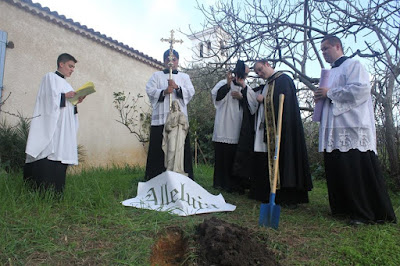
On Septuagesima Sunday we have a custom of burying the Alleluia right after the Asperges (of a Solemn Mass).  Otherwise, just before Mass.

This Sunday is already Septuagesima.

In pre-Lent we get ourselves in order for a fruitful and serious Lenten fast, more works of mercy, greater introspection, and a stem to stern holy stoning.

As you know, we don’t sing “Alleluia” from Septuagesima onward.  Of yore there were ceremonies to mark the exemption of the “A-Word” including an entombment a decorated, symbolic word.

Here is one pic from a while back of a parish digging the dirt and sending the A-Word six feet under.

And the wonderful singing, vestment making nuns, the Benedictines of Mary, Queen of Apostles in Missouri (they have a great music CD for Lent, by the way), also sent “Al” on his way.

16_01_24_Alleluia_01 16_01_24_Alleluia_02  16_01_24_Alleluia_04

C’mon.  Be trads!  Get your parish priests up to speed, make plans, offer to do all the work and preparations and bury your Alleluia!

And GO TO CONFESSION!

(I just thought I’d get that in there in case you haven’t gone lately.)

Posted in "How To..." - Practical Notes, Liturgy Science Theatre 3000, Our Catholic Identity | Tagged
8 Comments

WDTPRS – 25 Jan – Conversion of St. Paul: Comparison of Novus and Vetus Collects

In honor of the Apostle to the Gentiles let us make a rapid comparison of the Collects for today’s feast of the Conversion of St. Paul.

We’ll look first at the 1962 Missale Romanum and then the 2002 edition.

The Collect is nearly the same in both.

COLLECT (1962MR):

Deus, qui universum mundum beati Pauli Apostoli praedicatione docuisti: da nobis, quaesumus; ut, qui eius hodie Conversionem colimus, per eius exempla gradiamur.

This prayer is ancient.  It is found already in the 8th century Liber sacramentorum Engolismensis (Angoulême) and the 9th century Augustodunensis (Autun) as well as the Liber sacramentorum Romanae ecclesiae ordine excarpsus, but with the variation in the Engolismensis multitidinem gentium” in place of “universum mundum”.

Our precious Lewis & Short Latin Dictionary (UK HERE) informs us that the deponent verb gradior is “to take steps, to step, walk, go;” and in ecclesiastical Latin “of the conduct of life, to walk, live, conduct one’s self”.  The French source for liturgical Latin I call Blaise/Dumas (UK HERE) indicates that gradior is “to behave oneself”.

An exemplum is, “a sample for imitation, instruction, proof, a pattern, model, original, example….”

For the Fathers, so steeped in Greek and Roman rhetoric and philosophy, exemplum could mean many things.

First, an exemplum brings auctoritas to your argument, “authority”, inter alia the moral, persuasive force of an argument.  When we hear this prayer with ancient, Patristic ears, exemplum is not merely an “example” to imitate. It brings deeper moral force.  Let’s spin that out.

The historic event of Paul’s conversion is a reason for hope. It is an incitement to lead the kind of life which will lead ultimately to being raised up after the Risen Christ, the perfect exemplum.  The core of this exemplum is St. Paul’s response to the call of the Lord to turn his life around, his conversio or in Greek metánoia.

I especially like the word gradior in this prayer.  It invokes the image of St. Paul trudging the byways (without a horse off of which to fall).  And remember the subtle meaning of gradior includes behavior.

LITERAL VERSION:

O God, who instructed the whole world by the preaching of the Blessed Apostle Paul: grant us, we beseech You, that, we who are today honoring his Conversion, may walk according to his examples.

Many (many many) of the prayers of the pre-Conciliar form of the Missale Romanum, were cut up and changed for the Novus Ordo, if they made the cut at all. Today’s prayer is a case in point.

COLLECT (2002MR):

Deus, qui universum mundum
beati Pauli Apostoli praedicatione docuisti,
da nobis, quaesumus,
ut, cuius conversionem hodie celebramus,
per eius ad te exempla gradientes,
tuae simus mundo testes veritatis.

LITERAL VERSION:

O God, who instructed the whole world
by the preaching of the Blessed Apostle Paul:
grant us, we beseech You,
that we, walking in life toward You according to the examples of him
whose conversion we are celebrating today,
may be witnesses of Your truth in the world.

Some may argue that the newer Latin version makes the point of “witness” more clearly.

I am not convinced the ancient prayer needed these “improvements”.  Are you?  Were these improvements?  Did the prayer really changing?  Did the good of the Catholic faithful really call for that?

Today is also the anniversary of the moment that John XXIII announced the Second Vatican Council when at Vespers at the Basilica of St. Paul outside-the-walls.   So, in reference to that Council’s first major document…

Sacrosanctum Concilium 23 gives a sound principle for liturgical changes which was nearly completely ignored.

23. That sound tradition may be retained, and yet the way remain open to legitimate progress careful investigation is always to be made into each part of the liturgy which is to be revised. This investigation should be theological, historical, and pastoral. Also the general laws governing the structure and meaning of the liturgy must be studied in conjunction with the experience derived from recent liturgical reforms and from the indults conceded to various places. Finally, there must be no innovations unless the good of the Church genuinely and certainly requires them; and care must be taken that any new forms adopted should in some way grow organically from forms already existing.

Surely, that’s what we got.   Right?

Posted in Liturgy Science Theatre 3000, WDTPRS |
8 Comments

ROME SHOT 921 – On the road

Please remember me when shopping online. US HERE – UK HERE  WHY?  This helps to pay for health insurance (massively hiked for this new year of surprises), utilities, groceries, etc..  At no extra cost, you provide help for which I am grateful.

WELCOME REGISTRANTS
CowgirlB
ELMof8
Siberian72
happytoBhere

g*****@msn.com – Sorry, I deleted you because you used email for a public nickname, bad idea.

Meanwhile, white to play and mate in 3.


NB: I’ll hold comments with solutions ’till the next day so there won’t be “spoilers” for others.

Priestly chess players, drop me a line. HERE

I’m putting together some things for News of the Church.

In chessy news Gukesh D. and Nodirbek Abdusattorov both won on Wednesday.  They share the lead with 6½/10 points. In third (half-point distance) are Prag and Anish. Nepo shares forth thanks to a victory over his nemesis Ding Liren.  Nodirbek needed 6 hours to beat Max Warmerdam. Today is a rest day.  Three rounds to go.

I … am on the road.  My tools are limited due to my not paying attention to my usual “Go List”.   Grrr.  I’ve met a group of friends in a new city, a very foodie place and foodie friends.   In other news, I got my last estimate for my roof work and I’ve pinned down my dates for Rome for March and April.  More to come about that.

Finally,…
Federated Computer… your safe and private alternative to big biz corporations that hate us while taking our money and mining our data.

  • Have an online presence large or small?
  • Catholic DIOCESE?
  • Cottage industry?

See what Federated has to offer. Save money and gain peace of mind.  Contact David.
More HERE
Ceterum censeo Firoujza esse delendum.

Posted in SESSIUNCULA |
3 Comments

ROME SHOT 920

Please remember me when shopping online. US HERE – UK HERE  WHY?  This helps to pay for health insurance (massively hiked for this new year of surprises), utilities, groceries, etc..  At no extra cost, you provide help for which I am grateful.

Four players are tied for first at Tata Steel: Nodirbek, Anish, Prag and Gukesh.

Rabbit, ready to go!

WELCOME REGISTRANTS
EmmaG
Siberian72
(I deleted one who used email for a nickname and had a less than satisfactory “bio”)

White to move and mate in 4.

NB: I’ll hold comments with solutions ’till the next day so there won’t be “spoilers” for others.

Priestly chess players, drop me a line. HERE

I’m putting together some things for News of the Church.

Posted in SESSIUNCULA |
3 Comments

REPORT FROM A SECRET LATIN MASS HELD IN THE US CAPITOL

I received this very interesting message, which I have been given permission to share.

As I write, it is the Feast of St. Raymond of Peñafort (and of St. Emerentiana).

I haven’t edited this.  It is from a reliable source.   Ed Condon of The Pillar was there, since I saw a different photo of the altar has his photo credit at their site.

REPORT FROM A SECRET LATIN MASS HELD IN THE US CAPITOL TODAY

The Capitol building and grounds wore a sullen air, almost of foreboding today, as a couple of dozen American Catholics gathered at the South entrance for the first Latin Mass to be celebrated there in living memory.

Capitol police were stationed everywhere, appearing to be deeply engrossed in conversations among themselves. They barely glanced at us.

Aside from them, the nation’s beloved Capitol was empty — no school groups, no lovers snapping selfies — just this quiet, self-conscious group of Catholics, filing silently into a makeshift chapel set up in an anonymous meeting room.

They had come at the personal invitation of Speaker Mike Johnson and Chairman Jim Jordan, to mark the one year anniversary of the release of an internal FBI memo smearing them and their families as ‘extremists’ and ‘domestic terrorists’.

When that memo became public, the head of the FBI was called before Congress to explain this targeting of American Catholics. Christopher Wray repeatedly denied that Catholics were the subjects of the FBI’s criminal investigations. But the memos from Portland and Richmond belied Mr Wray’s testimony.

The writers of those memos are still in their jobs. Mr Wray remains in his office. Both are apparently above the Bill of Rights.

There was standing room only in the meeting room chapel. All of us in that room knew that our presence there was being duly noted by the US intelligence apparatus. All of us

All of us knew that we were not allowed to know the identity of the priest who celebrated the Mass. All of us, on up to the octogenarians kneeling with difficulty on that utilitarian carpet, knew that we were taking a risk.

We were there anyway.

Why was I there? I flew in to DC expressly for this Mass in order to make a point to both the President of the United States who authorized this outrage against Catholics and to the Cardinal Archbishop of Washington from whom the celebration of this Mass was hidden, for fear of reprisals against the clergy present.

Here’s my point, gentlemen. This Mass was celebrated by my ancestors, going straight back to Roman antiquity. My own father, in whose veins ran the blood of the Roman Army, rode shotgun as a copilot and navigator on the B24 bombers in World War Two. His brother was in the first Army Ranger unit in the Philippines. My cousins served in Vietnam and my late husband put 35 years into the US Army Medical Corps.

Gentlemen, I have a God-given right to worship as I see fit in this country that the men in my family risked their lives for. And your atavistic, power-mad impulses notwithstanding, I will do exactly that.

I will kneel on the carpet of Capitol meeting room, surrounded by my fellow believers. I will revel in the breath-taking Gregorian chant redolent of early Christian worship in the catacombs. And I will receive my Savior in Communion on the tongue.

And I will do so as a free woman, because my freedom was purchased by the blood of patriots whose sandals you are not fit to tie.

My experience today at the Mass at the Capitol was a poignant juxtaposition of a troubled DC officialdom against the thousand year old Mass of the Saints.

An unforgettable experience in this Year of Our Lord, 2024.

St Raymond of Penafort, Ora pro Nobis!

The comment queue is, as always, ON.  Be prudent.

Posted in Be The Maquis, Just Too Cool |
48 Comments

ROME SHOT 919

Please remember me when shopping online. US HERE – UK HERE  WHY?  This helps to pay for health insurance (massively hiked for this new year of surprises), utilities, groceries, etc..  At no extra cost, you provide help for which I am grateful.

Click!

Meanwhile, Tata Steel. Alas, The Boy has rejoined the leaders in the Master’s section by defeating Ding yesterday, who made a blunder. Our gal Ju drew against Gukesh. Nepo beat Nordi. In the Challengers 16 yr old Marc Andria Maurizzi is at the top of the heap and Niemann is way down. Lots of chess remains.  You might need coffee.   I haven’t “checked” Tata today.  I went to play OTB.  My long time control game was disaster and then I beat the same opponent in 10 minute games 4-1.  Go figure.  I’m usually not great at the fast format.

Interested in learning?  Try THIS.

White to move and mate in 3.  More than one answer.


1.Ke4 Kh7, 2.Qf7+ Kh8/h6, 3.Bc3/d2# If 1…Kg5/h5, 2.Qf5+Kh4/h6, 3.Be1/f8#
NB: I’ll hold comments with solutions ’till the next day so there won’t be “spoilers” for others.

Priestly chess players, drop me a line. HERE

I’m putting together some things for News of the Church.

Thanks to CG who helps me out with practical things from my wish list.  He sent some anti-tarnish bags for my chalices, and some tarnish defeating elements.  For a brighter tomorrow!

Finally,…

Federated Computer… your safe and private alternative to big biz corporations that hate us while taking our money and mining our data.

  • Have an online presence large or small?
  • Catholic DIOCESE?
  • Cottage industry?

See what Federated has to offer. Save money and gain peace of mind.  Contact David.

More HERE
Ceterum censeo Firoujza esse delendum.

Posted in SESSIUNCULA |
4 Comments

22 January – St. Vincent Pallotti. God’s finger moves you around, digitus Dei.

Today, in addition to being the Feast of Sts. Vincent of Saragossa and Athanasius the Persian, it is the feast of another Vincent, St. Vincent Pallotti, founder of the Pious Society of Missions (the Pallottine Fathers).

I have a connection to this saint, along with San Filippo Neri and Francesca Romana.  The first time I was in Rome, before my conversion, I was studying ancient history and archeology.   The place where we were lodged was called the Casa Pallotti in the Via Pettinari, the street that aims directly into the Ponte Sisto across the Tiber.  It was across the street from the “flank” of what years later would become, and still is, my adoptive Roman home parish, Ss. Trinità dei Pellegrini, which Providence decreed would be the personal parish for the Traditional Roman Rite in Rome.

It is amazing how these things connect together over the decades.  We need hindsight and perspective to see how God works His plans for us, how the digitus Dei moves us around.  Another reason why this is “my neighborhood” more than any I had growing up.

Anyway, the Casa Pallotti, was run down when I was there, part of the Pallottine complex (their Rome HQ).  It has since been transformed into a swanky hotel.

The Casa Pallotti, now Hotel Ponte Sisto, is next to a little church, San Salvatore in Onda, where you find the body of… St. Vincent Pallotti.

He was canonized by John XXIII in 1963, so he didn’t make it into the 1962 Missale Romanum.  However, according to the CDF Decree Cum sanctissima, we could honor him through a celebration of Holy Mass, with the Common of Confessors, perhaps even – being flexible – with the Latin orations of the subsequent missal.

In the same church is the tomb of Bl. Elisabetta Sanna.

Meanwhile, it is also the Feast of Sts. Vincent and Athanasius, whose church is across from the Trevi Fountain.  It is distinguished for having the innards – yes, you read that right – of various Popes.   More on that HERE.

Posted in Saints: Stories & Symbols |
3 Comments

21 January – “O glorious St. Agnes, intercede with Christ the High Priest for a return of orthodoxy, sanity and sanctity to the Roman Church!”

The Church, especially the Church in Rome, is in an objectively dreadful state.

For the sake of the Roman Church, let us today invoke St. Agnes, virgin and martyr.

O glorious Agnes who, though weak, was chosen by God to make His own might manifest in your martyrdom, together with the Peter and Paul and the other Roman martyrs and confessors, intercede now before the throne of our Christ the High Priest in heaven and beg a return of orthodoxy, sanity and sanctity to the Church especially in Rome and in particular the Roman Curia at every level.  O holy Agnes, who bravely suffered torments, ask Mary, the Queen of the Clergy, to protect and aid all priests, so that they will all stand up boldly and teach the truth about the Sacrament of Matrimony, the integrity of the Sacrament of Holy Orders, the truth about the Most Holy Eucharist, and beg for the restoration and renewal of our sacred liturgical worship of the Lamb who was slain.  We entrust this to you, blessed Saint Agnes, with all our confidence.  Amen.

I have posted the following in times past, but it bears repetition. Newcomers to this blog may not have seen it.

Behold the skull of Agnes, in situ, in her beautiful church in Rome on the Piazza Navona.

The dies natalis (“birthday into heaven”) of Agnes was recorded in the register of the depositio martyrum as 21 January.

St. Agnes was slain probably during the reign of the Emperor Diocletian in 304. Some say she died during the time of the Emperor Valerian (+260).

The little girl was buried by her parents in praediolo suo, on their property along the Via Nomentana where there was already a cemetery.

This cemetery expanded rapidly after that, because many wanted to be buried near the grave of the famous martyr. The ancient cemetery grew in stages between the Basilica which Constantina, daughter of Constantine and Fausta began over her tomb from 337-350 and the small round Basilica of Constantia (Constantine’s daughter).

There was an acrostic inscription from that time in verses about the dedication of the temple to Agnes:

Constantina deum venerans Christoque dicata
Omnibus impensis devota mente paratis
Numine divino multum Christoque iuvante
Sacravit templum victricis virginis Agnes…

You get the idea.

The Basilica of St. Agnes was reconstructed towards the end of the 5th c. by Pope Symmachus (+514). Honorius I (+638) rebuilt it as a basilica with three naves, adding a wonderful fresco of Agnes. It was worked on again in the 16th c. by St. Pius V and in the 19th by Bl. Pope Pius IX.

Excavations in 1901 uncovered the silver sarcophagus made by Pius V for St. Agnes together with St. Emerentiana.

It contained the headless body of a young girl.

Zadock gave us a photo of the miraculous protection of Bl. Pius IX when once at the Basilica there was a near disastrous cave-in/collapse and no one was injured.

While Agnes’s body is in her tomb on the Via Nomentana, her skull is now at the place of her supposed martyrdom at the Piazza Navona in Rome’s heart. It is a fitting place to venerate a saint so much in the heart of the Roman people even today. It is not unusual for people today to name their children Agnes in honor of this great virgin martyr, whose name is pronounced in the Roman Canon.

The skull was bequeathed to that church at the Piazza by Pope Leo XIII who took it from the treasury of the Sancta Sanctorum.

The Piazza itself was in ancient times the Stadium of Domitian (+96) a place of terror and blood for early Christians, far more than the Colosseum ever was. The Piazza is thus called also the “Circo Agonale” and the name of the saint’s church is Sant’Agnese in Agone. “Navona” is a corruption of “Agonale”, from Greek agon referring to the athletic contests of the ancient world. St. Paul used the athlete’s struggle as an image of the Christian life of suffering, perseverance, and final victory even through the shedding of blood. Early Christian tombs often have wavy lines carved on the front, representing an metal instrument called a strigil, used by athletes to scrape dirt and oil from their bodies after contests. Victory palm branches are still used in the iconography of saints, as well as wreathes of laurels.

We know about St. Agnes from St. Jerome, and especially St. Augustine’s Sermons 273, 286 and 354. St. Ambrose wrote about Agnes in de virginibus 1,2,5-9 written in 377 as did Prudentius in Hymn 14 of the Peristephanon written in 405.

Ambrose has a wonderful hymn about Agnes (no. 8), used now in the Roman Church for Lauds and Vespers of her feast. The Ambrosian account differs somewhat from others. For Ambrose, Agnes died from beheading. Prudentius has her first exposed to shame in a brothel and then beheaded.

Here is the text of the hymn from the Liturgia horarum for the “Office of Readings” with a brutally literal translation.

Igne divini radians amoris
corporis sexum superavit Agnes,
et super carnem potuere carnis
claustra pudicae.

Shining with the fire of divine love
Agnes overcame the gender of her body,
and the undefiled enclosures of the flesh
prevailed over flesh.

Spiritum celsae capiunt cohortes
candidum, caeli super astra tollunt;
iungitur Sponsi thalamis pudica
sponsa beatis.

The heavenly host took up her brilliant white spirit,
and the heavens lifted it above the stars;
the chaste bride is united to the
blessed bride chambers of the Spouse.

Virgo, nunc nostrae miserere sortis
et, tuum quisquis celebrat tropaeum,
impetret sibi veniam reatus
atque salutem.

O virgin, now have pity on our lot,
and, whoever celebrates your victory day,
let him earnestly pray for forgiveness of guilt
and salvation for himself.

Redde pacatum populo precanti
principem caeli dominumque terrae
donet ut pacem pius et quietae
tempora vitae.

Give back to this praying people
the Prince of heaven and Lord of the earth,
that he, merciful, may grant us peace
and times of tranquil living.

Laudibus mitem celebremus Agnum,
casta quem sponsum sibi legit Agnes,
astra qui caeli moderatur atque
cuncta gubernat. Amen.

Let us celebrate with praises the gentle Lamb,
whom chaste Agnes binds to herself as Spouse,
he who governs the stars of heaven
and guides all things. Amen.

We can note a couple things from this prayer. First, the reference to fire probably a description of Agnes’s death related in a metrical panegyric of Pope Damasus about how Agnes endured martyrdom by fire. On the other hand, St. Ambrose, when speaking of her death, speaks of martyrdom by the sword.

Pope St. Damasus composed a panegyric, an elogia, inscribed in gorgeous letters on marble (designed and executed by Dionysius Philocalus) in honor of Roman saints, including Agnes.  This was the period when the Roman liturgy shifted from Greek to stylized (not common or everyday “vernacular”) Latin.  Damasus was also trying to make a social statement with these great inscriptions, set up at various places about the City.   The panegyric of St. Agnes was placed in the cemetery near the saint’s tomb, but through the ages it was lost. Amazingly, it was at last rediscovered in 1728 inside the basilica, whole and complete: it had been used as a paving stone!  Fortunately, upside down!  Its rediscovery was a find of vast importance.

Now it is affixed to the wall in the corridor descending to the narthex.

damasus inscription agnes

FAMA REFERT SANCTOS DUDUM RETULISSE PARENTES
AGNEN CUM LUGUBRES CANTUS TUBA CONCREPUISSET
NUTRICIS GREMIUM SUBITO LIQUISSE PUELLAM
SPONTE TRUCIS CALCASSE MINAS RABIEMQUE TYRANNI
URERE CUM FLAMMIS VOLUISSET NOBILE CORPUS
VIRIBUS INMENSUM PARVIS SUPERASSE TIMOREM
NUDAQUE PROFUSUM CRINEM PER MEMBRA DEDISSE
NE DOMINI TEMPLUM FACIES PERITURA VIDERET
O VENERANDA MIHI SANCTUM DECUS ALMA PUDORIS
UT DAMASI PRECIBUS FAVEAS PRECOR INCLYTA MARTYR

It is told that one day the holy parents recounted that Agnes, when the trumpet had sounded its sad tunes, suddenly left the lap of her nurse while still a little girl and willingly trod upon the rage and the threats of the cruel tyrant. Though he desired to burn the noble body in the flames, with her little forces she overcame immense fear and, gave her loosened hair to cover her naked limbs, lest mortal eye might see the temple of the Lord. O one worthy of my veneration, holy glory of modesty, I pray you, O illustrious martyr, deign to give ear to the prayers of Damasus.

Damasus used the sources available. There were the stories told by her parents, the 4th edict of Diocletian against Christians in 304 (lugubres cantus tuba concrepuisset). Agnes did what she did of her own free will (sponte). Note the reference to the body as temple of God (1 Cor 3:16 and 2 Cor 6:16).

St. Agnes of Rome, has two grand churches in Rome.  She has two feast days in the traditional Roman calendar.

Since the reform of the calendar, Agnes now has only one day, alas.

Ask Agnes to intercede with God for a return of sanity to the Roman Church.

Also, here is a shot of my 1st class relic of St. Agnes. Thank you to the kind reader – Susan – who sent me the reliquary back in May 2020.
Posted in SESSIUNCULA |
4 Comments

ROME SHOT 918 – AGNES!

From The Great Roman™

And I will have bonus pic later.

First… a commercial… Please remember me when shopping online. US HERE – UK HERE  WHY?  This helps to pay for health insurance (massively hiked for this new year of surprises), utilities, groceries, etc..  At no extra cost, you provide help for which I am grateful.

WELCOME REGISTRANT:
albert1953

In chessy news, at Tata Steel in the Netherlands, Nodirbek is in the lead!    There was a CRAZY game between Gukesh and Max Warmerdam.  It was NUTS.  I am happy to report that Vidit defeated The Boy, Alireza Firouzja.  Vidit’s post game comment: “A win is like two draws, so it’s better than a draw.”  Maybe not a word smith, but he sure can play chess.  Ju drew against Donchenko.

Fun photo… from ChessBase.

From the Piazza Navona and the beautiful Church of St. Agnes, comes this shot of “Agnesina” and her wonderful Roman “Ci penso io!” stance…

“I’ve got this… leave it to me!”

One of the things you can get, is wonderful BEER from the traditional Benedictine monks of Norcia. It is really good. Three different kinds. You get great beer. The monks get to build their monastery. I get a small percentage. Win. Win. Win.

Meanwhile…

White to move and mate in 2.

NB: I’ll hold comments with solutions ’till the next day so there won’t be “spoilers” for others.

Priestly chess players, drop me a line. HERE

Interested in learning?  Try THIS.

Ceterum censeo Puerum esse delendum.


Posted in SESSIUNCULA |
6 Comments

Your Sunday Sermon Notes – 3rd Sunday after Epiphany (N.O.: 3rd Ord) 2024

Too many people today are without good, strong preaching, to the detriment of all. Share the good stuff.

It is the 3rd Sunday of Ordinary Time in the Novus Ordo and the 3rd Sunday after Epiphany in the Vetus Ordo.

Was there a GOOD point made in the sermon you heard at your Sunday Mass of obligation?

Tell about attendance especially for the Traditional Latin Mass.  I hear that it is growing.  Of COURSE.

Any local changes or (hopefully good) news?

I have a few thoughts about the orations in the Vetus Ordo for this Sunday: HERE

Heaping hot coals on someone’s head doesn’t sound very charitable.  What could this mean?  In ancient times it was critically important to keep a fire going in the home.  Great effort was made to bank coals in ashes over night and get the fire going again later.  Providing food and drink and fire were ways to tend to your neighbors’ true needs.  For the Romans a sentence of exile was given with a decree of aquae et ignis interdictio… privation of water and fire.  You were to be denied the essentials of life precisely so that you were forced to leave the area or die.  The reverse of this is how on the day of her marriage a bride would be received by her husband with fire and water, which represented that he would care for her needs.  Hence, heaping coals on a person’s head is the opposite of cruelty.  It is a way of waking them up to their true selves.  As St. Augustine put it, your kindness will burn away your enemy’s hatred.


Posted in SESSIUNCULA |
5 Comments