A message from Pope Leo to Charlotte

From Leo’s Christmas Address to the Roman Curia today.

 We can fall into the temptation of swinging between two opposite extremes: uniformity that fails to value differences, or the exacerbation of differences and viewpoints instead of seeking communion.  Thus, in interpersonal relationships, in internal office dynamics, or in addressing questions of faith, liturgy, morality and more besides, there is a risk of falling into rigidity or ideology, with their consequent conflicts.

I fear that that is what is driving policies in Charlotte and other places.

Uniformity is not unity.  Forced uniformity is destructive.

Posted in Leo XIV, Liturgy Science Theatre 3000, Save The Liturgy - Save The World | Tagged
5 Comments

Pope Leo XIV’s 1st Christmas Address to the Roman Curia – I’m sensing a theme

Each year before Christmas, the Roman Pontiff has an audience with members of the Roman Curia. Back in the day, I used to accompany Card. Mayer. It was a wonderful experience with Pope John Paul II of happy memory.

You might remember Francis’ interminable hectoring jeremiads in which he lambasted and belittled pretty much everyone.  You might remember Benedict XVI’s supremely important first address in which he exposed (especially against the influence of Rahner) the contrast of hermeneutics of continuity and of discord.  HERE  It bears rereading.  That was TWENTY YEARS AGO TODAY, 22 December 2005.

Leo XIV had his first Christmas audience and message with the Curia. HERE There was a decidedly different tone. In English, the address is a bit over 1600 words, so it was about average for these addresses over time.

You should read it yourself, but it can be easily summarized.

Pope Leo XIV presents a vision of ecclesial unity rooted in two points: mission and communion. Christmas was God’s decisive “going forth” in the Incarnation. He frames unity – this is a major theme with him – as a Christ-centered communion ordered to evangelization, not institutional uniformity. Citing Evangelii Gaudium (Francis’ programmatic document penned in part by Tucho who plagiarized matierial), Leo said that the Church is missionary by nature because mission originates in the Trinity itself: God’s initiative in Christ continues through the Holy Spirit in the Church. Consequently, ecclesial structures, including the Roman Curia, must be judged by their service to evangelization. Administration alone is insufficient. Curial work must respond to present pastoral, ecclesial, and social challenges.

Mission is inseparable from communion. Christ’s mission reconciles humanity to the Father, making believers brothers and sisters. Leo warns against two threats to unity: rigid uniformity that suppresses legitimate diversity, and ideological fragmentation that absolutizes differences. True unity, expressed in the Augustinian formula In Illo uno unum (his motto – One, in Him), preserves diversity within the one Body of Christ and finds concrete expression in a synodal Church where all cooperate according to their charisms.

Addressing the Curia ad intra (within itself), Leo speaks frankly of temptations toward power, self-interest, and mistrust. Quoting Augustine of Hippo’s letter to the wealthy widow Proba (ep 130) on the rarity of genuine friendship, he asks whether true fraternal relationships are possible in the Curia. Such communion, he argues, requires personal conversion, transparency, and daily practices shaped by Christ’s love, not policies or documents.

This lived communion has an outward (ad extra – toward the world) dimension. In a world marked by conflict, polarization, and aggressive discourse amplified by digital media and politics the Church must be a prophetic sign of peace and universal fraternity. The Curia therefore serves not itself, but the Kingdom of God and the Church’s global mission.

The Pope situates this vision within major ecclesial milestones: the Jubilee Year, the Council of Nicaea, the Second Vatican Council, and the fiftieth anniversary of Paul VI’s Evangelii Nuntiandi, which taught that evangelization belongs to the whole Church and is first accomplished through the witness of a Christian life lived in communion.

Leo concluded with Dietrich Bonhoeffer on God’s closeness to human lowliness, calling the Curia to humility, compassion, and credibility. Unity in the Church comes where mission and communion converge in conformity to the humility of the Incarnate Lord.

So, it’s unity… unity… unity.

NB: Unity is not mere uniformity.  Didn’t I write that yesterday?  HERE

Again he leans hard on Francis’ programmatic Evangelii gaudium, which he seems to be making his own in some way.   He told the Cardinals in advance to read it before the upcoming consistory.

Posted in Leo XIV, The Drill | Tagged
1 Comment

ADVENTCAzT 2025 – 23 – Monday 4th Week of Advent – “Thy kingdom come!”

A 5 minute daily podcast to help you in your Advent preparation.

Pius Parsch describes the progression of Advent and it’s ongoing importance for our spiritual lives.

The Collect and “O”.

Yesterday’s podcast HERE.

Posted in ADVENTCAzT, ADVENTCAzT, PODCAzT | Tagged , , ,
1 Comment

Forced unity is not unity.  It’s uniformity.

It is hard to watch what is happening in the Diocese of Charlotte. It is hard to watch what is happening and wonder if there isn’t something seriously out of whack.  It’s as if the 1980’s are back.

First, the bishop has issued a “pastoral letter” “on norms for Holy Communion”. Download PDF.

Here’s a sample (my emphases and comments):

Manner of Receiving Holy Communion
According to liturgical norms, regional episcopal conferences are entrusted with establishing more precise norms for the reception of Holy Communion. 6 The United States Conference of Catholic Bishops (USCCB), with the approval of Rome, has established “[t]he norm … that Holy Communion is to be received standing, unless an individual member of the faithful wishes to receive Communion while kneeling” and that a bow is the act of reverence made by those receiving. 7 The normative posture for all the faithful in the United States is standing, it is nonetheless the free choice of an individual member of the faithful to kneel, and Communion cannot be denied this individual solely based on their posture (Redemptionis Sacramentum, n. 91).

A normative posture is not only given so that we may be united in how we receive Holy Communion, but also as an aide to direct our catechesis and sacramental preparation. While it is the right of an individual member of the faithful to kneel, pastors should not direct their faithful to do so as something that is “better.” It is the responsibility of those in a pastoral or teaching role to instruct those in his/her care the episcopal conference norms for reception without prejudice. Doing otherwise disrupts the harmony and unity [“harmony” as used in the documents by the Central Committee of the Chinese Communist Party] that the Bishops have legitimately set forth for the manner of distribution of Holy Communion in the United States. [Wait a minute… look around in these USA at other dioceses.  Are other bishops going this far to repress kneeling for Communion?  Are even the neighboring dioceses?  But now get this nasty dig…] The faithful who feel compelled to kneel to receive the Eucharist as is their individual right should also prayerfully consider the blessing of communal witness that is realized when we share a common posture.  [Sort of nauseating.  Yeah… that’s what people are thinking about when going to Communion… “what a beautiful communal witness this is”.]

The episcopal conference norms logically do not envision the use of altar rails, kneelers, or prie-dieus for the reception of communion. [Qui tacet consentire videtur.] Doing so is a visible contradiction to the normative posture of Holy Communion established by our episcopal conference. Instead, the instruction emphasizes that receiving Holy Communion is to be done as the members of the faithful go in procession, witnessing that the Church journeys forward and receives Holy Communion as a pilgrim people on their way. 8 The USCCB in its explanation for the norms governing reception of Holy Communion reminds us of the beauty of this procession: “In fact, each time we move forward together to receive the Body and Blood of the Lord, we join the countless ranks of all the baptized who have gone before us, our loved ones, the canonized and uncanonized saints down through the ages, who at their time in history formed a part of this mighty stream of believers.” 9  [Who writes this dreamy blah blah?  And does this seem familiar?   Almost exactly a year ago HERE in which Feser and Esolen comment on the goofy notions under consideration.]

Therefore:

    1. Clergy, catechists, ministers of Holy Communion, and teachers are to instruct communicants according to the normative posture in the United States. They are not to teach that some other manner is better, preferred, more efficacious, etc.
    2. The use of altar rails, kneelers, and prie-dieus are not to be utilized for the reception of Communion in public celebrations by January 16, 2026.
    3. Temporary or movable fixtures used for kneeling for the reception of communion are to be removed by January 16, 2026.

He also promotes Communion under both kinds if “there is no danger of profanation of the Eucharist”.   Problem: danger of profanation is galactically increased thereby.

And this:

In addition, the practice of intinction has arisen to distribute under both kinds in a handful of our parishes. While allowed in the General Instruction of the Roman Missal, it should not be considered an option in the Diocese of Charlotte for distribution to the faithful in public celebrations.

You know what he is doing here, right?  He is trying to stop any sort of reception of Communion on the tongue instead of in the hand.

Can he do that?   I suspect not.  But, hey, he would probably find a way to crucify a priest who offered it for some other reason because he has power and the priest doesn’t.

He trots out the old “progressive solemnity” chestnut.   I thought that was pretty much a nothing burger about a decade ago.  Note also, the notion of “progressive solemnity” was originally a music issue.  The problem with “progressive solemnity”, which seems to be a good idea founded in common sense and the obvious difference between a “dies non” ferial day and a major feast is that it produces a minimalism on less weighty days which enervates and diminishes liturgy.  This is particularly so in the realm of sacred liturgical music… not that there is much worthy of that name to be encountered these days.  “Progressive solemnity” starts with the watering down of some Masses, rather than raising the bar, and militates against the use of the true propers of the Mass, especially sung.     It’s curious to see it introduced in this context.  Is this a subtle utilitarian treatment of the Most Precious Blood? An “instrumentalizing” of the Eucharist for the sake of an agenda?

What I find particularly irritating is that the whole thing is sandwiched – introduction and conclusion – between references to Pope Leo, as if to say, “Hey.. this is what Pope Leo thinks too!”  To wit: “As Our Holy Father’s motto — In illo unum uno — reminds us, “In Him who is One (Christ), we are One,…” and “These norms for our diocese move us together toward the Church’s vision for the fuller and more active participation of the faithful, especially emphasized by our Holy Father, Pope Leo XIV, at the beginning of his Petrine ministry.”  That second quote is footnoted:

“Brothers and sisters, I would like that our first great desire be for a united Church, a sign of unity and communion, which becomes a leaven for a reconciled world” (Homily for the Beginning of the Pontificate of His Holiness Pope Leo XIV, May 18, 2025).

Amy gets it.

Next, the Pillar reports that

[…]

The Diocese of Charlotte announced a change to its seminary formation program in a Dec. 15 email to the priests and deacons of the diocese.

Starting with the upcoming academic year, diocesan seminarians will spend a pastoral year teaching at a local high school or middle school, the email explained.

Seminarians will each have a lay mentor, and will receive pay and benefits. Each seminarian will live at a local rectory, paying room and board at a rate established by the diocese.

[…]

One Charlotte priest said the initiative will ask seminarians to function in a sort of in-between state, “kind of a lay person, kind of a seminarian” — and that situation could cause confusion.

Others lamented that seminarians will reportedly not be permitted to wear clerical garb during the “teaching year,” which could undermine, priests said, the effort to form a clear clerical identity during priestly formation.

[…]

Priests in the diocese said their biggest concern is that a major change to priestly formation in the diocese comes without a widespread consultation before making the shift.

And in that light, priests expressed frustration with Martin, and a sense among the clergy, they said, that their bishop has not developed a synodal leadership style.

One priest of the diocese called the bishop an “autocrat,” while another said he is “a bully” who has a reputation for berating his priests, going once on a lengthy tirade toward diocesan seminarians that left clergy frustrated.

Criticisms of that nature seem to reflect a growing morale problem among Charlotte clergy, which several priests said is causing them concern.

[…]

He said the new program adds to a general feeling of instability and uncertainty with the priesthood, and frustration at feeling unheard.

“Everybody is upset. It doesn’t matter — liberal, conservative, traditional, not so traditional, whatever. It’s a style of leadership issue,” another individual commented.

And while many of the recent headlines surrounding the diocese have focused on liturgical changes, the real issue is much bigger, sources said.

“It’s not just about the liturgy,” one person emphasized.

“The liturgy gets in there, and it is the flashpoint that people respond to, but this is a much deeper problem of a kind of leadership style that is antithetical to the Catholic way of life.”
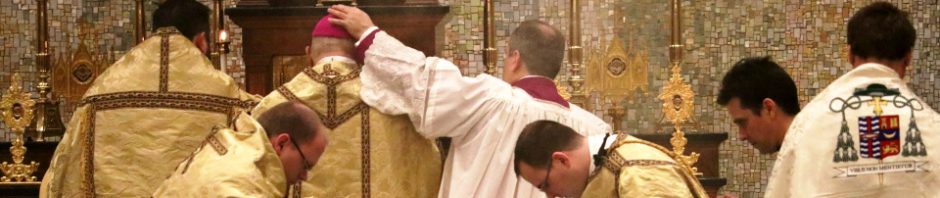
Posted in Liturgy Science Theatre 3000, Pò sì jiù, The Drill | Tagged
23 Comments

Your Sunday Sermon Notes – 4th Sunday of Advent – 2025

Too many people today are without good, strong preaching, to the detriment of all. Share the good stuff.

Was there a GOOD point made in the sermon you heard at your Mass of obligation for this Gaudete Sunday, the 4th of Advent?

Tell us about attendance especially for the Traditional Latin Mass.

Any local changes or (hopefully good) news?

A taste of what I offered at 1 Peter 5 this week:

[…]

With apologies to the faithful Flannery O’Connor and with no apologies whatsoever to the weirdo Jesuit Pierre Teilhard de Chardin, Advent could be summarized as “everything that rises must converge.”

Within the rhythm of the Advent season, the 4th Sunday stands as a moment of concentration and convergence. From the beginning, the season forms the faithful by directing attention toward the Lord’s coming in glory. The Collect of the 1st Sunday, marked by the urgent, rousing imperative Excita, asks that God would stir the wills of His people so that they may be prepared through worthy works. Isaiah dominates this opening stage of Advent, giving voice to watchfulness, longing, and expectation shaped by the horizon of judgment.

The 2nd Sunday continues this movement …

[…]

Also, a priest friend in a texting group wrote:

I preached on St Joseph this morning at Mass. I said that Joseph taught Jesus carpentry. And that though he wasn’t Italian, until he began his public ministry at the age of 30, Jesus lived with his parents. In their basement.

Posted in Sermons | Tagged
Comments Off on Your Sunday Sermon Notes – 4th Sunday of Advent – 2025

21 December – Feast of St. Thomas, Apostle… and the beating, living, healing, Heart of Love.

Here is something that I wrote a while back. Since today in the Vetus Ordo calendar is the Feast of St. Thomas the Apostle, I figured that it might be good to share for those who haven’t seen it.


[…]

Christ showed [the Apostles in the locked room] His hands and feet and side, to demonstrate that He had a real body and that it was also is His Body. He didn’t pick up some unwounded, perfect Body that He was now inhabiting. We are our bodies, as we are our rites. The fact that the wounds remained in His Body’s hands, feet and side provided continuity with His Body before and during His Passion. He isn’t a mere shade of the Lord. Nor has he exchanged Himself for an unwounded version. In this way Christ began to show them the traits of the risen Body, traits which we, too, will share in the Resurrection: clarity (reflecting God’s glory), impassibility (incapable of suffering), agility (ease and speed of movement), subtlety (unhindered by barriers).

[…]

We don’t know why Thomas wasn’t with the other ten Apostles in the room for that first appearance of the Lord. I like to imagine that it was his turn to get the “take out” for the rest of them.

Thomas, who had doubted, put his trust in the Lord at this point. In fact, he literally handed his trust to Him where the point of the lance had left its mark on the Lord’s glorious Risen Body, a wound from a Roman lance large enough to insert his hand. The Lord told Thomas to “thrust” (Greek bále) his hand “eis ten pleurán… into (His) side”. If we want to be picky, we might note that the Greek word “cheír”, insofar as our anatomy is concerned, can mean “hand”, but it can also mean “finger” or “hand and arm”, the later so much so that in some contexts additional words are added to denote “hand” as distinct from the arm (cf. Liddell-Scott-Jones, A Greek-English Lexicon aka LSJ – “χείρ , ἡ”).

This is significant for depictions in art, as in the famous painting by Caravaggio, wherein Thomas puts his finger into Christ’s side and peers into it, which smacks of the spirituality of St. Bonaventure who wrote about how Thomas the Apostle looked through the Lord’s visible wounds and saw His invisible wound of love. It also affects depictions of the crucifixion of the Lord and of His risen Body, with the holes of the nails in the hands. Some maintain that Christ would have been crucified with nails through the wrists so that the ulna and radius bones would sustain His Body’s weight rather than tearing through the flesh of His hands.

Christ tells Thomas to explore with his finger (dáktylos) the spike holes of His “hands/wrists”, which would be more or less the size of a large finger. However, he tells Thomas to use his hand for the wound in His side. The Greek suggests to me that the Lord instructed Thomas to push, thrust His hand into the wound channel left by the Roman lance, which had gone so far as to lacerate the Lord’s Sacred Heart.

We don’t have in the Gospel account of this stunning moment, to which John was eyewitness, a precise statement by John that Thomas physically did it. All it says is that Thomas responded, “My Lord and my God!” Christ responded with a “beatitude” (v. 29): “Jesus said to him, “Have you believed because you have seen me? Blessed are those who have not seen and yet believe.”

Was Thomas so overwhelmed that He could not touch the Lord in that way? All He could utter was that amazing witness to belief in the divinity of Christ? The clearest and most exultant of any in the Gospels?

Christ refers to Thomas seeing Him, but He did not say, “because you have touched me”. Nevertheless, it seems to me that if the Risen Christ tells you to do something, you do it. Furthermore, John immediately concludes this chapter with something so definitive that it feels like the end of the whole work (vv. 30-31):

Now Jesus did many other signs in the presence of the disciples, which are not written in this book; but these are written that you may believe that Jesus is the Christ, the Son of God, and that believing you may have life in his name.

There follows chapter 21 and the account of the reconciliation of Peter at the Sea of Galilee. We moderns count that as chapter 21. Remember, the Gospels were not written with chapters and verses and not even word breaks. Those were imposed centuries later. Yet, one has the sense that what happened between Christ and Thomas was so amazing that John penned something like a conclusion to his Gospel after Thomas’s cry of faith, arguably the climax of John’s account.

Given the various meanings of “hand” in Greek, and that word “thrust”, and the fact that the wound from the lance remained, therefore remained all the way to His Heart, perhaps Our Lord required Thomas not merely to touch His side but even to feel the breath, the ruach, in His torn lung. Did Thomas, while feeling the ruach on his wrist, touch with his hand the physical, risen, subtle, impassible, agile, blazing bright Heart of Jesus?

By the way, in art, statues and painting, the Apostles are usually depicted with the instruments of their martyrdom. St. Thomas is often depicted with a lance.

On this Sunday we emphasize the mercy of God and the institution of the Sacrament of Penance, perhaps the greatest encounter we have with incarnate Mercy, Holy Communion notwithstanding.

Christ told Thomas to do what He did before witnesses so that they too would understand about the traits of His risen Body and that it was truly His own. Knowing full well that we would one day read this, He inspired the disciple He most loved to write his Gospel account, an account that connects Thomas to the inspiration of the Spirit and the mercy of Christ’s Heart in a way that other Apostles didn’t experience on that first Easter evening appearance.

When we go to confession, we enter into Mercy in order to be breathed upon by the Spirit and to feel the beating, living, healing, Heart of Love.

UPDATE 21 Dec 2025

John 19 has the Greek word ????? (logché) for the spear or lance, especially the iron tip, that pierced Christ’s side. Interesting note: there is a proverbial use applied to a bragging coward, as in English, “fire eater” a “logché eater” (Timocl. 12.5 – probably Timocles, a Middle Comedy poet). Thomas seems to have been a bit braggadocios about the Lord’s wounds.

2nd c. Praetorian

The logché in this case was surely not the throwing Roman pilum of the legionaries that was designed to bend and become a embedded nuisance in a shield.  It would have been the flat, leaf-shaped blade thrusting lance for closer contact.  These were guards for civilian crowd control after all, not a battle line.

The Latin Jerome chose was lancea.  It can apply to different types of spears.  I note, however, that in Lewis & Short we find Tacitus refer to the lancea lata which has a broad head.

lanciarii from the column of Antoninus Pius

Posted in Classic Posts, Saints: Stories & Symbols, SESSIUNCULA |
Comments Off on 21 December – Feast of St. Thomas, Apostle… and the beating, living, healing, Heart of Love.

ADVENTCAzT 2025 – 22 – 4th Sunday of Advent – How we treat our neighbor says a lot

A 5 minute daily podcast to help you in your Advent preparation.

Today, we hear about the intersection of divinity and humanity and how we tend to treat God like we treat each other.

Card. Bacci contrasts flashy works of pride and quiet works for God.

Yesterday’s podcast HERE.

Posted in ADVENTCAzT, ADVENTCAzT, PODCAzT | Tagged , , ,
1 Comment

Daily Rome Shot 1510

The Archconfraternity of the Most Holy Trinity of the Pilgrims and Convalescents holding a regular meal for the poor.

Photo from don VP.

Welcome registrant:

mikemo75


Please remember me when CHRISTMAS shopping online and use my affiliate links.  US HEREWHY?  This helps to pay for health insurance, utilities, groceries, etc..  At no extra cost, you provide help for which I am grateful.


White to move.  Mate in 4.  Pretty easy.

NB: I’ll hold comments with solutions ’till the next day so there won’t be “spoilers” for others.

Posted in SESSIUNCULA |
3 Comments

WDTPRS The O Antiphons: 20 December – O Clavis David – The Key to everything

We continue our look at the O Antiphons with today’s O Clavis David

Again we hear the theme of Christ as the Liberator.

LATIN: O clavis David, et sceptrum domus Israel: qui aperis, et nemo claudit; claudis, et nemo aperit: veni, et educ vinctum de domo carceris, sedentem in tenebris.

ENGLISH: O Key of David, and scepter of the house of Israel, who opens and no man shuts, who shuts and no man opens: come, and bring forth the captive from his prison, he who sits in darkness and in the shadow of death.

Scripture Reference:

Isaiah 22:22
Revelation 3:7

Relevant verse of Veni, Veni Emmanuel:

O come, thou Key of David, come,
And open wide our heavenly home;
Make safe the way that leads on high,
And close the path to misery.

Do not fall into the trap of thinking that the we are dealing with events isolated solely in the past. Even taking just the image of the key in Scripture, we see how God’s plan is still in effect for us today, and we are all still players in his plan for salvation. The Old Testament reference from Isaiah helps us see this.

In Isaiah we read how the Lord said to Shebna, who was the master of the household of King Hezekiah:

“And it shall come to pass in that day, that I will call my servant Eliakim the son of Helkias, and I will clothe him with thy robe, and will strengthen him with thy girdle, and will give thy power into his hand: and he shall be as a father to the inhabitants of Jerusalem, and to the house of Juda. And I will lay the key of the house of David upon his shoulder: and he shall open, and none shall shut: and he shall shut and none shall open. And I will fasten him as a peg in a sure place, and he shall be for a throne of glory to the house of his father”.

God established in the House of David an office to be handed down through a succession, an office of jurisdiction.  The vicar of the Davidic King would exercise the King’s authority.

This same language and image was used by our Lord when in Matthew 16 He conferred His own authority on Peter to exercise as a office to be handed down in a succession.  The Lord, the David King Priest Messiah, gave His keys to Peter.  His clear intent, clear from the David key image He used, was to establish an office with a succession.

In Revelation 3:7 the Lord is described as He who still wields David’s key. Even as Peter holds the keys on earth, it is the Lord’s own hand which holds Peter’s hand.

Truly the Lord who came to us at Bethlehem is with us always in His Church until His ultimate Coming at the end of the world.  He is, in a real sense, the Key itself which Peter wields to open doors and to shut, to bind chains and to loose.

On the note of the keys, the El-Araj Excavation Project at ancient Bethsaida, the birthplace and home of Peter, Andrew and Philip has a Byzantine mosaic inscription referring to Peter, discovered in an ancient excavated basilica. The church had been described by the pilgrim Willibald in AD 724, built over the home of Peter and Andrew. The inscription names a donor, “Constantinos, servant of the Messiah,” and refers to the “Head and Leader of the Heavenly Messengers,” a Byzantine title for Apostle Peter. So, El-Araj is biblical Bethsaida, hometown of Peter, Andrew, and Philip, and a center of Jesus’ ministry.

Let’s sing about the Key with the help of the terrific Benedictine monks of Le Barroux.   NB: They don’t use the flat “ti”.

Posted in SESSIUNCULA |
1 Comment

ADVENTCAzT 2025 – 21 – Ember Saturday 3rd Week of Advent – Smiles?

A 5 minute daily podcast to help you in your Advent preparation.

Bl. Ildefonso on how we are more blessed than the patriarch and prophets.

With reference to the Usus Antiquior Mass for Ember Saturday Pius Parsch looks at those who will accompany the King.

Yesterday’s podcast HERE.

Posted in ADVENTCAzT, ADVENTCAzT, PODCAzT | Tagged , , ,
1 Comment
























