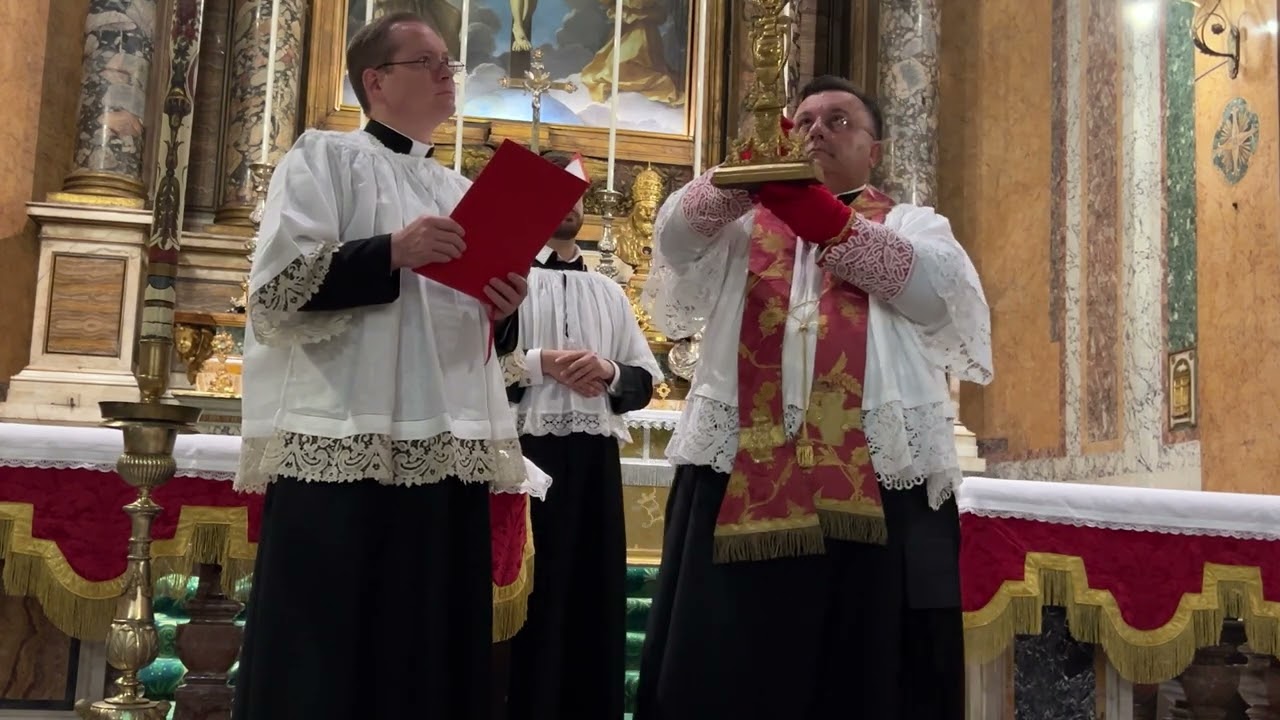
VIDEO: Feast of the Holy Relics

In the traditional Roman calendar,  the Vetus Ordo, today is the Feast of Holy Relics.

No, we are not celebrating your superannuated pastor.

Someone will, I hope, correct me if I am wrong, but I don’t believe there is a corresponding Mass in the Novus Ordo Missale.

I am mindful today and grateful for the apostolate of my good friend Fr. Carlos Martins, whose Treasures of the Church has brought countless thousands of people into contact with holy relics, resulting in conversions and healings.   At present he is taking a major relic of St. Jude the Apostle to different parishes in the United States, a real labor of love.

Just the other day here in Rome, at the parish I attended a solemn and festive exposition of the relics of which they have possession.   Each one was brought out and explained.

I learned that this is something that all the parishes used to do in Rome once upon a time.  No one does it anymore.  I think it is unique in Rome other than in Lent when in St. Peter’s many relics are exposed and the Veil of Veronica is displayed.

Here again is the video I made for the exposition at Santissima Trinità.

The organ you hear is over 400 years old. It was found in bad condition tucked away in a corner and efforts were made to restore it. It is a “portative” organ, and it could have been carried in processions with someone pulling straps on the side to blow the bellows within. There are only five like it in the world. Hearing this gives you a sense what what the Roman churches sounded like hundreds of years ago.

YouTube thumbnailYouTube icon

Posted in SESSIUNCULA |
Comments Off on VIDEO: Feast of the Holy Relics

What does the new Latin inscription really say? – “P.M.A.X.”

UPDATE:

This was suggested by a reader…

The letters “P. M. A. X” are not a – ridiculous – maltreatment of ‘P. MAX.’, but should be read as ‘P.M. A.X’, i.e. ‘Pontifex Maximus, anno decimo’. The work was done *in the tenth year* of this pontificate. The ‘X’ is a numeral, not a letter.

Hmmmm. Perhaps. However, there are standard ways of expressing that.


When you write something that you desire others to understand down the years, perhaps even down the centuries, it is probably a good idea to stick with clarity and to eschew the obscure.  So it is even today with living Latin.

I read a piece at Messa in Latino which jumped up and down on a new inscription in Latin on a new cathedra in Santa Maria Maggiore – more glorious than anything Caesar dreamed to park himself on.  The MIL piece says:

Sul secondo gradino è inciso invece, in latino, il nome del papa, seguito da quattro lettere inframezzate da punti, un’assoluta novità epigrafica: «Franciscus P.M.A.X.»“.

On the second step is engraved in Latin the name of the Pope followed by four letters broken up by periods, an absolutely new abbreviation: “Franciscus P.M.A.X.”

This abbreviation causes wonder.

The usual version is “PONT MAX” or “PM” for Pontifex Maximus (Supreme Pontiff).

The MIL piece has blistering comments by Giovanni Maria Vian, former editor of L’Osservatore Romano.

The error in the epigraph of the new artefacts installed in Santa Maria Maggiore for the jubilee is only the point of arrival in the long decline of sacred art. … The grotesque accident of the acronym P.M.A.X. it adds to the jarring placement of the ambo, candelabra and throne – more suited to a film set in the Middle Ages – on both sides of the canopy, supported by four wonderful porphyry columns, which surmounts the main altar. That is, in an area where the important eighteenth and nineteenth century interventions had demonstrated their ability to compare with the previous structure of the thousand-year-old basilica, confirming that the ancient can harmoniously coexist with the modern.
The new additions therefore appear completely incongruous in Santa Maria Maggiore, of a level certainly not up to the level of the surrounding scenery. But both the acronym – more surreal than macaronic – and the negligence or distraction of the clients, truly unforgivable, leave us astonished. Are those who were supposed to supervise also so ignorant of a minimum of Latin and history that they have not yet noticed the background?

I agree with Vian that this is a sign of lack of competence.

Nope.  They seem out of place.

“On the other hand,” quoth I, “there is bound to be a precedent for “PMAX”, which sounds like the name of the shop where you can buy pontifical vestments he will never wear.

Sure enough.  There is precedent for “PMAX.”   In a couple thousand of years of Latin there was bound to be.

I am not suggesting that the fellow who chose “P.M.A.X.” [sic] for this inscription was so brilliant that he knew that. Then, being a smarticus pantsicus (or S PANT) he used it to make people go “Hey, wait a minute!”

No. The easiest answer is the right one: he made a mistake that has a semi-precedent he didn’t know.

He and broken clocks…

Online I found a site about Roman coins.  HERE

It says:

P. MAX., or PON MAX., or PONT., or PONTIF MAX., and sometimes with the words at full length PONTIFEX MAXIMVS., is very frequently read on imperial coins from Augusts to the time of Gallienus, and, indeed, is found almost always to take priority before the other imperial titles.  And this we may readily suppose to have been done, in order that by such a union of the priestly and imperial functions in their own single persons, the Emperors might make it known to the world that the Senate and people of Rome invested them with the supreme administration as well of sacred and religious affairs, as of the civil and military business of the state.

P. MAX. Parthicus Maximus – Caracalla is thus denominated.

As you know, the Emperors were awarded the office of Pontifex Maximus.

NB: Caracalla and his title from having beaten some Parthians… .   Caracalla went with his father Septimius Severus, but wasn’t the general in the war.   So, his being P MAX… well… perhaps he beat some Parthians in a game of Pinocle.  Or… P. NOCLE.

I’m not sure I would like to be associated with him via a Latin inscription of dubious style.

Also, on a milestone in Algeria, there is a Latin inscription:

PART MAX BRIT MAX P MAX TR POT

Which is:

Parthici maximi Britannici maximi pontificis maximi tribunicia potestate

You see the title PMAX just before indicating that he was also Tribune of the Plebs.

Another:

NER ABNEP PART MAX BR GER MAX P MAX TRIB POT

Nervae abnepoti Parthico maximo Britannico Gerermanico maximo pontifici maximo tribunicia potestate

In Umbria at Gubbio

AUG P MAX TR P

Augustus pontifex maximus tribunicia potestate

And in Austria, Vienna

P F AUG P MAX TRIB POT COS

Pius Felix Augustus pontifex maximus tribunicia potestate consul

There are others for AUG P MAX. I won’t bore you with them.

P MAX – yup – it’s there.

The new “P.M.A.X.”… nope.

So, another dopey thing that some day a few guys with crowbars will be able to haul away for recycling in another project.

Posted in You must be joking! | Tagged ,
5 Comments

ROME 23/10 – Day 35: Purge them!

Sun up: 06:44

Sun down: 19:03

Ave Maria: 19:30

Days left: 3 full days

The Feast of St. Charles Borromeo, whose heart is in the church San Carlo al Corso.

Tomorrow it was one year ago that I had my newly re-gilded chalice consecrated by Card. Pell.  How we miss him.  During that day I had had a very important meeting and I prayed to St. Thérèse for help.  That evening I received, for the second time in my life, a sign from Thérèse, the absolutely out of the blue gift from my florist friend Pippo of a perfect white rose as I walked through the tumult of a very windy Campo de’ Fiori during its disassembly and clean-up phase.

I ask you dear readers for the next few days to pray to St. Thérèse for me.

Welcome registrant:

Gregory M.

Heading to church this morning.  Very peaceful.

Breakfast today after Mass with The World’s Best Sacristan™.  Which is mine?

Yesterday I had a hankerin’ for clams.  As you know, I went to the fishmonger, as one does.

The basis for this is white wine and a little oil in which I had for about 20 minutes warmed a half dozen smashed garlic cloves.   Then the heat went UP and in went the clams.   They had been purged in salt water for about 8 hours.   They say they are purged already.   “HA!” I purge them.  Salt water.  Change it a couple times.

All but one opened.   Really good.

Pull the clams out and finish cooking the half cooked spaghetti in the juice.

Dessert: puntarelle with anchovy.  Yum.

In the great church San Carlo al Corso, go around in back of the main altar where there is a little chapel with altar in the ambulatory.   This contains the heart of St. Charles.

The writing says “humilitas”, which was San Carlo’s motto.

St. Charles is instantly recognizable by his enormous nose…. er um… heart.   Actually, it was St. Philip Neri who had the miraculously enlarged heart.

What a lovely image, no?  Offering his heart?

Meanwhile offer this puzzle.   White to move and win.


1. Rd8+ Kb7 2. Rxc7+ Qxc7 3. Rd7 Qxd7 4. Qxd7+ Kb8 5. Kxb2 Rh6
NB: I’ll hold comments with solutions ’till the next day so there won’t be “spoilers” for others.

Interested in learning?  Try THIS.

Your use of my Amazon affiliate link is a major part of my income. It helps to pay for insurance, groceries, everything. Please remember me when shopping online. Thanks in advance.  US HERE – UK HERE

Think about candles for your advent wreath!

Posted in SESSIUNCULA |
4 Comments

23rd Sunday after Pentecost: “Stand firm in the Lord, my beloved!”

Cross posted with One Peter Five HERE.


We would have had a first selection from Philippians last week, the last Sunday of October, but the 22nd Sunday after Pentecost was superseded by the Feast of Christ the King in the Vetus calendar.  Sunday’s reading from Philippians 3:17-21 and 4:1-3 is also used in the Vetus calendar on the Feast of St. Clement (for an obvious reason).   About the issue of the reading being from two chapters.  This is not a case, as is so often happens in the Novus Ordo lectionary, of snipping out bits and pieces and gluing together the ends.  In this case, the end of the third chapter flows seamlessly into the fourth.  Paul did not write using chapters and verses. Those were added much later.

As always, let’s get some context.

We are drawing to the end of the liturgical year.  Therefore, we will more and more have references to the Second Coming, the end of the world and the resurrection.   Pius Parsch in his The Church’s Year of Grace writes of this period:

In the Sunday liturgies of autumn time it is not too difficult to detect a progression in three stages. The first stage consists in the Sundays transitional from summer to fall (15th to 17th after Pentecost); the second stage embraces the four finest formularies in the Church’s Harvest Time (19-21); the last stage begins today and brings the season to its conclusion (23-24). Nevertheless, the liturgy is at all times concerned primarily with the present situation, even when her sights are directed momentarily to the end of things. It is no different today.

It is noteworthy that for the Offertory antiphon we sing from Ps 129/130 which is the De profundis

De profúndis clamávi ad te, Dómine: Dómine, exáudi oratiónem meam: de profúndis clamávi ad te, Dómine. … Out of the depths I cry to You, O Lord; Lord, hear my prayer! Out of the depths I cry to You, O Lord.

Timothy is also a “co-signer” of the Letter to the Philippians.   Paul had visited Philippi with Timothy and Silas during his second missionary journey (50-52 AD) and also during his third (53-58).  Philippi was in north-eastern Greece in Thrace.  Fathers of the Church thought Philippians was written when Paul was in custody in Rome for the second time.   In Acts 16:20 we find they were accused of creating a disturbance in the city.  They were beaten and imprisoned.  This is when there was an earthquake while they were praying and singing hymns. Their chains fell off and the doors opened, leading to the conversion of their guard.  Philippians has the famous poetic Christological passage about Christ (2:5-11) where we get the mystery of His “self-emptying” (Greek kenosis).  Though He was equal to the Father, He did not consider being equal to God something to be “exploited/grasped at” (Greek harpagmón).  Instead, the Son “emptied himself” taking the form of a slave/servant and was obedient to death on a cross.    The hymn-like quality of this passage suggests that Paul had taught it to the Philippians for use in their local (and maybe elsewhere) liturgy.

In his letters, Paul usually stressed some characteristic of Christ and his audiences need to conform themselves to it.  In this case, the trait is Christ’s humility.

There are little personal touches in Philippians, such as his mention of his background as a Pharisee (1:8), the aforementioned story about being in prison and the earthquake (1:12:24), the mention of disagreement between collaborators brought up in our passage for Sunday (4:19).

17 Brethren, join in imitating me, and mark those who so live as you have an example in us. 18 For many, of whom I have often told you and now tell you even with tears, live as enemies of the cross of Christ. 19 Their end is destruction, their god is the belly, and they glory in their shame, with minds set on earthly things. 20 But our commonwealth is in heaven, and from it we await a Savior, the Lord Jesus Christ, 21 who will change our lowly body to be like his glorious body, by the power which enables him even to subject all things to himself.  Therefore, my brethren, whom I love and long for, my joy and crown, stand firm thus in the Lord, my beloved. I entreat Eu-o?dia and I entreat Syn?tyche to agree in the Lord. And I ask you also, true yokefellow, help these women, for they have labored side by side with me in the gospel together with Clement and the rest of my fellow workers, whose names are in the book of life.

Immediately after this is when Paul writes:

4 Rejoice in the Lord always; again I will say, Rejoice. Let all men know your forbearance. The Lord is at hand. Have no anxiety about anything, but in everything by prayer and supplication with thanksgiving let your requests be made known to God. And the peace of God, which passes all understanding, will keep your hearts and your minds in Christ Jesus.

Consoling for our own days.

The first verse of our reading for Mass has Paul telling the community to imitate him.  However, he and Timothy are already imitators.  At the very beginning of the Letter Paul and Timothy self-identify also as “servants”, which is the image presented of the Lord who self-emptied.   The Lord is humble, so his servant leaders must be humble so the people can be humble.   Christ is Paul’s model, Paul is their model: “Brethren, join in imitating me, and mark those who so live as you have an example in us” (3:17) and “What you have learned and received and heard and seen in me, do; and the God of peace will be with you” (4:9).  This isn’t the only time Paul urges this imitation.  For example, in 1 Cor 4:16-17:  “I urge you, then, be imitators of me. Therefore I sent to you Timothy, my beloved and faithful child in the Lord, to remind you of my ways in Christ, as I teach them everywhere in every church.”   Again, Timothy is involved.  Again, we have an indication of Paul’s programmatic instruction as he moved about.

The humility that Paul preaches cannot be attained in a day.

Let’s circle back to one thing.  Paul, as is often the case, is addressing a problem in his letter.  In Philippi there are, again, false teachers, probably Judaizers who would impose also Mosaic practices on all Christians, non-Jews alike.  He touches on this saying:

For many, of whom I have often told you and now tell you even with tears, live as enemies of the cross of Christ.  Their end is destruction, their god is the belly, and they glory in their shame, with minds set on earthly things (vv. 18-19).

I don’t think we should reduce the line about “their god is the belly” to mere sins of gluttony.  It stands for living according to the flesh, according to the world, rather than the “commonwealth in Heaven” which comes next.  Sometimes “commonwealth” (Greek políteuma) is rendered “conversation”, Latin conversatio, which is “conduct of life”.

We Christians must look beyond the world-bound to the Heaven-free, our true patria.  In our own day we hear about those who would reduce those means of freedom for Heaven, including self-control, abnegation, to a relaxed complacency which ultimate reflects the chains of the flesh.  In fact, there are calls by some to overhaul the Church’s perennial moral teachings according to “lived experience”.  You might recall how, some years ago in matters concerning marriage and divorce, the concept of continence, chastity, was relegated to an “ideal” that not all could attain.  As if God does not in fact offer sufficient graces and He lets people struggle under burdens they cannot bear.  In other words, God has set for us impossible goals, “ideals” of comportment.  We, on the other hand, can reinterpret those “ideals” through our “lived experience”. Taking note that most people don’t live according to the ideal upheld in the Church’s perennial teaching on morals, therefore we should – while not claiming to remove the ideal – simply go along with, tolerate those lapses from the ideal.   People can discern for themselves whether the “ideal” is really for them or not.  In effect, they come, with the seeming approbation of their pastors, to “glory in their shame, with minds set on earthly things”.

We must, as discussions about this approach build and multiply, be on our guard and not be seduced by them.  To this end, review your catechism!  Know well your Faith so you will not be confused when the cleverboots get going with their patter.

The Church’s perennial teachings on faith and morals are solid and dependable.  Anything proposed that would erode the plain meaning of those teachings should be firmly rejected.  Let our imitation of Christ and His humility to submit in the form of a servant even to the Cross be our model when we are faced with the temptation to live not for Heaven, but merely for the earthly.

Above, I mentioned the kenotic dimension of the Christology in Philippians, whereby Paul describes the self-emptying of the Son, talking the form of a servant.  At His earthly end, He was stripped of every worldly thing and showed us the perfection of freedom.  John in the Prologue of his Gospel says that they saw His “glory”.   Also above, I mention how at Philippi Paul and Silas, were singing in prison and an earthquake broke their bonds.  In the midst of their nothingness they were freed.   I’ll close with a remark by Bl. Ildefonso Schuster about our attitude toward worldly goods.

How much easier it is to save one’s soul in the midst of poverty and in a humble and obscure condition of life I Not that riches or worldly position are in themselves blameworthy; but very often to these advantages are joined certain dispositions of one’s mind and one’s surroundings which render the service of God very difficult to carry out. Such persons begin by excessive preoccupation concerning their material possessions, and end by losing altogether the supernatural sense of Christian life and holy mortification, becoming at last inimicos crucis Christi, as St Paul sadly remarks.

Finally, now that we are in the month dedicated to prayer for the Poor Souls, I would be remiss if I did not remind you that you, too, will one day draw your final breath.   No earthly advantage in that moment is going to raise you to the Beatific Vision.  Only your love for and fidelity to Christ will do that.  Practice dying well now by living better now, not according to the flesh and world, but in humble service of our Lord and Savior, especially in charity toward others.
Posted in Liturgy Science Theatre 3000, Save The Liturgy - Save The World |
Comments Off on 23rd Sunday after Pentecost: “Stand firm in the Lord, my beloved!”

Another reason why the TLM cannot be killed off. Boys.

At Aleteia, which I also never look at, there is a piece very much worth reading from top to bottom.  I’m glad a friend alerted me to this.

A man with sons set them to a hard task.  He muses about how boys will rise to the challenge.

Give boys “impossible” challenges and watch them thrive

[…]

The job wasn’t easy. Not at all. I don’t own a chain saw so I sent the boys up with a wood saw to operate by hand. Their task was to take turns until the job was done. I gave them safety tips, helped them get started, and left them to it. After watching for a few minutes, it became clear they didn’t need my supervision or micromanagement. Even though the job is a hard one, they tackled it with persistence and enthusiasm. This was their chance to accomplish a difficult, meaningful, grown-up task.

[…]

And then there’s this…

[…]

To take another example, I was talking to a friend the other day about our parish altar-serving program. When I first arrived at the parish, I was amazed at how many boys there were. (We’re an oratory dedicated to the Traditional Latin Mass and only have male altar servers.) We have about 60 boys who all know how to serve. They exhibit enthusiasm, dependability, and discipline — down to the way they kneel on the stone floor and fold their hands. There are no rebellious comments about our no-sneakers-while-serving rule or complaints about lining up to pray post-Mass prayers in the sacristy. In fact, the boys can’t seem to get enough of it.

I was marveling about this to a friend, who responded, “Do you know how the server program became the way it is?” I didn’t, so he filled me in on the early days of training the boys. Back when everyone was still learning, the boys didn’t yet have the habitual discipline to remain quiet and reverent in the sanctuary. A few of them were misbehaving near the altar, so the young man in charge of training them paused the entire training session, took all the boys outside, and had them do wall-sits to instill some discipline. The boys moaned but accepted their fate. After a few minutes, they actually began to challenge each other and brag about who could do it longer.

They had risen to the challenge and, even more, had begun to increase the difficulty. Today, the boys as a group are the best servers I’ve ever seen. The goal was set before them, the expectations were high, and they rose to the occasion.

[…]

Boys.

They grow up.

TLM families are having lots of boys.

They are treating them like boys, too.


UPDATE 5 Nov ’23:

A reader sent this… it seems appropriate…

I loved your blog pointing out the phenomenon of boys growing up to do hard things. I had to share this picture of 2 of our sons along with other boys helping to clear the land for the Benedictine Whitestone Monastery in Eastern WA state. They tent camped in 20 degree weather and assisted at Mass at dawn enduring the same temps. Father Miller is a wonderful priest and ray of hope!

We attend the FSSP St Joan of Arc in Post Falls and are very grateful for the traditional orders all flourishing in this area (our boys also get to serve Mass for the Carmelites at the Monastery of Jesus, Mary and Joseph just a few miles from our home). I thought you’d appreciate this bit of sunshine in a troubled world.
God Bless,
EW

It occurs to me that that pile of rocks didn’t just happen to be there.  That’s another thing they did.

Posted in ¡Hagan lío!, "How To..." - Practical Notes, Be The Maquis, Hard-Identity Catholicism, Just Too Cool, Si vis pacem para bellum!, The future and our choices |
10 Comments

ROME 23/10 – Day 34: IMPROVISE – ADAPT – OVERCOME

The Roman rising of the sun was at 06:42.  The Roman setting of the same will be at 19:05.

The Ave Maria bell is still on the 17:30 cycle.

Welcome registrant:

Angela61

It is a 1st Friday.

Yesterday was NOT Friday, and I indulged in some meat.   Specifically sausage (savory) and chicken (free range).

Free range pepperoni as well.  In Italian these are pepperoni… not to be confused with American pizza toppings.

I set everything to get some color in separate pans (I only have small, here), and then combined and readied all for the oven.  Just at the end, I added peas.

BTW… your use of my Amazon affiliate link is a major part of my income. It helps to pay for insurance, groceries, everything. Please remember me when shopping online. Thanks in advance.  US HERE – UK HERE

I wanted a sauce, so I took everything out of the pan.  Suddenly I realized I didn’t have much of anything as a thickening agent, so as to make a roux, and I also wanted volume.    So, …

IMPROVISE – ADAPT – OVERCOME

I had a little butter and a bottle of white wine and… fiber supplement capsules.  Psillium.

A good slosh of dry white wine, a few caps and… ecco!  Gravy.  Really good, too.   Great consistency.   I’ve gotta remember this.  No “floury” taste.

I ate about half of what I prepared and the rest went into the fridge for tomorrow.

And this is for a friend.   Thanks for the apron.

You can get one of those t-shirts, btw, from my swag store.    It has the Memorare in many languages on the back, to be recited daily for the overturning of a certain cruel act.

Tonight… clams from the fishmonger.

These aren’t clams, but it is at the fishmonger.

I just like writing “fishmonger”

And on the way home from the fishmonger, a truck was stocking a local butcher.

Use FATHERZ10 at checkout

In the Vetus Ordo it is a dies non, so I said a Requiem Mass today and my intention was for my deceased benefactors, those I know of and those whom I don’t.   When I receive word that someone who was a donor has died, I make a note of it and remember them in my prayers on their former giving days.

As a matter of fact, the “daily Requiem” Mass formulary, as an optional set of orations precisely for benefactors.   Here is the Postcommunio.  Would someone like to have a crack at it?

Praesta, quaesumus, omnipotens et misericors Deus: ut animae fratrum, propinquorum et benefactorum nostrorum, pro quibus hoc sacrificium laudis tuae obtulimus maiestati; per huius virtutem sacramenti a peccatis omnibus expiatae, lucis perpetuae, te miserante, recipiant beatitudinem.

Not just Latin puzzles….

…white to move.  Good luck.   This is hard.


1. Bc7 Qxc8 2. gxf7+ Kh8 3. Be5 Qc5 4. Bb2 Nc7
NB: I’ll hold comments with solutions ’till the next day so there won’t be “spoilers” for others.

Posted in Fr. Z's Kitchen, SESSIUNCULA |
13 Comments

ROME 23/10 – Day 33: Revelation of Relics and Repetition of Requiems

The sun rose at 06:41 and it will set at 17:06.

The Ave Maria will be silent when it ought to ring at 17:30.

5 full days left.

It is the Commemoration of All Souls.

I mentioned sunrise.

Yesterday, All Saints, a wonderful event took place at the parish. All the relics of which they have possession were exposed for veneration and were solemnly “introduced”.

One by one they were carried to the center of the church while they were described.  Then they were placed on the main altar.

Here is the video. At the end I edited it slight to eliminate a pause when the final relic, of the Cross, was fetched from the side altar in the back of church.

YouTube thumbnailYouTube icon

Here are a few closeups so you can see better what sort of reliquaries were involved.

Vespers followed.  It was lovely.

Today, All Souls, priests have the privilege of saying 3 Masses (without any other special pastoral circumstances necessitating it).   We can keep one stipend.    Christmas is the other day when priests can say three Masses, but we can keep all three stipends.

I’m cooking up another video for old subscribers, etc.

This morning found me putting on this….

It’s hard to see wear on black and the lighting isn’t great.

I remember that when we had the RED VESTMENT PROJECT we talked also about BLACK.  Some of you who had pledged for Red (or Black) hadn’t been selected at the time of the Red Project, because we had enough donors.

I posted something about a new SOLEMN set for the parish, but I didn’t receive quite the enthusiastic response as I did about the Red and Black vestments.

Perhaps it is time to revive the BLACK!   While I am in Rome, I could get things worked out.   I’ll watch the combox and email for feedback.

Who knows when this shop went out of business.  I’m perhaps the 50’s or 60’s.

Coming into church today, the place looked VERY different!

So, I won’t get to see the magnificent Guido Reni altarpiece again until I return, hopefully in March for Holy Week.

Pray for the dead, my friends.   This is the month of special prayer for the “Poor” Souls.

Pray for yourselves, as well, that God will preserve us all from a sudden and unprovided death.

Meanwhile.. DEATH to White’s King in THREE.

Black to move.

NB: I’ll hold comments with solutions ’till the next day so there won’t be “spoilers” for others.

Please remember me when shopping online. Thanks in advance. US HERE – UK HERE  These links take you to a generic “catholic” search in Amazon, but, once in and browsing or searching, Amazon remembers that you used my link and I get the credit.

Posted in Four Last Things, SESSIUNCULA |
13 Comments

ROME 23/10 – Day 32: Imagine the joy

We are out of the days of my natal month and the coincidence of calendar and my length of stay.  I enter now into the final stretch of days here, aka crunch time.  I’m disoriented at the prospect of leaving.  I feel as if I haven’t gotten done some of what I came to do.   What has happened, however, was a serious “recharging”, “deep cycle” so to speak.

The Ave Maria bells ought to chime at 17:30.   The sun shall set at 17:07.  Up came the sun at 06:40, somewhat obscured.

Welcome registrant:

lausannelad

It’ll probably rain this afternoon.

It is the Feast of All Saints.  Most places are closed today.

I renew my request for prayers for Giancarlo through the intercession of Bl. Luigi Maria Monti.  Ask the Blessed specifically for a sudden, complete and lasting healing.

Today we begin the month during which we pray in a special way for the souls in Purgatory.  They are called “poor” in that they can do little for themselves in their time of purgation and they need our assistance.  Happily we can do that as members, still, of the Church Militant.

Try to imagine the heavenly hosts rejoicing at the entry of another soul into the Beatific Vision, perhaps immediate, perhaps after a time of purification.   We have the more or less famous stories of the officially and traditionally acknowledged saints in heaven, yet the vast majority of the multitudes in the beyond are anonymous to us in large part.

We can at times be very confident about the happiness in Heaven of this or that person, especially those who received the Last Sacraments and Apostolic Blessing.  It is good to continue to pray for them.

Imagine also meeting someone in Heaven and learning that your prayers and penances. gaining indulgences, were helpful in abbreviating the time of purification.

On this joyous feast of All Saints, let us contemplate daly of our own path toward Heaven, which must involve death.   Holy Church has us pray in the Litany of Saints that we be preserved from a sudden and unprovided death, that is, a death without the chance for a good confession and, if possible, anointing and Communion.   As in everything else in life we need to practice to get good at something.  So, be mindful of death as the way to Heaven.

“State buoni se potete… Be good if you can” (St. Philip Neri)

Take on some penances.

Go to confession.

Yesterday I received a kind donation of RLR via Chase/Zelle (a favorite way of receiving).  RLR, I don’t have any email address for you, or I would send you a private note.  Thank you.

Thank you Roman donors.  Today’s Holy Mass is for your intention.   You’ve covered my time here and I will return the favor in the best way I know how.

Speaking of cover, I went by a hat shop I used to frequent… I now have enough hats, I think, so I was not looking to buy, but just to admire.

It seems they don’t want you to know what they are up to.  LOL.   I noticed this after I shot the pic.  The irony was too rich.

What’s the deal?  They don’t want people to know their prices?  What do they have?

At the place where LifeSite had their conference yesterday, I saw this which amused me greatly, given that the “Sant’Uffizio” or “Holy Office” was synonymous with the “Inquisition”.  So,… “Inquisition and Spa”… for your “wellness”.

Probably a nice place.

This sight just cheered me up.   Everything laid out in an orderly manner for priests and their Masses.

Your use of my Amazon affiliate link is a major part of my income. It helps to pay for insurance, groceries, everything. Please remember me when shopping online. Thanks in advance.  US HERE – UK HERE

Meanwhile, is it BLACK’s move.  Can you find mate in 4?

NB: I’ll hold comments with solutions ’till the next day so there won’t be “spoilers” for others.


The Summit Dominicans also make candles. Think: ADVENT WREATH.

Remote Chess Academy has a new price for their beginning package.


Posted in SESSIUNCULA |
15 Comments

1 November 2023 – All Saints – Holy Day of Obligation: We are all in this together.

While some bishop might obliterate the obligation by transferring it to a Sunday (what’s the point of that?), as All Saints falls on a Wednesday this year, it is a Holy Day of Obligation.

The Church can determine our obligations in regard to Mass attendance.  It is a Commandment of the Church that we are to fulfill our obligation on Sundays and other Holy Days of obligation. The Catechism of the Catholic Church explains our obligation in the section about the Third Commandment of the Decalogue:

2180 The precept of the Church specifies the law of the Lord more precisely: “On Sundays and other holy days of obligation the faithful are bound to participate in the Mass.” “The precept of participating in the Mass is satisfied by assistance at a Mass which is celebrated anywhere in a Catholic rite either on the holy day or on the evening of the preceding day.”

2181 The Sunday Eucharist is the foundation and confirmation of all Christian practice. For this reason the faithful are obliged to participate in the Eucharist on days of obligation, unless excused for a serious reason (for example, illness, the care of infants) or dispensed by their own pastor. Those who deliberately fail in this obligation commit a grave sin.

Canon Law

The Collect for today’s Mass for All Saints is the same in both forms of the Roman Rite.  It it found already in the 8th century Liber sacramentorum Engolismensis. It was also, with variations in the Gelasian Sacramentary, among the prayers for Sts. Peter and Paul.

Omnípotens sempitérne Deus, qui nos ómnium Sanctórum tuórum mérita sub una tribuísti celebritáte venerári: quaésumus; ut desiderátam nobis tuæ propitiatiónis abundántiam, multiplicátis intercessóribus, largiáris.

I like the separations of nos from venerari and, in the next section, desideratam from abundantiam. Note the assonance on “o” in the second line and “i” in the second. The third has strong alliteration and that whole second section hums with “m” and “n”. That last line has some thumping fine rhythms, and the final largiaris gives us a splendid clausula, or rhythmic closing: íntercessóribus lárgi-ÁH-REES. Wonderful to sing.

Our L&S says that celebritas, which looks an awful lot like an English word, is in the first place “a great number, a multitude, a large assembly, a numerous concourse or gathering, a crowd”. However, Cicero and Livy use it for “festal celebration, a solemnity” as in c. supremi diei, “a solemn procession for the dead”, appropriate for this time of year, for All Saints and All Souls. In the third place celebritas is “fame, renown”. But you might be able to hear how celebritas, while most naturally is in our prayer in the second sense of “solemnity”, can also bear that echo of “multitude” or even “throng” in our Latin ears and minds. Veneror is a deponent verb, and therefore has passive forms but active meanings. It means, “to reverence with religious awe, to worship, adore, revere, venerate” and “to ask reverently for any thing, to beseech, implore, beg, entreat, supplicate”.

Propitiatio, in our liturgical prayer, reflects propitiation in the sense of atonement, to be sure, but it is often rendered as “pardon, mercy, merciful indulgence”.

LITERAL REWORKING:

Almighty, eternal God, who granted us to venerate the merits of all Your saints under a single solemn festal celebration: we beseech You; that, our intercessors having been multiplied, You bestow upon us the longed for abundance of Your atoning mercy.

I like that image of the multiplication of intercessors.

Each saint before the throne of God – in love for us and desire for us to join them – intercedes and and glorifies.  God’s glory and how we receive intercessory help are both greatly increased with every soul that enters heaven.  Each soul entering heaven massively increases joy by orders of magnitude.

Remember the great scene in the movie Fantasia when Mickey Mouse is trying to stop the brooms from multiplying?  They redouble and redouble and redouble, their numbers compounding.  Or, sticking to pop culture and magicky stuff, that time in the Harry Potter movie when touching something made it reduplicate until you were overwhelmed by the volume.

We, however, cannot for a moment think that we can be mere passive recipients of their loving intercession, any more than we can commit the errors of Lutherans and think that we are strictly passive in the reception of graces.  We have to do our part.

Concerning our brethren in the Church Triumphant, we of the Church Militant must beg for intercession from on high and pray and intercede for the Poor Souls in Purgatory.

We are all in this together.

We are together because of our common humanity and our baptism into Christ, from whom come and to whom go all things.

This perspective can help us get through all the vicissitudes of this life, the duties and challenges of our respective vocations… no matter what.

Are you frustrated in your life or what you see going on around you?  Anxious?  Angry or sad?

Let’s hear this prayer through the lens of the Imitation of Christ (3, 47):

THE VOICE OF CHRIST:

My child, do not let the labors which you have taken up for My sake break you, and do not let troubles, from whatever source, cast you down; but in everything let My promise strengthen and console you. I am able to reward you beyond all means and measure.

You will not labor here long, nor will you always be oppressed by sorrows. Wait a little while and you will see a speedy end of evils. The hour will come when all labor and trouble shall be no more. All that passes away with time is trivial.

What you do, do well. Work faithfully in My vineyard. I will be your reward. Write, read, sing, mourn, keep silence, pray, and bear hardships like a man. Eternal life is worth all these and greater battles. Peace will come on a day which is known to the Lord, and then there shall be no day or night as at present but perpetual light, infinite brightness, lasting peace, and safe repose. Then you will not say: “Who shall deliver me from the body of this death?” nor will you cry: “Woe is me, because my sojourn is prolonged.” For then death will be banished, and there will be health unfailing. There will be no anxiety then, but blessed joy and sweet, noble companionship.

If you could see the everlasting crowns of the saints in heaven, and the great glory wherein they now rejoice – they who were once considered contemptible in this world and, as it were, unworthy of life itself – you would certainly humble yourself at once to the very earth, and seek to be subject to all rather than to command even one. Nor would you desire the pleasant days of this life, but rather be glad to suffer for God, considering it your greatest gain to be counted as nothing among men.

Oh, if these things appealed to you and penetrated deeply into your heart, how could you dare to complain even once? Ought not all trials be borne for the sake of everlasting life? In truth, the loss or gain of God’s kingdom is no small matter.

Lift up your countenance to heaven, then. Behold Me, and with Me all My saints. They had great trials in this life, but now they rejoice. They are consoled. Now they are safe and at rest. And they shall abide with Me for all eternity in the kingdom of My Father.


Posted in WDTPRS |
4 Comments

The present needs the past

Right now some clamor for everything in the Church, all her doctrine, liturgy (which is doctrine), law, structures… everything… to be “reinterpreted” in light of the “spirit” of Vatican II and the “spirit” of ongoing “synodality” (“walking togetherity”).

From the indominable Laudator.  My emphases…

Linking Up the Present With the Past

Ronald A. Knox (1888-1957), Occasional Sermons (New York: Sheed & Ward Inc., 1960), pp. 47-48:  (A different edition HERE)

[E]very new thing in human history is built against the background of some older thing which went before it. As the picture gallery of some great house preserves the memory of its ancestry, tracing down to the latest instance the persistence of the same characteristics, and linking up the present with the past; so the greatest institutions of the world are those which combine something ancient with something new. And among these, even the Catholic Church.

It is a human weakness of ours to be always crying out for complete novelty, an entire disseverance from our past. Our old traditions have become so dusty with neglect, so rusted with abuse, that we are for casting them on the scrap-heap and forgetting that they ever existed. The Church conserves; she bears traces still of the Jewish atmosphere in which she was cradled; traces, too, of the old heathen civilization which she conquered. And in her own history it is the same; nothing is altogether forgotten; every age of Christianity recalls the lineaments of an earlier time. People think of her as if she kept a lumber-room; it is not so; hers is a treasure-house from which she can bring forth when they are needed things old as well as new.

And again… for those who think that one mustn’t, can’t, dassent ever disagree with “Peter”.

Ronald A. Knox (1888-1957), The Pastoral Sermons (New York: Sheed & Ward Inc., 1960), pp. 430-431:

No, there is nothing distressing to the Christian conscience, either in the fact that St Paul should have disagreed with St Peter, or in the fact that St Peter should have been on the wrong side. Nor is it historically accurate to think of St Peter as a man wedded to old ways of thought, over-anxious about what other people would think; the account given of him in the Acts of the Apostles is enough to prove the contrary. But we may, if we will, concentrate our attention upon this particular scene in the lives of two great princes of the Church, and trace in it the age-long conflict between two forces in the history of the Church. Let us not call them two contrary, rather two complementary forces, the resultant of which is the well-being of the Catholic community. One is the tendency to strike out on new lines, try new experiments, assert, wherever it may be lawfully asserted, the principle of freedom. The other is a jealous regard for tradition, for established precedent; a reluctance to be stampeded by the fashion of the moment, to barter away, for some momentary advantage, a long inheritance of accumulated wisdom. Call them, if you will, the Liberal and the Conservative tendency; but do not forget that those words have modern associations which will confuse our thought, if we are not careful in the use of them.

I shall be told that the Catholic Church is not alone in feeling, century after century, the strain of that conflict. It is all around us; in a changing world, all our debates can easily be summed up under the formula, “Is it wiser to go forward, or to protect what we have?” But we Catholics, it must be remembered, cannot approach these questions so lightly, or with such free hands, as our neighbours. It is the first business of the Church to safeguard a deposit of revealed truth handed down to her, for all time, by a divine Founder; let her prove false to that trust, and the Church unchurches herself.

Abandon the past, let go or – quod Deus avertat – reject a divinely revealed deposit, and the Church is unchurched.

Posted in Our Catholic Identity, Pò sì jiù | Tagged
5 Comments