The present needs the past

Right now some clamor for everything in the Church, all her doctrine, liturgy (which is doctrine), law, structures… everything… to be “reinterpreted” in light of the “spirit” of Vatican II and the “spirit” of ongoing “synodality” (“walking togetherity”).

From the indominable Laudator.  My emphases…

Linking Up the Present With the Past

Ronald A. Knox (1888-1957), Occasional Sermons (New York: Sheed & Ward Inc., 1960), pp. 47-48:  (A different edition HERE)

[E]very new thing in human history is built against the background of some older thing which went before it. As the picture gallery of some great house preserves the memory of its ancestry, tracing down to the latest instance the persistence of the same characteristics, and linking up the present with the past; so the greatest institutions of the world are those which combine something ancient with something new. And among these, even the Catholic Church.

It is a human weakness of ours to be always crying out for complete novelty, an entire disseverance from our past. Our old traditions have become so dusty with neglect, so rusted with abuse, that we are for casting them on the scrap-heap and forgetting that they ever existed. The Church conserves; she bears traces still of the Jewish atmosphere in which she was cradled; traces, too, of the old heathen civilization which she conquered. And in her own history it is the same; nothing is altogether forgotten; every age of Christianity recalls the lineaments of an earlier time. People think of her as if she kept a lumber-room; it is not so; hers is a treasure-house from which she can bring forth when they are needed things old as well as new.

And again… for those who think that one mustn’t, can’t, dassent ever disagree with “Peter”.

Ronald A. Knox (1888-1957), The Pastoral Sermons (New York: Sheed & Ward Inc., 1960), pp. 430-431:

No, there is nothing distressing to the Christian conscience, either in the fact that St Paul should have disagreed with St Peter, or in the fact that St Peter should have been on the wrong side. Nor is it historically accurate to think of St Peter as a man wedded to old ways of thought, over-anxious about what other people would think; the account given of him in the Acts of the Apostles is enough to prove the contrary. But we may, if we will, concentrate our attention upon this particular scene in the lives of two great princes of the Church, and trace in it the age-long conflict between two forces in the history of the Church. Let us not call them two contrary, rather two complementary forces, the resultant of which is the well-being of the Catholic community. One is the tendency to strike out on new lines, try new experiments, assert, wherever it may be lawfully asserted, the principle of freedom. The other is a jealous regard for tradition, for established precedent; a reluctance to be stampeded by the fashion of the moment, to barter away, for some momentary advantage, a long inheritance of accumulated wisdom. Call them, if you will, the Liberal and the Conservative tendency; but do not forget that those words have modern associations which will confuse our thought, if we are not careful in the use of them.

I shall be told that the Catholic Church is not alone in feeling, century after century, the strain of that conflict. It is all around us; in a changing world, all our debates can easily be summed up under the formula, “Is it wiser to go forward, or to protect what we have?” But we Catholics, it must be remembered, cannot approach these questions so lightly, or with such free hands, as our neighbours. It is the first business of the Church to safeguard a deposit of revealed truth handed down to her, for all time, by a divine Founder; let her prove false to that trust, and the Church unchurches herself.

Abandon the past, let go or – quod Deus avertat – reject a divinely revealed deposit, and the Church is unchurched.

Posted in Our Catholic Identity, Pò sì jiù | Tagged
5 Comments

ROME 23/10 – Day 31: LifeSite Rome Forum meeting

On this last day of my natal month, the sun rose at 06:39 and it set at 17:08.   The Ave Maria – 17:30.

It is the Feast of Alfonso Rodriguez, SJ (+1617), and the Vigil of All Saints.

Does that name seem familiar to anyone?  Yes, but no.

Hence, some relics are covered for tonight.   TOMORROW… wow!

I went to Day 1 of the Rome Life Forum held by LifeSite.

Bp. Strickland spoke.  I had a nice chat with him ahead of time.  I like him.

Card. Müller spoke.  He is getting better and better.

These two chatted after… I heard about it.  Heh.

Liz Yore gave a forceful speech.

Michael Matt is really pissed off, but there was in the end a positive message.

After all… we’re Catholic, right?

I ran a couple quick errands tonight.  I needed flowers and more aceto d’alcool… and dish sponges… and a toothbrush.   At St. Bridget I prayed for the A’s, who have stayed there many times, kind donors and supporters for years.

I’m tired.

White to move.   Just DO IT.

Buy wine from monks.  Just do it… please.

Please remember me when shopping online. Thanks in advance. US HERE – UK HERE  These links take you to a generic “catholic” search in Amazon, but, once in and browsing or searching, Amazon remembers that you used my link and I get the credit.

Posted in SESSIUNCULA |
8 Comments

ROME 23/10 – Day 30: promised videos

The Roman sun came up at 06:38 (now that we are off the “ora legale”) and it will leave Rome’s sight at 17:10.

The Ave Maria Bell should ring at 17:30.

Welcome registrants:

DePicchi
Knee1987
PaterNoster22

I offered Holy Mass (Votive of the Holy Trinity) today for the intention of all my monthly donor benefactors.  How grateful I am to you all.  Thank you.  It is my duty and pleasure to pray for you on a daily basis and to offer Mass for your intention frequently.

In the last couple of days, I promised a little video.   My poor laptop processes this rather slowly, *sigh*.

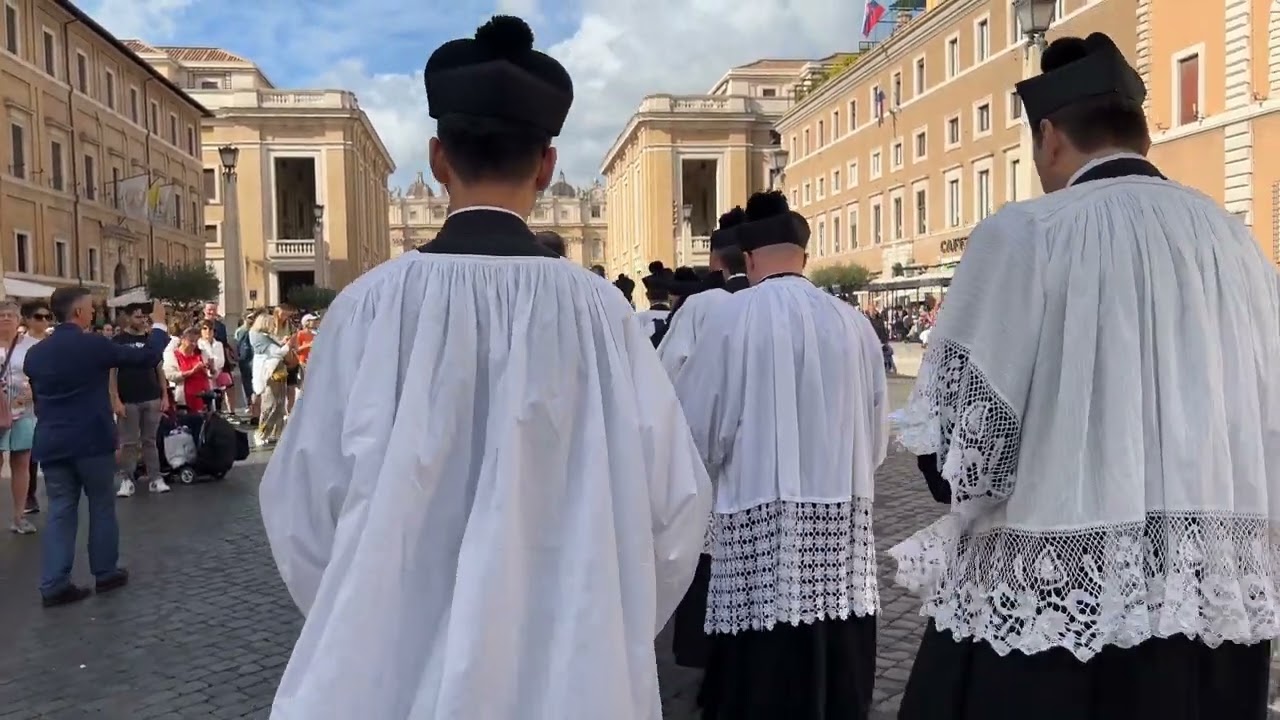
Here is a taste of the Procession last Saturday to St. Peter’s Basilica for the oh boy how wonderful celebration of Sext so generously permitted by the powers that be in their magnificent largess and charity.

YouTube thumbnailYouTube icon

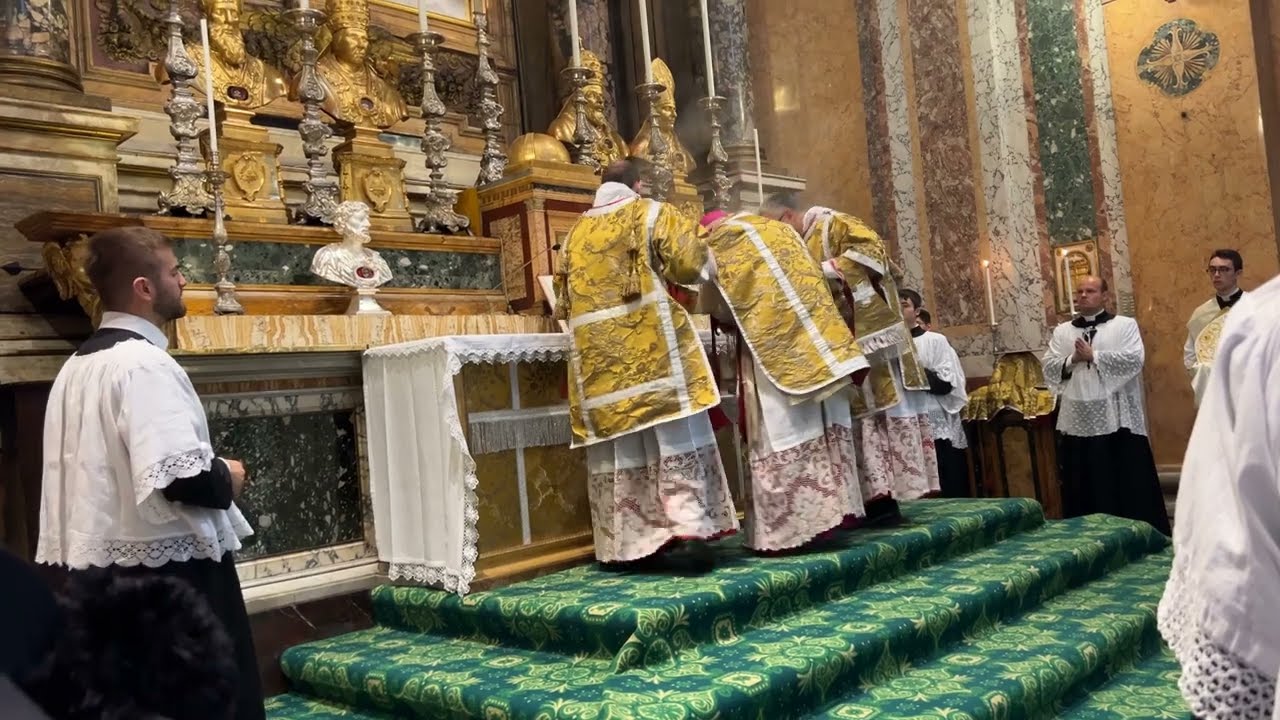
Here is a taste of the Pontifical Mass at the Faldstool for Christ The King.  Bishop Pozzo, formerly of the Pontifical Commission “Ecclesia Dei” is the celebrant.  BTW… in the video of Benedict’s resignation, you see Bp. Pozzo sitting near the papal throne with a look of shock on his face, since he understood the Latin he was hearing.

YouTube thumbnailYouTube icon

Meanwhile, black to move and win.   There is a forcing line.

NB: I’ll hold comments with solutions ’till the next day so there won’t be “spoilers” for others.

Until 2 November, Igor is offering 50% off on courses along with a BOGO deal. It seems that he and I share the same birthday (28 Oct) and this is how he is celebrating. Fine with me! You might take a moment just to check it out.

In chessy news, there is a battle going on in the Grand Swiss on the Isle of Man for spots in the Candidates Tournament which will decide who challenges Ding Liren for the World Champion title.   Several spots are still open, but four have already qualified: Ian Nepomniachtchi (the last challenger), Magnus Carlsen (World Cup winner but who knows), Praggnanandhaa Rameshbabu (2nd World Cup) and Fabiano Caruana 3rd World Cup).   In the Swiss, Hikaru Nakamura is leading in the Open section.

Finally, there’s this from a priestly reader.

1. … Rxd7 2. Rxd7 Qf3! 3. Rxf7+ Kg8 4. Rd7 Re2+ 5. Qxe2 Qxe2+

3. Kg1 Re2 eventually white can try for perpetual check but will soon run out of checks

Posted in SESSIUNCULA |
2 Comments

“Moral Injury” revisited

Some time ago, I wrote about moral injury and priests who are compelled by authorities to do things that are against their consciences.

Today I read that Archbp. Broglio of the Military Services had a series of convocations with active duty priest chaplains and the topic was “Warrior Ethos and Moral Injury” presented by Dr. Mark Moitoza, who wrote his thesis on the issue.

In this case moral injury is defined as:

“damage to a person resulting from a violent contradiction of deeply held moral expectations. Those impacted by moral injury find that it disrupts their confidence and affects their ability to make ethical and moral decisions. When this happens trust of self, trust of others, trust of the command, and even trust in God is broken and becomes difficult to bear.”

Going on…

“While moral injury can be a potential invisible injury of war it may also occur in the high-stakes situation of military training, disaster relief efforts, military sexual trauma, or unhealthy command structures. One’s sense of self-worth becomes diminished and inhibits seeking help from God or the community of faith.”

Does this sound familiar?

While you are at it, please support the Archdiocese for Military Services.

Click to help.

Posted in "How To..." - Practical Notes | Tagged
5 Comments

ASK FATHER: “active participation” in the Traditional Latin Mass

From a reader…

QUAERITUR:

I have a question about “active participation”.

The priest that used to service my SSPX chapel was very adamant about is using a missal to follow and pray the Mass. He added that it wouldn’t be necessary if you were fluent in Latin.

When I mentioned this in a Trad Facebook group, a couple people mentioned the old school “say the Rosary” during Mass and expressed respectful disagreement with Father.

We all know the line about “active participation” concerning the vernacular of the Novus Ordo. But this is the first time I heard it applied as such to the Vetus Ordo.

In your opinion, is Father correct in his insistence on using the missal to pray the VO?

The concept of “full, conscious and actual/active” participation expressed in Sacrosanctum Concilium did not leap full-grown like Athena from the heads of the Council Fathers.   The call for deeper participation grew up all through the time of the 20th century’s “Liturgical Movement” and before.   Long before the Council and Popes John XXIII and Paul VI, Pius X and Pius XI were urging people to more outward participation as an aid to their interior engagement.   Pius XII also had his crack at it, although late in his pontificate in a document on music we were instructed that the highest form of active participation at Mass is the reception of Communion in the state of grace.  Reception… sounds passive, right?  It isn’t! When the mind is engaged and the heart is straining forward toward the moment you are actively receptive.  There’s nothing passive about it!

The use of a “hand missal” is really helpful, particularly for those who have a hard time remembering something for more than a quarter hour.   This is why I constantly suggest that people start looking at the readings and other texts of Mass with a good hand missal or other source on THURSDAY, refreshing every day till Sunday.   On Sunday, you will be able to hear what you learned over the last few days even as the Latin is being sung.  Sure, the reading is being said or sung in Latin.  So?  You’ve familiarized yourself with it for days before hand.   Sure, take the missal along.   Then, review what you heard on Sunday each day through Wednesday and start over.   Vernacular is being read?  Okay… repetita iuvant.   Fluent in Latin or not… prepare.

One thing we have to remember about the readings at Mass, which is especially evident in the Vetus.   The readings are also sacrifices being raised on high to the Father.  The Word is being raised upward.  This is why the priest has to read them and why they are read at the altar even if they are sung by subdeacon and deacon or read in the vernacular.  This is also why they should be read in a sacral language, for us in the Latin Church – Latin.  This sacrificial sense is stripped from the Novus Ordo, which, along with the multiplication of readings, gives the whole first part of Mass, the “liturgy of the Word” a didactic feeling.   While there is certainly room for and an element of didacticism in liturgy it is not by any stretch of the imagination the primary element.

(I’ll wager that quite a few priests trained in more recent times who say the Vetus Ordo don’ realize that the readings are also sacrifice.)

It is right that we should be urged to engage with our minds and hearts, focused and commanded by our wills, in the words and gestures of Holy Mass, either in the Novus Ordo or in the Vetus Ordo.   Frankly, the Vetus Ordo is in many ways even richer than the Novus, even though there isn’t the legendary variety of Scripture in the Vetus as the Novus.   If you can do this without the aid of a book or sheet, great!   If the book helps, great!   If you want to pray the Rosary, great!  Maybe a little less great, but… prayer is prayer.   It’s just that the Mass is for us Catholics the “fons et culmen… source and summit” of our Catholic identity.

Every word and gesture of the sacred liturgy, especially Holy Mass, is CHRIST acting and speaking.   As Head, He speaks in the person of the priest.  As Body He speaks through the congregation.  When they speak and act together, such as the moment of Communion, Head and Body are manifestly one, Christus Totus, in that sublime, mysterious moment.

The rites are our rites.  We are our rites.  They shape us.  We have our identity also from them.

As a baptized person you have a real share in Christ’s priesthood.  That share isn’t like that of the ordained priest, but it is real.  It enables you to offer pleasing sacrifice to God.

Knowing that you share in the priesthood of Christ, knowing that every word is Christ, knowing what you are going to be presented on Sunday, prepare well so that you can with your whole mind and heart under the guidance of your will actively receive everything that Christ wants to give you through the sacred rites of His Church.

I will never say that it is a bad thing to say the Rosary during Mass.  As a matter of fact, sometimes that is just the right thing to do.  However, most of the time we are offered the opportunity for a fuller engagement, not just with the Lord at Communion (or maybe not if you are not in the state of grace), but in the whole beautiful formulary of Mass for the day, part of a seasonal cycle or a saint’s day.

Posted in "How To..." - Practical Notes, ASK FATHER Question Box, Hard-Identity Catholicism, Liturgy Science Theatre 3000, Save The Liturgy - Save The World | Tagged ,
15 Comments

ASK FATHER: How much prayer is enough?

From a reader…

QUAERITUR:

I have seen several Examination of Conscience guides mention neglecting prayer as a sin. Could you unpack this a bit? Failing to pray at all for a week, for example, seems like it would be a mortal sin, but what about saying only 3 Hail Marys before bed on a particular day? Is this such light prayer that it also constitutes sinful neglect?

St Teresa of Avila says: “no prayer, no salvation. No mental prayer, no holiness.”

Turning to Scripture, I am reminded of 1 Thessalonians 5:16-18:

16 Rejoice always, 17 pray constantly, 18 give thanks in all circumstances; for this is the will of God in Christ Jesus for you.

“Pray always”.  How’s that?

It isn’t a suggestion, by the way.  Paul was serious.

Okay, we are not going to be doing that explicitly.   Not even those who are like Carthusians are going to get that that point unless …

…unless in their relationship with God their will – their intention – is oriented to God such that all that they do has a prayerful component.  Their desire is to pray.  They want that all that they do be also offered to God.  Therefore, in all that they do their actions are intentionally prayerful.   That takes a lot of practice, I think and a lot of grace.   It’s a matter of relationship with God.

It is important that we don’t reduce our relationship with God to a contractual relationship.

For example, the ancient pagan Romans thought they had a contractual relationship with the gods expressed in the phrase “Do ut des… I give (something to you) in order that you give (something to me)”.  Hence, if the Romans offered their sacrifices according to the proper form, the contract was maintained, peace with the gods – the pax deorum – was maintained.  The ancient pagans thought Christians were interrupting that contractual arrangement, which made them a danger to the pax deorum, which made the enemies of the “state”.

As an aside, the ancient pagan sacrifices had to be precise for the contract to be maintained.  So, if anyone screwed up anything, they had to start over.   No state business could be done without the necessary sacrifices blah blah by the consul whose turn it was, etc.  There was one period of internal political warfare between factions when one side manage to ram into the consulship a guy with a stutter.   Get my point?   I digress.

Let’s not reduce our relationship with God to a contract.  “I’ll pray this amount.”

We want to have a good, strong healthy deepening relationship with God.

Asking, “how much is enough” is sort like asking “How often should I talk to my wife so she won’t leave me?”  That’s not a healthy marriage.

An examen list will address the issue of lack of prayer.  However, sins are not so much breaking of rules as they are breaking of the Sacred Heart, a violation of a relationship.

That said, rules can be helpful if the relationship isn’t yet strong.

If one’s heart has all sorts of disordered attachments, “pray always” becomes difficult if not impossible. In that case rules guide us.

For example, clergy and religious have a rule to pray the Office.

Our Lady insists on the daily prayer of the Rosary (15 or 20 minutes). Perhaps, for a layman, that would be enough to maintain the relationship.

No matter what, when we do what we do with great love, Our Lord will be better pleased than if what we do is just for following the rules.   For example, almsgiving is more pleasing to Our Lord when given with love.   Full, conscious, actual participation at Holy Mass is more pleasing that simple fulfillment of a precept.

Perhaps we can see prayer and all the other good things we can do as being like the talents in the parable.  God has made a great investment in each one of us.  How can we repay and also overpay in loving gratitude for His investment in us?   Formal prayer can be like that.  Formal prayer is a kind of tithing of one’s time determined by one’s state in life.

Formal and loving with enduring intention are not mutually exclusive, of course.  And the one -the formal – can, over time, lead to the other.

We should all have a solid regimen of good devotions and prayers.  Classic devotions and prayers were crafted in prayer and then polished over time into beautiful jewels.

The beautiful thing about such a regimen is that it deepens with time.  Maybe it begins more in the category of a “rule”, but it nevertheless affects and effects a relationship. Time and experience (regularity and quality) make it ever more meritorious.

After that longish ramble, I’ll try to be concrete, provided we don’t make the mistake of reducing our relationship with God to a contract.

What might be “enough”?   It seems to me that:

  • a morning offering
  • prayers before and after meals
  • the Angelus/Regina caeli
  • the Rosary (15-20 minutes of your day?)
  • an evening offering with your examination of conscience

Our Lady insists on the Rosary… doesn’t she.  That, at least, should be your practice, if nothing else.

Of course we can add all sorts of other wonderful things, such as visits to the Blessed Sacrament.  However, for a layman that might be enough to establish a good daily prayer relationship with God provided that we are also on the road to more rather than just remaining in the status quo ante.

Posted in "How To..." - Practical Notes, ACTION ITEM!, Our Catholic Identity | Tagged
5 Comments

Feast of Christ the King and the Act of Consecration of the Human Race to the Sacred Heart of Jesus

Sunday, in the Church’s Vetus Ordo calendar, is the Feast of Christ the King, there fixed on the last Sunday of October.

It is customary on the Feast of Christ the King publicly to recite the Act of Consecration of the Human Race to the Sacred Heart of Jesus.  This can bring a plenary indulgence.

GET ON YOUR KNEES RIGHT NOW AND RECITE THIS PRAYER ALOUD.  JUST DO IT.


Act of Consecration of the Human Race to the Sacred Heart of Jesus

Most Sweet Jesus, Redeemer of the human race, look down upon us humbly prostrate before Thine altar. We are Thine, and Thine we wish to be; but to be more surely united to Thee, behold each one of us freely consecrates ourselves today to Thy Most Sacred Heart.
Many indeed have never known Thee; Many too, despising Thy precepts, have rejected Thee. Have mercy on them all, most merciful Jesus, and draw them to Thy Sacred Heart. Be Thou King, O Lord, not only of the faithful children, who have never forsaken Thee, but also of the prodigal children, who have abandoned Thee; Grant that they may quickly return to their Father’s house lest they die of wretchedness and hunger.
Be Thou King of those who are deceived by erroneous opinions, or whom discord keeps aloof, and call them back to the harbor of truth and unity of faith, so that there may be but one flock and one Shepherd.
Be Thou King of all those who are still involved in the darkness of idolatry or of Islamism, and refuse not to draw them into the light and kingdom of God. Turn Thine eyes of mercy towards the children of the race, once Thy chosen people: of old they called down upon themselves the Blood of the Savior; may it now descend upon them a laver of redemption and of life.
Grant, O Lord, to Thy Church assurance of freedom and immunity from harm; give peace and order to all nations, and make the earth resound from pole to pole with one cry; praise to the Divine Heart that wrought our salvation; To it be glory and honor forever.

UPDATE

From the Vatican’s Apostolic Penitentiary, the concession of the plenary indulgence, in Latin, with the prayer, in Latin:

Plenaria indulgentiaconceditur christifideli qui, in sollemnitate D.N. Iesu Christi Universorum Regis, actum dedicationis humani generis eidem Iesu Christo Regi (Iesu dulcissime, Redemptor) publice recitaverit; in aliis rerum adiunctis indulgentia erit partialis.5

Iesu dulcissime, Redemptor humani generis, respice nos ante conspectum tuum humillime provolutos. Tui sumus, tui esse volumus; quo autem tibi coniuncti firmius esse possimus, en hodie sacratissimo Cordi tuo se quisque nostrum sponte dedicat. Te quidem multi novere nunquam; te, spretis mandatis tuis, multi repudiarunt. Miserere utrorumque, benignissime Iesu, atque ad sanctuum Cor tuum rape universos. Rex esto, Domine, nec fidelium tantum qui nullo tempore discessere a te, sed etiam prodigorum filiorum qui te reliquerunt: fac ut domum paternam cito repetant, ne miseria et fame pereant. Rex esto eorum, quos aut opinionum error deceptos habet, aut discordia separatos, eosque ad portum veritatis atque ad unitatem fidei revoca, ut brevi fiat unum ovile et unus pastor. Largire, Domine, Ecclesiae tuae securam cum incolumitate libertatem; largire cunctis gentibus tranquillitatem ordinis; perfice, ut ab utroque terrae vertice una resonet vox: Sit laus divino Cordi, per quod nobis parta salus: ipsi gloria et honor in saecula. Amen.

Posted in SESSIUNCULA |
6 Comments

Your Sunday Sermon Notes – Christ the King (N.O.: 30th) 2023

Share the good stuff.

It’s the Feast of Christ the King in the Vetus Ordo and the 30th Sunday of the Novus Ordo.

Was there a GOOD point made in the sermon you heard at your Sunday Mass of obligation?

Tell about attendance especially for the Traditional Latin Mass. I hear that it is growing. Of COURSE.

Any local changes or (hopefully good) news?

I have some thoughts about the Sunday Epistle reading posted at One Peter Five.

Sometimes we speak loosely about the “head of the Church.” Most of the time that’s tolerable, since we are speaking somewhat casually.  Very often people say that “the Pope is the head of the Church.” No. Christ is the head of the Church. The Pope, Successor of Peter, is Christ’s Vicar on earth. Vicar is from the Latin vicarius, “a substitute, deputy, proxy, a locum tenens.” The Successor of Peter is the visible, substitute “head” of the earthly Church. He is the visible figure of unity, one of the Church’s marks or attributes along with holiness, catholicity and apostolicity. The Petrine (having to do with Peter) ministry of the figure whom we call the “Pope” (papacy is an institution that over time developed around the office of the Bishop of Rome, Peter’s Successor) is a constitutive element of the Church that solidifies Christ’s gifts to the Church of indefectibility and infallibility.

Ultimately, however, the Pope is not the “head of the Church.” The head of the Church is Christ.

Posted in SESSIUNCULA | Tagged
6 Comments

ROME 23/10 – Day 29: This is day 302 of this year of grace

Okay… let’s do this.   “Daylight savings” is over.

06:36

17:11

17:30 is the Ave Maria

This is day 302 of this year of grace.  There were/are 64 to go as I write and this day ends soon.

Welcome registrants:

SierraFaith
gerardandrewjohn

In the Vetus calendar, it being the last Sunday in October, it is the Feast of Christ the King.

Again, I had this pesky video problem.  I have some lovely audio.  Will you be patient and let me get to it later?

Today…

That archpriest shouldn’t be looking around!

It was a feast for the eyes and ears.  There was a visiting choir from England.  Ahhhhhh…..

I wanted to give you a sense of the textures.  Imagine this with strong choral music and incense heavy with frankincense wafting.

Why not just a humble clay thing and some strips of whatever.  Sure, when nothing else is possible, with joy!

This… this… speaks to decorum and decorum speaks to what is aptum et pulcrum which speak to bonum et verum which point to DEUM UNUM TRINUM.

There was a moment in the Mass when the choir was singing and the sacred ministers were doing their ballet and I was reading Lauds and I went into a kind of tunnel, like StarGate with less whoosy woozy.  It was a perfect moment of clarity in the Roman Rite, in Rome, in this church and at this moment with all these people from every where in the world so focused and happy.

Here’s a nice shot of some members of the Archconfraternity that was founded by St. Philip Neri.  I especially want to post this for a friend whose induction in the confrat is pending his return to Rome.

This week they are conducting another food drive for the poor of the area.  People will bring food stuffs and give donation.  If only they had a world-wide donate button on a dedicated site… hmmm.

Folks.  I need income so I keep posting this.  I like getting income when you also can benefit. Please remember me when shopping online. Thanks in advance. US HERE – UK HERE  These links take you to a generic “catholic” search in Amazon, but, once in and browsing or searching, Amazon remembers that you used my link and I get the credit.

Black to move.  Mate in 3.  Yes, BLACK to move.

Isn’t chess great?

NB: I’ll hold comments with solutions ’till the next day so there won’t be “spoilers” for others.

Right now Igor has big discounts because it was his birthday on 28 Oct (copy cat).  Check him out.  Discounts and I get a cut.

I mentioned before that there could be a project for a white solemn set which would also include a gremial for Pontifical Mass at the Faldstool, cope, an altar frontal, and tabernacle canopy. There is also hanging in the air a fund drive BLACK VESTMENTS (how nice it would be to have them this week… and all the priests LOVE the red sets!)   From the parish the priest in charge of vestments wrote:

The idea is to make something in the style of our existing green solemn, namely damask and inserts from a stunning velvet fabric and short bushy fringe edging. In this case, the base damask would be white(ish) and the velvet would be kinda goldy with some red and blue in the pattern.

I’ll float this survey by you again.  Don’t send money yet.  However, drop me a note. You might say what you could give. Add any other comment you want, hopefully encouraging and relatable.

[contact-form-7 id=”e3a97a8″ title=”WHITE SOLEMN for Ss. Trinità”]

Posted in SESSIUNCULA |
2 Comments

Card. Müller makes some terrific points about what a Synod (“walking togther”) is and must never be

At First Things there is a really helpful piece by Gerhard Card. Müller, former Prefect of the Congregation for the Doctrine of the Faith and a present participant in “Walking Together about Walking Togetherity”.

Card. Müller gives some background to the history and theological placement of what a “synod” is and he identifies modern dangers if misapplied.

Toward the top, I found these paragraphs of great interest.

[…]

Many observers think that Pope Francis wants to correct what might be called the hierarchical, or “primacy” element, of church leadership by appealing to the synodal element of leadership allegedly preserved in the East. Since Vatican I, so-called “Rome-critical” theologians have described the Church’s emphasis on primacy as excessive. It would be good, here, to be guided by Pope Francis’s predecessor Leo the Great. His pontificate shows that, theologically and pastorally, the principles of primacy and synodality do not oppose each other, but rather mutually condition and support each other.

Leo often gathered the bishops and the Roman presbyters for joint consultations. Calling such a synod was not for the purpose of distilling a majority opinion or establishing a party line. In Leo’s time, a synod served to orient all to the normative apostolic tradition, with the bishops exercising their co-responsibility to ensure that the Church abides in the truth of Christ.

[…]

Leo the Great (+461) was one of the first Bishops of Rome to give shape to what is now the modern “papacy”.   Note the direction of the “direction”.   From Leo to the bishops.  Why?  “To orient all to the normative apostolic tradition.”

There is a huge difference between the situation of bishops in the 5th century and today.  For example, we have had seminaries for centuries.  We have over a millennium of theological reflection on the nature of the Church.  We have basic catechisms which you would think that today’s bishops would have been steeped in from childhood.   There is far deeper and more precise theological information for bishops today than ever there was in the 5th century.

However, I am mindful of something that Benedict XVI wrote in his forward to his first book on Jesus of Nazareth.  HERE.  He wrote about Biblical scholarship that many have forgotten how to read Scripture properly.  They are technocrats who applied modern tools of investigation which pretty much dissects without truly understanding.   Instead, Benedict said that we ought to return to reading the Fathers of the Church and see how they read Scripture, and strive also to read like they did without abandoning modern tools of scholarship.  We have to recover from antiquity was had been obscured.

Another pair of paragraph from Müller and then I will let you go… my emphases…

[…]

As is well known, theoretical reflection on the principles of being, knowing, and acting is considerably more difficult than talking about concrete things. Thus there is a danger that an assembly of almost 400 people of different origins, education, and competence, engaged in unstructured back-and-forth discussion, will produce only vague and blurred results. Faith can easily be instrumentalized for political agendas, or blurred into a universal religion of the brotherhood of man that ignores the God revealed in Jesus Christ. In the place of Christ, technocrats can present themselves as saviors of humanity. If the Synod is to keep the Catholic faith as its guide, it must not become a meeting for post-Christian ideologues and their anti-Catholic agenda.

Any attempt to transform the Church founded by God into a worldly NGO will be thwarted by millions of Catholics. They will resist to the death the transformation of the house of God into a market of the spirit of the age, for the whole of the faithful, anointed as they are by the Holy One, cannot err in “matters of belief” (Lumen Gentium). We face a globalist program of a world without God, in which a power elite proclaims itself the creator of a new world and ruler of the disenfranchised masses. That program and power elite cannot be countered by a “Church without Christ,” one that abandons the Word of God in Scripture and Tradition as the guiding principle of Christian action, thought, and prayer (Dei Verbum).

[…]

I agree with His Eminence on that point about the faithful.  The FAITHFUL will because of the sensus fidei fidelium.   However, not all the “faithful” are FAITHFUL.   Sensus fidei is not automatic.  It is fostered, maintained, enriched for a lifetime.  Do all the “faithful” do that?  Not by any stretch of the imagination.

Therefore, I think we have to make a serious commitment to know our FAITH well and be, as Peter, says, “always ready”.

What do you do to foster, enrich and maintain?  For yourself and others?

Posted in Hard-Identity Catholicism, Synod, The Coming Storm, The Drill, The future and our choices |
7 Comments