Time flies… 7 Dec 1965 – Vatican II closed

On 7 Dec 1965 Paul VI declared Vatican II to be closed.  If he only knew.

Sixty years ago today the bishops of the world gathered in St Peter’s Basilica to close the Second Vatican Council. The day was meant to signal continuity with the Church’s long doctrinal tradition. Instead, many quickly treated it as a rupture, a “new beginning.” As Joseph Ratzinger later warned, a “hermeneutic of discontinuity and rupture” created an “artificial split” between a pre-conciliar and post-conciliar Church, distorting both history and doctrine (Address to the Roman Curia, 22 Dec 2005).

Karl Rahner, S.J. famously described Vatican II as the beginning of a “Weltkirche,” a truly “world Church,” marking what he called “the beginning of a new epoch.” He considered the Council the moment when the Church moved irreversibly beyond its historically European form. Although he insisted that doctrine had not been overturned, Rahner nevertheless tended to frame the Council as a major shift in self-understanding. In The Shape of the Church to Come he wrote that Vatican II “will perhaps be seen as the most important event in the Church since the Reformation,” language that encouraged the view of the Council as epoch-making rather than as one link in a continuous chain. Rahner also argued that the Council’s pastoral style opened space for what he called “future dogmatic decisions,” which some critics took as implying that the Council had relativized previous doctrinal formulations. His vision of a Church entering an unprecedented pluralistic future strengthened the idea that Vatican II launched a new phase rather than consolidated tradition.

Hans Küng went further. For him, Vatican II was not only a new beginning but a corrective. In The Council, Reform, and Reunion he declared that Vatican II “ended the Counter-Reformation Church.” He suggested that the Council marked the transition from a “static, authoritarian” model to a more open, dialogical one. Küng believed the Council initiated a necessary theological reorientation that should continue, particularly in issues of authority, infallibility, ecclesial structure, and ecumenism. In On Being a Christian and later writings he argued that post-conciliar reforms had not gone far enough, and he famously claimed that the Church must continue the unfinished “aggiornamento” of Vatican II. This interpretation directly fed the so-called “spirit of the Council,” often detached from the texts themselves.

John W. O’Malley, S.J., in What Happened at Vatican II, argues that the shift in “tone” was the most thing the Council produced, a dramatic shift from the juridical and condemnatory style of many previous councils.  This becomes a meta-text for the reading of… pretty much everything and fuels the “new beginning” idea.

Archbishop Marcel Lefebvre, founder of the Society of Saint Pius X, was a critic of Vatican II and its aftermath. His assessments, especially from the mid-1970s onward, argued that the Council introduced ambiguities, doctrinal shifts, and pastoral approaches that produced devastating consequences for the Church.   Despite his critiques, Lefebvre maintained a distinction between rejecting the errors connected with the Council and denying its legitimacy. “We do not reject the authority of the Pope or of the Council. We refuse the destructive tendencies that have come from the Council.”

Fr. Ralph M. Wiltgen, S.V.D., in his account The Rhine Flows Into the Tiber said that several periti from the progressive theological bloc intentionally inserted formulations that could be read in a strictly traditional way at the Council, but which could also “explode” later, enabling doctrinal or pastoral changes the bishops would not have explicitly approved.  Cardinal Léon-Joseph Suenens, one of the leading progressive voices in the Council, was reported by Henri de Lubac and others to have joked that certain passages were “bombs” that would go off after the Council, making deeper reform possible in the future.  Once-peritus Ratzinger/Benedict XVI noted that parts of the Council texts were crafted as compromise formulas reflecting opposing theological positions. These ambiguous formulations created “room for a pluralism” that was exploited by the hermeneutic of rupture (Address to Roman Curia, 22 Dec 2005). In practice, this made them function like time bombs.

Most of the famous liberal leaning Popes and writers claim that Vatican was like a “new” or “second Pentecost”.

This justifies all manner of rupture with the past including, especially a surrender of philosophy and metaphysics in favor of politics (i.e., “lived experience”).

Card. “Tucho” Fernandez of the DDF says that the Church must “read everything again in the light of Vatican II,” especially the teachings of Dignitatis humanae, Lumen gentium, and Gaudium et spes. [In effect, everything before Vatican II and then then everything before the time of Francis beginning with his ] He argues that the Council represents a major shift in ecclesiology, religious liberty, ecumenism, and the Church’s relationship with the modern world.  “The pre-conciliar formulations can no longer be repeated without rereading them in the light of the Second Vatican Council.” This is precisely the tendency Rahner, Küng, and Suenens helped embed: Vatican II as epochal break rather than one council among councils.  In his 2023 interview with L’Osservatore Romano, he stated: “The Council is the great event of the twentieth century. Everything must be reread starting from it.” This elevates Vatican II as a hermeneutical norm, implying a priority over earlier magisterial expressions.  He further invokes the “contemporary magisterium”, a phrase he uses to emphasize that the living teaching authority of the Church today has interpretive priority over older magisterial formulations. Fernández argues that doctrine remains true but must be “expressed in new ways” for new cultural situations.

Because of the “new beginning” of Vatican II the Church’s pre-Conciliar (and now Pre-Francis) teachings (and practices) must bend to “reality”.  Truth can vary from place to place and time to time. What might have once been true doesn’t necessary need to be true now. The German/Kasperite/Rahnerian approach replaces the philosophical grounding of theology with politics (majorities can determine truth, and that might diverge from what people thought in the past). Truth changes according to shifting mores, values, etc. To hell with reason (e.g., syllogisms).  Now, it’s lived experience.  After all, Vatican II true underlying message, meta-text, was its change in tone.  Cf.  Thomas Heinrich Stark in Catholic World Report: German Idealism and Cardinal Kasper’s Theological Project. HERE

The actual reception of the Council has not borne the fruits widely promised. Cardinal Giacomo Biffi noted that “from the moment the Council ended, an interpretation both forced and unilateral took over,” unleashing experiments that weakened Catholic identity. Romano Amerio observed that the post-conciliar period saw “a decline of doctrinal certainty and liturgical coherence,” not because of the Council’s texts, but because of a “para-council” that operated in its name. Cardinal Müller similarly reminds us that Vatican II “cannot be understood as a super-council that re-founded the Church,” and that earlier councils such as Nicaea, Trent, and Vatican I had far more decisive doctrinal weight.

Vatican II was, by design, pastoral rather than dogmatic.  Its documents sought to present perennial truths, not redefine them. Its significance is real, but it is not unique or foundational in the way some have insisted.

Treating 7 December 1965 as “year zero” has obscured the Council’s proper place and contributed to decades of confusion.

The way forward is the clarity articulated by Benedict XVI: authentic renewal only occurs in continuity. Vatican II must be received as one council among councils, part of the Church’s unbroken tradition, not the moment the Church began anew.

Vatican II must be recognized as less important than many other ecumenical councils, particularly the great doctrinal councils that defined the faith. This is not a rejection of Vatican II, but a call to place it in correct historical proportion.

This is the 1700th anniversary of the Council of Nicea, vastly more important than Vatican II.  Moreover, Chalcedon, Trent, and Vatican I were manifestly more consequential.

Vatican II was significant, mostly because it is closest to us in our time line, but it is not uniquely or supremely significant. Its pastoral character means it ranks below the great doctrinal councils in authority and doctrinal impact. The attempt to elevate it above all other councils has produced confusion and rupture.  Restoring Vatican II to its proper place, as one council among many, not as the Council, allows the Church to receive it as the Fathers intended: in continuity, not as a new beginning.


Posted in SESSIUNCULA |
13 Comments

7 December St. Ambrose of Milan, Doctor and Very Cool

Today is the feast of St. Ambrose.  I have a 1st class relic in the Two Trinities Chapel, so he is, in a sense, a homie.
St. Ambrose of Milan (+4 April 397), was a titanic figure of the late 4th century who changed the shape of Church and State relations for a thousand years.  He brought much of the wisdom of Greek writings to the West. He helped God bring St. Augustine of Hippo into the fold.

There are many things to write about Ambrose.  Here are a few.

Legend has it of baby Ambrose that once when he was sleeping, bees swarmed in and out of his mouth, foretelling that his preaching would be as sweet as honey.  St. Bernard is the called Doctor Mellifluous, however.  On the theme of bees, the Exsultet has bee imagery and the text is sometimes attributed to Ambrose.

There is a famous moment recounted by St. Augustine in his Confessions (6.3) about visiting St. Ambrose. Firstly, you should know that, in the ancient world, when people read, they read aloud, or at least moved their lips. It helped the memory in a time when written works were precious. One day Augustine walked into the room where Ambrose was sitting and saw him staring at a book! Ambrose was reading and not even moving his lips! Augustine was so impressed by this that slipped silently out of the room without saying anything to Ambrose, lest he disturb him.

Ambrose had a remarkable poetic gift.  Western congregational hymnody was revolutionized by him, with rhythmic, metrical hymns so effectively that frightened imperial officials once complained that the people were being “bewitched” by singing. His hymns survive in the Office today.

Ambrose was an insightful biblical interpreter. While many Latin contemporaries favored moral summaries, Ambrose applied an Alexandrian method learned from his reading of Origen and Philo, blending allegory with pastoral insight. His exegesis of Genesis, for example, insists that paradise is at once a real garden and the interior landscape of the soul. His approach attracted and then shaped Augustine’s own hermeneutics and, through Augustine, the medieval West.

Ambrose son of Roman provincial governor and himself once a high official, was a political beast.  His famous rebuke of Emperor Theodosius is well known, but were other moments too.  Once he calmly continued preaching when soldiers entered a church to arrest him. He once stopped an imperial official from seizing a synagogue by arguing that even the protection of non-Christian worship served public justice.  He won a war over the reinstallation of a pagan altar in the Senate of Rome.

In 385–386, Milan witnessed a dramatic clash between Arian imperial power and the Ambrose. When the Arian Empress Justina demanded that he surrender the Portian Basilica for Arian worship, Ambrose refused, declaring that “the emperor is within the Church, not above it.” Imperial officials sent soldiers to seize the church, but the faithful barricaded themselves inside with their bishop, keeping vigil day and night. Ambrose preached to steady them, and, according to Augustine (conf 9.7), introduced antiphonal hymnody so the frightened congregation could strengthen one another through sung scripture.

Non tamen succumbebat Ambrosius; custodiebatur et ipse a fidelibus, animo prompto ut moreretur pro altari tuo. Tunc hymni et psalmi, sicut in Oriente, ut ferunt, instituti, ne populus maeroris taedio contabescat; ex illo usque in hodiernum diem retentus est mos multisque iam populis per totum orbem imitandus provenerat. …  Yet Ambrose did not yield; he too was guarded by the faithful, with a mind ready to die for Your altar. Then hymns and psalms were instituted—after the manner of the Eastern Churches, as they say—so that the people might not waste away under the weariness of sorrow. From that time to the present this custom has been preserved and has come to be imitated by many peoples throughout the whole world.

The standoff intensified when Justina ordered the seizure of another church, the Basilica Nova. Again the people occupied it, and the soldiers hesitated to force entry. The risk of harming unarmed Christians, including women and children, created public pressure; even some guards began sympathizing with the Catholics.

Ultimately the imperial court backed down. Ambrose remained in possession of the churches, and the Arian attempt to impose control on Milan collapsed.

Ambrose use of Eastern writers irritated St. Jerome, who pretty much despised Ambrose. I have a theory about that. Anyway… of Ambrose, Jerome wrote that he was like a raven croaking ill omens and a jackdaw who dressed himself in the feathers of other birds (i.e., he was a plagiarist… of Eastern writers). Of Ambrose’s swift rise from being unbaptized to be the mighty bishop of the imperial city Milan within one week, Jerome savagely wrote:

Heri catechumenus, hodie pontifex; heri in amphitheatro, hodie in ecclesia; uespere in circo, mane in altari; dudum fautor strionum, nunc uirginum consecrator: num ignorabat apostolus tergiuersationes nostras et argumentorum ineptias nesciebat?

One who was yesterday a catechumen is today a bishop; one who was yesterday in the amphitheater is today in the church; one who spent the evening in the circus stands in the morning at the altar: one who a little while ago was a patron of actors is now a dedicator of virgins. Was the apostle ignorant of our shifts and subterfuges? Did he know nothing of our foolish arguments?

Ambrose’s friendship with his sister, St. Marcellina, shows a tender domestic dimension. Her consecrated life profoundly shaped his spirituality, reminding us that the lion-bishop of Milan was also a man schooled in holiness at home. Ambrose complained to his sister St. Marcellina about being in pain from his right shoulder.  In 2018 there was a forensic examination of the remains of Ambrose.  They found that his right clavicle had been broken (an injury in his youth) and it hadn’t healed properly.  This also explains his asymmetrical posture in a mosaic of him – probably while still alive – in the chapel of S Vittore in Ciel d’Oro in the Basilica of St Ambrose in Milan.

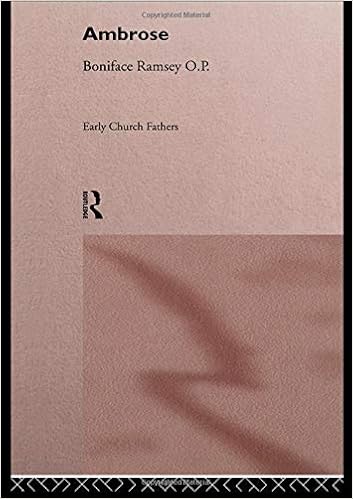
Want to read more about him?  The best you can find is Ambrose by Boniface Ramsey. US HERE – UK HERE

I also have several old PODACAzTs in which I speak of Ambrose. HERE

There’s not a single bishop alive today who can vaguely approach Ambrose for either brains or b****.  Shall we see his like again?

Posted in Patristiblogging, Saints: Stories & Symbols | Tagged
3 Comments

Daily Rome Shot 1500

Welcome registrants:

Karine
latinritecatholic

Please remember me when shopping online and use my affiliate links.  US HEREWHY?  This helps to pay for health insurance, utilities, groceries, etc..  At no extra cost, you provide help for which I am grateful.


And THIS is one example of why you should read the BOOKS before you see the movies.

Black to move and mate in 4.

NB: I’ll hold comments with solutions ’till the next day so there won’t be “spoilers” for others.


Posted in SESSIUNCULA |
1 Comment

Your Sunday Sermon Notes – 2nd Sunday of Advent – 2025

Too many people today are without good, strong preaching, to the detriment of all. Share the good stuff.

Was there a GOOD point made in the sermon you heard at your Mass of obligation for this 2nd Sunday of Advent?

Tell us about attendance especially for the Traditional Latin Mass.

Any local changes or (hopefully good) news?  A taste of what I offered at 1 Peter 5 this week:

[…]

The Forerunner’s question, however, has long raised perplexity. Did John doubt? How could the one who leapt in the womb at the presence of Christ, who baptized Him and pointed to Him as the Lamb of God, now falter? St. Gregory the Great resolved this by considering the order of events. When free beside the Jordan John proclaimed Christ boldly. Yet once he had been cast into prison, Gregory says, John desired to know whether Christ would enter personally into the realm of the dead. Gregory writes, …

[…]

Posted in Sermons | Tagged
8 Comments

ADVENTCAzT 2025 – 08 – 2nd Sunday of Advent

A 5 minute daily podcast to help you in your Advent 2025 preparation.

Pius Parsch show how this Sunday, this week, focuses on Jerusalem, which is symbolic.

We hear about the second week from  Advent and Christmas with the Church Fathers: a seven week Retreat on the Mystery and the Meaning of the Incarnation.

Yesterday’s podcast HERE.


Posted in ADVENTCAzT, ADVENTCAzT, PODCAzT | Tagged , , ,
1 Comment

ADVENTCAzT 2025 – 07 – Saturday 1st Week of Advent

A 5 minute daily podcast to help you in your Advent preparation

The striking figure of St. Nicholas
Jesus, Son of Mary
Linking Advent and illness

Yesterday’s HERE

Posted in ADVENTCAzT, ADVENTCAzT, PODCAzT | Tagged , , ,
2 Comments

Daily Rome Shot 1499

The last vestige of the sad little Church of Sts. Simon and Jude in Rome off the Via dei Coronari,

And…

And…


Posted in SESSIUNCULA |
5 Comments

ADVENTCAzT 2025 – 06 – Friday 1st Week of Advent

A 5 minute daily podcast to help you in your Advent preparation

  • Today we hear about an approach to putting up the manger scene and the Christmas tree.
  • Card. Bacci warns against activism.
  • Fulton Sheen on God-life.

You hear a bit of “Prayer To A Guardian Angel” from the album LUX by Voces8. HERE

Posted in ADVENTCAzT, ADVENTCAzT, PODCAzT, SESSIUNCULA | Tagged , , ,
1 Comment

Daily Rome Shot 1498 – URGENT VIDEO WHICH FIGHTS AGAINST BOTH *STUPID* AND *HERESY*

Photo from The World’s Best Sacristan™.

I’ll just put this here.

YouTube thumbnailYouTube icon

White to move and mate in 4.

NB: I’ll hold comments with solutions ’till the next day so there won’t be “spoilers” for others.

BONUS SHOT

Posted in Our Catholic Identity, Our Solitary Boast |
8 Comments

ADVENTCAzT 2025 – 05– Thursday 1st Week of Advent

A 5 minute daily podcast to help you in your Advent preparation

Today, we hear that the Church is perhaps bigger and smaller than we think.
Fr. T explains how we will be judged by Christ in his humanity.

Published by TAN:  Advent and Christmas with the Church Fathers: a seven week Retreat on the Mystery and the Meaning of the Incarnation.

You hear also the Benedictine nuns of Gower Abbey, the Benedictines of Mary, Queen of Apostles.

Click

US HERE – UK HERE

Posted in ADVENTCAzT, ADVENTCAzT, PODCAzT | Tagged , , ,
Comments Off on ADVENTCAzT 2025 – 05– Thursday 1st Week of Advent