YOUR URGENT PRAYER REQUESTS

PLEASE use the sharing buttons! Thanks!

In your charity would you please take a moment look at the requests and to pray for the people about whom you read?

Continued from THESE.

Let’s remember all who are ill, who will die soon, who have died recently, who have lost their jobs, who are afraid.

I get many requests by email asking for prayers. Some are heart-achingly grave and urgent.

As long as my blog reaches so many readers in so many places, let’s give each other a hand. We should support each other in works of mercy.

If you have some prayer requests, feel free to post them below.

You have to be registered here and approved to be able to post.

  • In your kindness continue prayers for my mother, who has been diagnosed with something grave, progressive and incurable.
  • Pray for me, for my circumstances and wisdom in my decisions.
  • Pray for a really good episcopal appointment which could have a massive impact.
Posted in SESSIUNCULA |
18 Comments

There is an ancient paradox – sobria ebrietas – the sober intoxication of sacred worship.

Under the post Msgr. Bux’s Open Letter v. Card Cupich a commentator brought up the issue of “liturgical sobriety”. Card. Cupich referred to “sobriety” twice in his offering.

The renewal of our worship was pursued in keeping with the Council Fathers’ desire to present to the world a church defined not by the trappings of world power but marked by sobriety and simplicity, enabling it to speak the people of this age in a way that more closely resembles the Lord and allowing it to take up in a fresh way the mission of proclaiming good news to the poor.

[…]

With the recovery of the ancient sobriety of the Roman Rite the Eucharist is once again the locus of genuine peace and solidarity with the poor in a fractured world.

It is highly unlikely that “the poor” (whoever they are) would be more attracted to what the Church has to give through drab vestments, banal architecture and dreadful music than they might be by a beautiful church, splendid vestments and the great works of the Church’s treasury of sacred music. And would the not-poor (whoever they are) be more motivated in their service to “the poor” through the drab, banal and dreadful?

But let’s dig into the idea of “sobriety” as it has been used over the centuries.   It is conceivable that that word does not mean what he thinks it means in a liturgical context viewed through the centuries.

There is an ancient paradox – sobria ebrietas, the sober intoxication of sacred liturgical worship.

This sheds light on Msgr. Bux’s reply to Cardinal Cupich.

Authentic reform never flattens the sacred, which is what Cupich promotes. The liturgy elevates and clarifies. It does not dilute.  God’s proffered chalice – which we receive and return in fulfillment of the virtue of Religion – intoxicates with beauty which reflects truth.

The little Latin oxymoron sobria ebrietas sounds like something out of Chesterton, yet it is far older. It names a biblical and patristic intuition that grace makes a man “drunk” without destroying his reason, caught up in God yet more lucid than before.   This is a result in full, conscious and actual participation (aka active receptivity) in sacred worship.

Scripture gives the core imagery. In the Vulgate Psalm 35(36):9 we pray,

inebriabuntur ab ubertate domus tuae,
et torrente voluptatis tuae potabis eos

RSV: Ps 36:8 – They feast on the abundance of thy house, and thou givest them drink from the river of thy delights.

The wording is strong. God does not merely “refresh” his friends, he makes them inebriated in his presence. This does not bring fuzziness or confusion, but rather: “apud te fons vitae, et in lumine tuo videbimus lumen” (v. 10), “with you is the fountain of life, and in your light we shall see light.”    It expands the mind with clarity.

The New Testament gives the negative and positive poles in a single sentence. Saint Paul exhorts the Ephesians (5:8),

Et nolite inebriari vino, in quo est luxuria, sed implemini Spiritu Sancto

“Do not be drunk with wine, in which is debauchery, but be filled with the Holy Spirit.”

The contrast is not between “feeling something” and being flat and sober. It is between one kind of inebriation, that dissolves man in sensuality, and another, where he is filled with the Spirit, speaking “in psalmis et hymnis et canticis spiritualibus” (Eph 5:19).  That, of course, is liturgical.

At Pentecost, the crowd misunderstands the apostles’ joy. ““ἕτεροι δὲ χλευάζοντες ἔλεγον ὅτι γλεύκους μεμεστωμένοι εἰσίν”” (Acts 2:13), “others mocking said, they are filled with new wine.” Peter answers:

οὐ γὰρ ὡς ὑμεῖς ὑπολαμβάνετε οὗτοι μεθύουσιν, ἔστιν γὰρ ὥρα τρίτη τῆς ἡμέρας

“These are not drunk as you suppose, for it is the third hour of the day.” They are “full,” but of the Spirit who has just been “poured out” on all flesh (Acts 2:17).

Out of this biblical matrix the Fathers coined sobria ebrietas. Patristic scholars trace the theme back at least to Philo and Origen, who already speak of an “ecstasy” in which the soul goes out of itself to God without losing its reason.

Ambrose of Milan, however, is the great transmitter of the phrase into the Latin West. Modern studies of his Eucharistic preaching note that he explicitly uses sobria ebrietas in his exposition of the Psalms and that he loves to speak of bona or spiritalis ebrietas in connection with the chalice.

One key text is Ambrose’s Eucharistic reading of our psalm verse. He returns again and again to inebriabuntur ab ubertate domus tuae as an image of the chalice that gladdens without making the feet totter. In a sermon on the Psalms he explains, in a passage preserved in translation,

Bona ergo ebrietas, quae non dissolvit animum sed erigit; quae non solvit, sed colligit sensus. Inebriari enim te volo deliciis domus Dei.” (Exp in Ps. 35, 46–47)

“Inebriation of this sort is good and fills the heart with joy without causing the feet to totter. Yes, it is good inebriation. It steadies the footsteps and makes sober the mind.”

Here is the heart of sobria ebrietas: a divine “drunkenness” that makes the mind more sober, not less.

Ambrose explicitly identifies the Eucharistic chalice with the calix inebrians of Psalm 22(23):5 in De sacramentis, 5,3, 17:

“Accipe quod ait propheta: ‘Calix inebrians quam praeclarus est.’
Calix iste est qui inebriat non corporis ebrietate sed mentis.”

“Take what the prophet says: ‘How glorious is the cup that inebriates.’
This cup is one that inebriates not with a bodily drunkenness but of the mind.”

Ambrose uses the exact expression sobria ebrietas (sometimes sobria ebrietas Spiritus) when contrasting Spirit-given intoxication with wine.  The clearest instance is in Exp Evangelii secundum Lucam, 7, 177:

“Sobria ebrietas est, quae mentem perducit ad modum, non ad vertiginem;
ebrietas Spiritus, non vini.”

“It is a sober drunkenness, which leads the mind to right measure, not to dizziness;
an inebriation of the Spirit, not of wine.”

The same Ambrose gives the Latin Church one of its classic hymns of light, Splendor paternæ gloriæ, sung at Lauds. It does not use the phrase sobria ebrietas itself, yet the motif is everywhere in it. The hymn opens:

Splendor paternae gloriae,
de luce lucem proferens,
lux lucis et fons luminis,
diem dies illuminans.

Christ is the “Splendor of the Father’s glory,” the “Light from light,” the “fountain of light,” who makes every day shine. The second stanza calls him verus sol, the “true sun,” and asks:

Verusque sol, illabere
micans nitore perpeti,
iubarque Sancti Spiritus
infunde nostris sensibus.

“True sun, come down, shining with unending brightness, and pour the radiance of the Holy Spirit into our senses.”

This is the same logic as Ephesians 5. Do not fill yourself with wine, which clouds the senses, beg the “true sun” to pour in the radiance of the Spirit, which enlightens the senses. Ambrose’s readers, already steeped in Psalm 35(36), hear the prayer for a filling that is an inebriation of light.

Medieval mystics, East and West, play with the same combination. Writers influenced by Gregory of Nyssa and the Dionysian corpus call this ecstatic state sobria ebrietas, linking it to the biblical ἔκστασις or excessus mentis, the “going out of the mind” that does not destroy, but fulfills, the mind.

Aquinas does not use the exact phrase, but in ST II-II, q. 168, he describes joy in the Holy Spirit as an affective “overflow” (redundantia) that perfects the mind while leaving it fully rational, a clear scholastic underpinning for the notion of sobria ebrietas.

Many authors commenting on the Song of Songs go down this same path.

In The Spirit of the Liturgy Pope Benedict XVI addresses sobriety in a discussion of liturgical music:

The Church’s Tradition has this in mind when it talks about the sober inebriation caused in us by the Holy Spirit. There is always an ultimate sobriety, a deeper rationality, resisting any decline into irrationality and immoderation. We can see what this means in practice if we look at the history of music.

He’s not talking about Joncas and Haas.

And:

It is above all in Church music that the “sober inebriation” of faith takes place—an inebriation surpassing all the possibilities of mere rationality. But this intoxication remains sober, because Christ and the Holy Spirit belong together, because this drunken speech stays totally within the discipline of the Logos, in a new rationality that, beyond all words, serves the primordial Word, the ground of all reason. This is a matter to which we must return.

In Catholic spirituality sobria ebrietas therefore marks a concrete set of experiences.

At the most basic level it belongs to sacramental life.

At the altar the priest takes up the chalice that is “calix salutaris,” the “cup of salvation,” and the faithful pray to be “inebriated” with the love that flows from Christ’s pierced side rather than with the spirit of the age.

Ambrose can say of the Eucharist, in De sacramentis 5, 4, 25: “Christus mihi cibus, Christus est potus, caro Dei cibus mihi et Dei sanguis est potus”, “Christ is my food, Christ is my drink, the flesh of God is my food and the blood of God is my drink,” and that “daily Christ is served to me.”

To receive that food with faith is to enter into the “good inebriation” of which he speaks.

At a deeper level the phrase names what happens when grace seizes the intellect and affections. The soul goes out of itself in love, it tastes something of divine sweetness, yet its faculties are not abolished.

On the contrary, the “drunken” man of the Spirit begins to see with new clarity that “omnis homo mendax” (Ps 115:11), “every man is a liar,” and that only God is faithful.

In short, the world offers an “inebriation” that dulls conscience and finally leaves a man empty. The liturgy, rightly loved, promises something loftier, sobria ebrietas, the sober intoxication of those who “inebriabuntur ab ubertate domus Dei,” and whose minds are made clear because they are “impleti Spiritu Sancto.”

Which sort of “inebriation” results from conforming liturgical rites to social programs?  From immanentism and horizontalism?

Which sort of “inebriation” results from conforming liturgical rites to an encounter with mystery which is tremendum et fascinans?  Transcendent and vertical?

Which of the two would provide the deeper and more lasting motive based on charity properly understood regards spiritual and corporal works of mercy toward the poor of body and of spirit?

With the lens of sobria ebrietas we return to the “walking together” of Bux and Cupich.

In his letter Msgr. Bux corrects Card. Cupich’s claim that the post-conciliar liturgical reform was primarily about creating “a new image … simpler and more sober, embracing the entire people of God … more closely resembling her Lord than worldly powers.”
Bux insists that this characterization distorts the intent of Sacrosanctum Concilium, which calls for “rites should be ‘distinguished’ by a noble simplicity” precisely because they reflect the majesty of God. He argues that reducing the liturgy to an aesthetic of poverty or solidarity with the poor neglects the transcendent and sacrificial dimension of worship, thereby weakening the “sober intoxication” of divine joy that true liturgy cultivates. In short, Bux defends the traditional Rite as a staged, majestic offering that leads the faithful into the mystery of God, not into a sociological program of “solidarity.”

Finally, regarding that quote from Sacrosanctum Concilium as provided by Cupich – “rites should be ‘distinguished’ by a noble simplicity” – another commentator points out that if we look at the Latin original we find ritus nobili simplicitate fulgeant as “The rites should shine by a noble simplicity”. Lewis and Short says fulgeo is “to flash, glitter, gleam, glare, glisten, shine (syn. splendeo)” and tropologically as “to shine, glitter; be conspicuous, illustrious (rare and mostly poet.)”.

This is not the same as “be distinguished by”.

The sociological arguments seeks to extinguish rather than to make distinguished.
Posted in Liturgy Science Theatre 3000, The Drill | Tagged , ,
8 Comments

Daily Rome Shot 1486

Please remember me when shopping online and use my affiliate links.  US HEREWHY?  This helps to pay for health insurance, utilities, groceries, etc..  At no extra cost, you provide help for which I am grateful.

Motus ad lusorem cum militibus albis pertinent. Scaccus mattus, scilicet mors regis, duobus in motis veniat.

NB: Detineam explicationes in crastinum, ne vestrae interrumpantur commentationes.

Posted in SESSIUNCULA |
3 Comments

Msgr. Bux’s Open Letter v. Card Cupich

Edward Pentin has – HERE – the text of an Open Letter correcting Card. Cupich who not long ago wrote a bizarre piece for Vatican News using Dilexi te as a springboard to trash the Church’s liturgy which has been (i.e., still is) in use in a relatively stable form for over a thousand years.  HERE

If you don’t remember what Dilexi te is, that’s alright.  Hardly one does.  It came out eons ago… last October!  It’s an Apostolic Exhortation from (but in large part not, I think, by) Pope Leo XIV, which focuses on the Church’s mission to love and serve the poor.

Msgr. Bux is the originator of the great “Bux Protocol”.   He is a liturgical expert and former consulter to the Dicastery for the Doctrine of the Faith and, if I remember rightly, the Office of Papal Ceremonies.

What did Cupich do?  He situates the liturgical reform of the Second Vatican Council (e.g. Sacrosanctum Concilium – SC) within the broader movement of the Church seeking “a new image … simpler and more sober, embracing the entire people of God … more closely resembling her Lord than worldly powers.”  According to Cupich, the liturgy therefore is not only about ritual or aesthetics, but must be a tangible expression of the Church’s mission among the poor and marginalized (never mind how those who want traditional liturgy are marginalized).  Cupich asserts that the “noble simplicity” mentioned in SC in the liturgical reform aimed to let God’s action shine more clearly in the liturgy, and to free the Church from the trappings of worldly power, so it can speak more authentically to our age.    Along the way the windy prelate proclaimed:

The liturgical reform benefited from scholarly research into liturgical resources, identifying those adaptations, introduced over time, which incorporated elements from imperial and royal courts. That research made clear that many of these adaptations had transformed the liturgy’s aesthetics and meaning, making the liturgy more of a spectacle rather than the active participation of all the baptized for them to be formed to join in the saving action of Christ crucified.

Ed Pentin’s reaction to Cupich’s musings –  HERE.

Shall we have a look at Msgr. Bux’s piece v. Cupich?

To His Eminence Cardinal Blase Cupich

Your Most Reverend Eminence,

“For I think that God has exhibited us apostles as last of all, like men sentenced to death; because we have become a spectacle to the world, to angels and to men.” (1 Cor 4:9). This statement of the Apostle describes the identity of Christianity, both as the proclamation of the Gospel and as the Church’s public worship. Focusing on the latter, it can rightly be said that the liturgy is the spectacle offered to the world by those who adore Christ, the one Lord of the cosmos and of history, to whom they belong and not to the world. This is recalled by the expression “liturgical service,” which is truly appropriate — unlike the term “animation,” now in vogue — as if worship were not already animated by Jesus Christ and by the Holy Spirit. [That “animation” language is used more in Italian liturgical jargon than in English.  For example, the old Willie Nelson imitator playing the bongo at Jesus Happy Lamb And Friend Faith Community in Rogerville is helping to “animate” the liturgy.]

After the persecutions, this became evident, because Christians did not burn incense to the Roman emperor but to Jesus, the Son of God. Catholic liturgy therefore has regal and imperial characteristics — Eastern liturgies teach us this [NB: Cupich doesn’t mention the Eastern “lung” of the Church] — because worship of God stands in opposition to any worship of the worldly rulers of the moment.

It is untrue that the Second Vatican Council desired a poor liturgy, since it asks that “rites should shine with noble simplicity” (Constitution on the Liturgy, 34), because they must speak of the majesty of God, who is noble beauty itself, and not of worldly banalities. The Church understood this from the beginning, both in East and West. Even Saint Francis prescribed that the most precious linens and vessels be used in worship.  [More about St. Francis on liturgy HERE]

What then is the “participation” of the faithful, if not to be part of and to take part in the “spectacle” of a faith that affirms God and therefore challenges the world and its profane spectacles — which are indeed spectacular: think of mega-conferences and rock concerts. The liturgy expresses the Sacred, that is, the Presence of God; it is not a theatrical performance. The participation desired by the last Council must be full, conscious, active, and fruitful (ibid. 11 and 14) — that is, a “mystagogy,” an entry into the Mystery that takes place per preces et ritus [through prayers and rites], which, as Saint Thomas reminds us, must elevate us as much as possible to divine truth and beauty (quantum potes tantum aude); or, in the words of then-Father Robert F. Prevost: “Our mission is to introduce people to the nature of the mystery as an antidote to the spectacle. [And the stiletto finds the gap between the 4th and 5th ribs.] Consequently, evangelization in the modern world must find adequate means to reorient the public’s attention, shifting it from spectacle toward mystery” (May 11, 2012). The usus antiquior of the Roman rite performs this function; [NB] otherwise it could not have withstood the secularization of the Sacred that entered into the Roman liturgy, to the point of making people believe that the Council itself wanted it. This is the identity and mission of the Church.

Finally, Your Eminence, I invite you to consider that the liturgy, since ancient times, was solemn in order to convert many to the faith, and for this reason it must also have an apologetic value and not imitate the fashions of the world, as Saint Cyprian reminds us (applause, dances, etc.), up to the “deformations at the limit of the bearable” that entered the novus ordo, as Benedict XVI observed. This is the authenticity of the “sacred liturgy”; this is the ars celebrandi, as demonstrated by the offertory of the Mass, which is performed for the needs of worship and for the poor.

Therefore, Your Eminence, I ask you to engage in a synodal dialogue for the good of ecclesial unity!

In the Lord Jesus,

Fr. Nicola Bux

Thus, Bux has tossed the gauntlet of dialogue across Lake Michigan.


Posted in Liturgy Science Theatre 3000, Our Catholic Identity, Save The Liturgy - Save The World, The Drill | Tagged , , ,
10 Comments

Daily Rome Shot 1485

Welcome Registrant:

Ole Boy at Prayer

Please remember me when shopping online and use my affiliate links.  US HEREWHY?  This helps to pay for health insurance, utilities, groceries, etc..  At no extra cost, you provide help for which I am grateful.

Black to move and mate in 3.

NB: I’ll hold comments with solutions ’till the next day so there won’t be “spoilers” for others.

As I write, my guy Wesley So is battling against Hikaru Nakamura in the quarterfinals of the Speed Chess (5 min) Championship which has implications for a spot in London next February.  Commentators are leaning to Hiraku, but I am sticking to my guns.

Posted in SESSIUNCULA |
5 Comments

From “The Private Diary of Bishop F. Atticus McButterpants” – 12-11-25 – Bishops meeting – Day 3

November 12th 2025

Dear Diary,

Dodged the Noonch again this morning.  It turns out it wasn’t my imagination that he was looking for me.   Both Jude and Mateo* said he asked.  He was lurking by the breakfast tables with a folder, so I hid behind a group of chatting bishops.  It’s handy that we all wear black.

Because breakfast was cut short, again, I ordered a huge pizza from Pizza Panic and sent Fr. Gilbert out to get it from the delivery boy. He’s not Fr. Tommy but he got the job done.  Would T have done it?  Hm.   Anyhow Fr G slid in the side door near where the electric piano is and gave it to me, Dozer**, and two other hungry souls in the back row of tables. The pepperoni smell spread around a bit and we got some dirty looks.  Jealous looks, too.   Fr G adiosed the box.  We left him a slice because we are so nice.  HA! I see what I did there!

The session on implementing synodality was unbearable. Flow charts like spaghetti and phrases like “itteractive accompniment vecters” whatever the hell that is.  I tried to focus, but inevitably fell asleep, mouth open, during a speech on empowered listening. Ernie Plowright later said I looked “deeply contemplative,” which was kind.  I think there was a lot of contemplating going on given the dazed looks.

Some of these guys actually thrive on this process stuff!  All I wanted to do is process a nap.  I would have settled for another trip around the display tables.  I like the colors.

The day closed with even more synodality talk.   And voting on endless items I had no clue about.  I nodded a lot and watched how Dozer voted.

Tired.   These days of doing so much nothing wear me out.  Can I still show up and keep on avoiding the Noonch?

I’m looking forward to the drive back, but not until I get a couple of the guys who will stay over after we’re done and go back to that terrific steak place Tommy found a couple years back, Harbor and Hearth.  They’ve got this porterhouse finished over old wiskey barrel wood and mashed potatoes to die for.   Darn.  I’m hungry now.  Is Pizza Panic closed?  Rats.


*Respectively Bp. Jude Noble of Black Duck and Bp. Mateo Cienfuegos of Recker.  The Diocese of Recker is often described as “three hours from anywhere”.  Unless you are from there, you always pronounce the name wrong.  The region suffered badly economically but is now in an upturn and is as culturally progressive as the 1952 Baltimore Catechism.  Bp. Mat is a ball of energy, is as hot tempered as his name implies, and preaches short, punchy sermons.  He is impatient with bureaucracy and famously interrupted a presbyteral council meeting saying, “Fathers, we’re done here.  Let’s plan a Eucharistic procession.”  He is known for his spontaneous pastoral visits, arrives unannounced, blesses everything in sight (including lawn mowers), and then departs leaving a trail of mildly bewildered parishioners.

**Bp. Antuninu “Dozer” Ruspa of Pie Town has a penchant for tearing down churches and reselling the architectural elements.  However, his classmates know that he mainly slept through theology classes.  The origin of the Diocese’s name is lost in obscurity, though the clergy now blame it on the bishop.  Formerly lively parishes now limp along with thinning attendance, puerile bulletin art, and homilies so directionless that you need a map and compass to follow them. Dozer’s administrative style consists mainly of issuing vague directives, forgetting he issued them, and then being irritated when no one follows through. He infamously eliminated most local devotions as “too distracting”, though from what he never explained.  +Fatty is his best friend.

Posted in Diary of Bp. McButterpants, SESSIUNCULA | Tagged
4 Comments

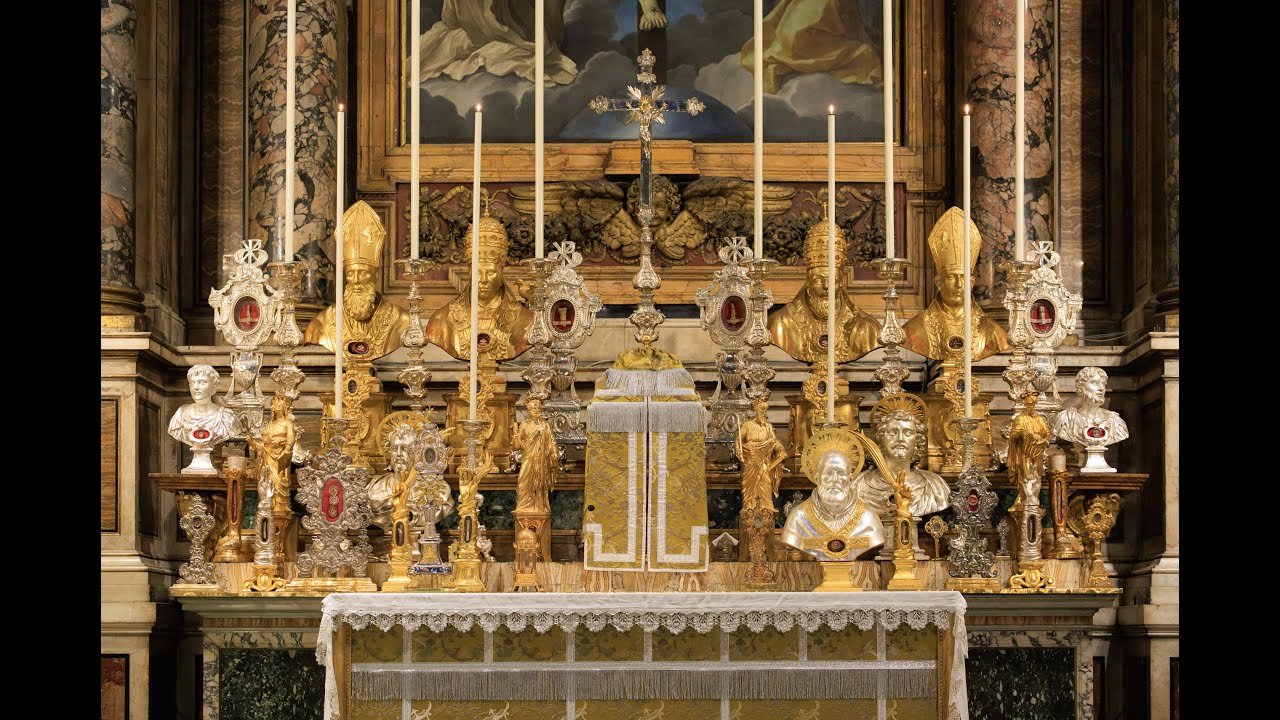
VIDEO: Solemn Exposition of Relics at Ss Trinità dei Pellegrini (Church of the Most Holy Trinity of the Pilgrims) in Rome

1 November 2025 – Solemn Exposition of Relics at Ss Trinità dei Pellegrini (Church of the Most Holy Trinity of the Pilgrims) in Rome

The custom of the exposition of relics on All Saints Day in the Roman tradition is richly symbolic and pastorally powerful. In bringing the physical remains of the saints before the faithful, the Church does more than adorn her altars. She shows us the “great cloud of witnesses” (Heb 12:1), invites our veneration of the holy ones who have gone before us, and unites the heavenly liturgy with the earthly. For those attached to the traditional liturgy, it offers a venerable and evocative means of deepening the celebration of 1 November. All Saints Day, together with the Commemoration of All Souls, confirms our solidarity in God’s One Holy Church in three manners, Triumphant, Penitent, and Militant.

Contact with the relics of saints has resulted in miraculous healings, exorcisms and conversions.

YouTube thumbnailYouTube icon

Posted in Just Too Cool, Our Catholic Identity | Tagged
3 Comments

Your Sunday Sermon Notes – 23rd Sunday after Pentecost (N.O.: 33rd) 2025

Too many people today are without good, strong preaching, to the detriment of all. Share the good stuff.

Was there a GOOD point made in the sermon you heard at your Mass of obligation for this 23rd Sunday after Pentecost, the 33rd Sunday of Ordinary Time in the Novus Ordo.

Tell about attendance especially for the Traditional Latin Mass.

Any local changes or (hopefully good) news?

A couple thoughts about the sign of the cross: HERE  A taste…

[…]

But the Philippians are beset by false teachers, probably Judaizers, whose insistence on Mosaic practices for Gentile converts would bind the faithful to old chains. Paul warns “even with tears” that these men are “enemies of the cross of Christ. Their end is destruction, their god is the belly, and they glory in their shame, with minds set on earthly things.” The “belly” represents not gluttony alone but the whole regime of the flesh, the worldview that grasps at the earth and refuses to look up. Paul immediately contrasts it with the term políteuma, “our commonwealth is in heaven.” This word sometimes becomes “conversation” (conversatio) in Latin Christian tradition, meaning manner of life. Christians, therefore, must not be ruled by amorphous “lived experience” that contradicts perennial teaching. Nor may we reduce the Church’s demands to “ideals” few can attain. If that sounds a bit familiar, remember what we were told from the highest places in confusing documents like Amoris laetitia that “lived experience” suggests that, for example, sexual continence in an adulterous marriage is an “impossible ideal.”  Hence, “lived experience,” trumping perennial doctrine and law, allows those living manifestly in objectively illicit relationships to receive Holy Communion because… you know… “discernment” and “accompaniment” … and reasons and… stuff.

[…]

Posted in SESSIUNCULA |
7 Comments

From “The Private Diary of Bishop F. Atticus McButterpants” – 11-11-25 – Bishops meeting – Day 2

November 11th, 2025

Dear Diary,

Arrived safely at the USCCB autumn meeting after a seemingly endless hours of driving.  I had Fr. Gilbert build in restaurant stops, as usual.  Over the years I’ve found some good ones.  Fr. Tommy used to drive with me and tell me reassuring things like, “Excellency… he always did that even when alone… planes have a statistical safety rate far better than most driver’s lane discipline.” I miss his way of making dangers seem like my fault.  Airplanes given me the creeps.  I dread flying to Rome for at liminals.  I would like to meet Leo.  He seems nice.  And I want to get that thing wrapped up for Fr. Tommy.  Dozer says there are cruise boats that go from Florida to Italy with huge buffets.

On arrival at the hotel registration desk who do I spot but the Noonch.  Hovering. He was smiling politely at bishops who were greeting him.  When he saw me I slid behind a large plant for a bit. Success for now.

Speaking of buffet, breakfast had something called “eco-friendly scrambled eggs,” which even sounds like something the bishops would make.  Seemed to be made of … lentils maybe?  And disappointment.  Tony Alvarez tried to convince me they was “good for liturgical clarity.” I didn’t understand that, but I nodded emphatically and he looked happy.

During the morning session, we heard the much-anticipated presentation about AI becoming “potentially conscious within five years.” One bishop actually asked if machines could eventually “discern spirits.” I raised my hand to agree, but Jude gently lowered it for me and whispered, “Not that kind of spirits.” He explained.  Now the thought troubles me. If my toaster becomes sentient, will it need a chancery position?

Lunch went poorly. They served quinoa “pilaf” with chickpeas.  Who does that? After my first bite, I found myself apologizing to the chickpeas because they tasted so resentful. Bishop Plowright said I was “building cross-cultural empathy,” which felt manipulative, but I nodded.  I sent Fr. Gilbert out to get a couple of subs and something for himself.  When in doubt.  I’ll order pizza tomorrow.  I hope that place Tommy found is still open – Pizza Panic Delivery – GREAT NAME  I think I’ll get some during the afternoon session!

Closing the day, I got cornered by a committee aide about voting tomorrow on funds to assist undocumented immigrants. I told him, honestly, that I didn’t know how to vote because the sheet had footnotes. He promised to “walk me through it” tomorrow. Fr. Tommy used to do that. He’d lean over and whisper, “Right choice is the second box, Excellency” or “Press 3”.   Sometimes I miss being told what to do.  It’s not easy being a bishop.

Posted in Diary of Bp. McButterpants, SESSIUNCULA | Tagged
6 Comments

Daily Rome Shot 1484

Please remember me when shopping online and use my affiliate links.  US HEREWHY?  This helps to pay for health insurance, utilities, groceries, etc..  At no extra cost, you provide help for which I am grateful.

White to move and mate in TWO.  How fast are you?  1…2…3… GO!

NB: I’ll hold comments with solutions ’till the next day so there won’t be “spoilers” for others.

How inappropriate is this?!? He should be pastorally instructed to stand for Communion! And in the HAND!

Posted in SESSIUNCULA |
3 Comments