Vigil of Ascension – old and new

fullsize_vanni_ascensionHere is something I wrote a loooong time ago – 2006 – for an WDTPRS article in the print version of The Wanderer.  I had a column there for 11 years.

The Wanderer… they have been faithful warriors for a long time.  You could give them some encouragement. With a subscription.  Help them out.

…(I)n some places the Feast of the Ascension, which falls always on a Thursday, has been transferred to this Sunday.  That would make it “Ascension Thursday Sunday”, I suppose. (Eye roll)

The third edition of the Missale Romanum issued in 2002 now provides a Mass for the Vigil of Ascension, which wasn’t in previous editions of the Novus Ordo.  Moreover, the prayers for the new Vigil of Ascension are not the same as those found in the pre-Conciliar Missale for the Vigil.

Also, there are now proper Masses for the days after Ascension, most having alternative collects depending on whether or not in that region Ascension is transferred to Sunday.

What a mess.

And some people wonder why it isn’t perfectly okay to just to celebrate the Novus Ordo in Latin with some lace and stuff.  These ignoramuses do not have an even partial clue.

Since many people do not have access to the prayers for the Vigil of Ascension, let’s look at them this week.

First, here are the antiphons. Ant. ad introitum:  Regna terrae cantata Deo, psallite Domino, qui ascendit super caelum caeli; magnificentia et virtus eius in nubibus, alleluia. (Ps 67:33,35)  Ant. ad communionem: Christus, unam pro peccatis offerens hostiam, in sempiterum sedet in dextera Dei, alleluia.  (Cf. Heb 10:12)

COLLECT:
Deus, cuius Filus hodie in caelos,
Apostolis astantibus, ascendit,
concede nobis, quaesumus,
ut secundum eius promissionem
et ille nobiscum semper in terris
et nos cum eo in caelo vivere mereamur.

This was modified from a prayer in ancient sacramentaries such as the Liber Sacramentorum when it was used on Ascension Thursday having its Station Mass at St. Peter’s Basilica.  Here is some liturgical education for you.  The eucological formulas (the prayers), for the Ascension found in what is sometimes called the Leonine Sacramentary surviving in one 7th century manuscript in Verona (the Veronese Sacramentary) are the oldest prayers we have in the Roman liturgy!  The Missale Romanum and those ancient collections consist principally in prayers for Masses which in fancy liturgist talk are called “eucological formulas”.

You might not immediately recognize astantibus as being from asto or adsto, which that ascendant lexicon of Latin lemmata, the Lewis & Short Dictionary, says means, “to stand at or near a person or thing, to stand by”  The L&S will also inform you that asto has the synonym adsisto.

If you have ever heard the phrase “to assist (adsisto) at Holy Mass” this is the concept: you are present and actively participating.   Of course what many say “active participation” is is dead WRONG… but I digress.

During the Roman Canon, the priest describes the people as circumstantes, “standing around”.  This doesn’t mean they there around the altar with their hands in the their pockets (though I have seen that happen, not rarely). Rather, they are there morally and spiritually “around” the altar, participating each according to their vocation and capacity.

So, circumstantes is used to identify the baptized who are present.

SUPER LITERAL VERSION:
O God, whose Son today ascended
into the heavens as the Apostles were standing close by,
grant us, we beseech You,
that, according to His promise,
we may be worthy both that He lives with us on earth,
and that we live with Him in heaven.

The Apostles, who were adstantes, actively participating in the Lord’s Ascension before, during and after the actual moment if the Ascension, both listened to the Lord and watched the Lord.  Similarly, at Holy Mass we actively participate before, during and after the consecration, both by listening to the Lord speak through the texts and watching what the Lord does in the liturgical action.

LATER ADDITION in 2011:

NEW CORRECTED ICEL (2011):
O God, whose Son today ascended to the heavens
as the Apostles looked on,
grant, we pray, that, in accordance with his promise,
we may be worthy for him to live with us always on earth,
and we with him in heaven
.

When the Second Person took up our human nature into an indestructible bond with His divinity, indestructible, we were thereby destined to sit at God’s right hand, first in Christ and then on our own.  Christ makes us worthy, no one else.

Christ alone.  It’s all His.  And because it’s His, it’s ours.

Posted in EASTER, WDTPRS | Tagged
4 Comments

ROME 25/5– Day 47: Last full day… sniff…

When, you ask, was sunrise in Rome? It was at 5:38. And you will likely ask when the sunset was, too. It was at 20:37.

The Ave Maria for the Curia is in the 21:00 cycle.

In the Venerable calendar, today is the Feast of Venerable Bede. In the New Fangled calendar, it is the Feast of St. Augustine of Canterbury.

Welcome new registrant:

R2D

Tomorrow, is the Vigil of Ascension and the Feast of St. Augustine of Hippo.

After Mass, breakfast was had with The World’s Best Sacristan™.

I defied common sense today for lunch and had risotto with saffron and ossobuco.    So, good, but so heavy.  I couldn’t eat it all.  However, it was the first time since I’ve been here that I had risotto… since before last time, too, I believe.

Last errands today.  Some prayer time also.

It’s quite hard to leave, in fact.

I arranged for a driver to the airport, prepped the fridge and freezer for shut down in the next couple days when the cleaner (bless her) will come in.  There are people who can check on the place and I will maintain my internet for my security cam.   I am almost completely packed except for things that must be done in the morning after Mass and before the car comes.

Please remember me when shopping online and use my affiliate links.  US HEREWHY?  This helps to pay for health insurance, utilities, groceries, etc.  At no extra cost, you provide help for which I am grateful.

If you are into chess, check out the summary of the Norway Chess classical format game between Magnus and, official world champ, Gukesh. It’s engaging and instructive. It’s the first time they’ve clashed in classical since Gukesh defeated Ding. HERE David Howell declared it the “game of the year so far!”

One of the features these tournaments are building in is what they call the “confessional booth”. That is, they go alone into a silenced room and, live on camera, say what they are thinking about the game.

I would be happy to be the chaplain for a large chess event and provide Mass and confessions for the players. Hey FIDE!

Posted in SESSIUNCULA |
3 Comments

Oldie ASK FATHER: Blessings that are not in Latin? Wherein Fr. Z rants at length.

NOTE: Today a question arrived in my email box which cited this post.  I took at look and thought that it would be good to share gain.

___ Originally Published on: Feb 2, 2022

I received a somewhat convoluted note about blessings, which contained several implicit questions. I will tease out the essence.

He can’t find a priest to bless things in Latin and it would be very far to drive to find one.

QUAERUNTUR: Why not just use the English translation provided in “Weller” (a three volume set that translated the traditional Rituale Romanum).  Or should the Book of Blessings be used?

I don’t think the Book of Blessings should be used for anything other than a tire block when parking on a slope.  There is only one prayer in the book that blesses the object.  Otherwise, it expresses happy thoughts about someone who might see it or use it someday.  In the Praenotanda there is an explicit repudiation of the Church’s teaching about invocative and constitutive blessings.  It is appalling.

That said, the Church has always been concerned lest people fall into the trap of seeing blessings and sacramentals and sacraments as a kind of theurgy or magic.

We are confident that, when the priest blesses, God blesses in the person of the priest.  We are confident that, when the priest exorcises, God exorcises.  We are confident that when the priest consecrates items or places or persons, God acts in the priest to constitute them as blessed or consecrated, to tear from from the grip of the Prince of this world and set them apart for the King and the advance His Kingdom.

The efficacy of the blessings depends ultimately on God, who desires what is good for us.

However, we do our best to bless and consecrate through outward signs, the gestures and words of, especially, the priest who is alter Christus.

If our blessings are not magic, neither are they nothing.  Gestures and words count.  Latin makes a difference, as exorcists will confirm.  Moreover, the Rituale Romanum, in the edition that was in force at the time of Vatican II and after explicitly states that if Latin is not used the blessing is void.  I am not making that up.

The Rituale Romanum, Title 8, Chapter 1 gives the general rules for blessings. These are also presented in Weller, vol. 3, pp. 2-5.

Note that n. 2 states:

“Benedictiones sive constitutivae sive invocativae invalidae sunt, si adhibita non fuerit formula ab Ecclesia praescripta.   

Both constitutive and invocative blessings are invalid if the form prescribed by the Church is not used.”

Weller’s English translations were never approved for use, even in that interim time after the Council when more English could be used.  The translations are for reference, not use.  The LATIN is approved for use.

The apparent meaning of that, read as it is, is that if priests are using the Weller translation to bless things, Holy Water, etc., they aren’t blessing.    At the end, you have salty water.

HIS SCRIPTIS

  • We cannot limit God.
  • We don’t make the perfect the enemy of the good.
  • People are not bound to do the impossible.

That said…

  • God gives us strong guidance in how to worship Him in a way that pleases Him and we see the fruits.
  • If there is a way to do things better, we should strive to perfect them.
  • People can improve themselves and, for example, learn Latin.

If a priest doesn’t use Latin and instead uses the English translation is something blessed or not?

All I know is that I will always use Latin when I bless holy water.  I will always use Latin to bless objects.  I will always use Latin for the important bits, such as forms of sacraments and exorcisms.

I am never going to leave anyone with the slightest whisp of a doubt about what just happened.  When you come to me for blessings or sacramentals or sacraments, I owe that to you.  It is my duty to make sure that you have no doubt as to what happened.  Latin always resolves that and the vernacular can resolve that.

Latin, for me, is now second nature.  It isn’t for a lot of priests.

These are troubling times.

When the People of Israel broke covenant after covenant with God, God eventually imposed Law on them which reflected not just their state of being chosen by Him, but reflected also their wickedness.  This is why, for example, God allowed for divorce, which, as Christ says, was not so before.

It seems to me that the Church is so messed up right now, and our Catholic identity is so violated and wounded and scrambled, that latitude has to be provided, because Deus providebit.

How do I mean this?

Take analogy of our sacred liturgical worship as, now, having been forced onto a continuum of Catholic identity, ranging from clueless to well-informed and dedicated.

Using Paul’s image of the newly converted being like children who can only take milk, not ready for solid food, in these our times we have to work within reality, not fantasy.

The hic et nunc has to be considered.  We have priests of the Latin Church, the Roman Rite, who have no idea about how to celebrate in their Church’s Rites and don’t know Latin.  This was purposeful on the part of those who both wrote and then warped what was written for the reform of the liturgy.  This was systematically done by those in charge of priestly formation.  They destroyed Catholic identity guttatim.  Drop by drop.  They undermined priesthood, brick from brick.   The result, hic et nunc, is what it is, and it is not what it isn’t.  That sounds tautological, I know, but we have to sober ourselves with this smelling salt and get the cobwebs out of our heads.

So, today, if a well-meaning priest, who through no fault of his own, blesses something using the English translation in Well, does he bless or not?

Here are the factors I put into the scales of my mind.

  • God loves us and wants us to have blessed things.
  • The Church without doubt said that the approved text, meaning Latin, has to be used.
  • God knows that 99% of priests don’t know Latin because the Church has, manifestly contrary to the law, cheated them out of that critical aspect of their formation and identity.
  • God is not limited by the Church’s positive law concerning blessings.
  • Priests of the Roman Catholic Church ought to pray like Roman Catholic priests.
  • The Rituale Romanum itself states that it is a starting point, a reference point for the development of local rituals.
  • It is extremely important to maintain the categories of constitutive and invocative blessings against modernist encroachment and the campaign against them.
  • We are our rites!
  • The wider world is affected by what we do regarding sacred objects, places and persons.  Getting it right is more important than our comfort zone.

Putting all of that into the mental hopper and letting it macerate, when a priest blesses (constitutive) using some other form than what is in the book, I am not sure what happens.  I am inclined to think that, God being merciful, something happens.   If, for example, someone were to walk up to me and ask me to bless the Rosary she was holding out, and if I were to make the sign of the Cross over it while saying something like, Benedictus benedicat (which I got from my old mentor the holy and late, great Card. Mayer), I am inclined to think that the Rosary was blessed.

You will object, why shouldn’t I have just memorized the Latin prayer for the blessing of a Rosary?

We have to fight to recover these things and use them properly.  In the meantime, we have to be smart and flexible.

Allow me to go back to my food analogy for liturgy. This might seem a little insulting but it is just intended to make a point about the continuum we are on.

In 99% of a man’s day and activities, it is  beneath his dignity to scrunch up his face and make airplane noises while moving a spoon around with his hand.  People would think he was nuts.   OR… if he is sitting in front of the high-chair of his little son, who can only eat goop and must sometimes be convinced to eat it, then that man is not doing anything beneath his dignity.  On the contrary, he is performing a sacrificial act of love for his child.  He sacrifices his dignity – becoming more dignified yet – for the sake of his boy’s eating something that will help him to grow out of the need to eat that sort of thing in that sort of way.  He helps his boy move up the food and eating continuum to more complicated foods eaten in a more human way.  Infants eat in the way that infants eat, not in the way that adults eat.  To force an infant to eat steak and cabernet is abuse, not love.

This is our situation with a large number of those who miraculously still self-identify as Catholic.  Some can take the solid food of the Vetus Ordo, with its greater challenge and deeper apophatic approach to an encounter with mystery.  Some are still pretty much bound up in the emphasis on the immanent in the Novus Ordo.  Some are ready to make a move quickly and others need more time.  Some are ready for steak and cabernet and others still need goop, or perhaps SpaghettiOs if they are into the Novus Ordo with some traditional elements.  Eventually, they can handle a slice of bologna and maybe stab at it with a fork that they have to hold in various ways while they learn and their dexterity improves.  You get the idea.  Eventually, it is china, linens, crystal, sharp knives and bistecca alla fiorentina with a bottle Tignanello.

Do not make the mistake of thinking that the toddler with Spaghetti O’s is bad because he can’t handle spaghetti all’arrabbiata.  Do not make the mistake of thinking that mom and dad who give their toddler SpaggettiOs are bad.    They would be bad if, once junior is grown and able to take more and better, they keep him eating pureed carrots in a special chair.   They would be infantalizing him, which would be abuse of their child and beneath their own dignity as parents.   Of course if the parents had been kept in an infantile state themselves, they wouldn’t know any better.

Keeping people down liturgically is just plain wrong.   However, if priests and bishops don’t have a clue themselves… what to do?  Priests and bishops are included in this.   Some priests are at the level of the boy in the high chair when in comes to liturgical identity.  Remember: we are our rites! Alas, they listen to the “experts” who did the infantalization in the first place and the closed circles just grinds on and on.

To move this into the plain of the Church’s teaching on morals, while we acknowledge that some people are in sinful situations, we don’t leave them in sinful situations.  Understanding that movement and improvement takes time, we don’t just excuse what they are doing because, after all, the ideals we have been presented are just too hard for some people.   No.  We are our rites and our rites are doctrine.   With the help of authority and of grace, we must be working toward the ideal, even if it is painful.  This is true for our moral lives and also our sacred liturgical worship, by which we individually and collectively fulfill the virtue of Religion.

Our Catholic identity is a mess.  There are correctives and remedies.   But the therapy will have its painful moments.  But they MUST be undertaken.

I’ve had injuries that required painful therapeutic exercises.   Oh, how I didn’t want to do them.  But I wanted recovery enough so that I was willing to deal with the discomfort.   In the long run, it paid off.  I never want to have that pain again, but it worked.

I am reminded of the Lord’s words in John 16, using the image of painful child-birth:

21 When a woman is in travail she has sorrow, because her hour has come; but when she is delivered of the child, she no longer remembers the anguish, for joy that a child[b] is born into the world. 22 So you have sorrow now, but I will see you again and your hearts will rejoice, and no one will take your joy from you. 23 In that day you will ask nothing of me. Truly, truly, I say to you, if you ask anything of the Father, he will give it to you in my name. 24 Hitherto you have asked nothing in my name; ask, and you will receive, that your joy may be full.

We have to get through this dark time together, in solidarity, with joy, hopeful determination and elbow grease.

Are you asking for restoration of our Catholic identity and sacred worship in the Holy Name of Jesus?

Posted in Latin, Liturgy Science Theatre 3000, Our Catholic Identity, Save The Liturgy - Save The World | Tagged ,
3 Comments

ROME 25/5– Days 46: anniversary day

This warm sunny day, the sun rose to make it so at 5:38. Cooling will commence in earnest at 20:37.

The Ave Maria bell is in the 21:00 cycle.

It is the feast of St. Philip Neri, my great friend and patron. His body is not far from where I type this, less than five minutes if I hit the green light to get across the Corso. I stopped into the Chiesa Nuova this morning after my own Mass.

Today I celebrated Mass for my parents.

Yesterday I celebrated Mass for all my benefactors.

Tomorrow I will say for all my ROMAN donors.

It is such an awesome grace to be able to offer Mass for intention which God’s understands better than I, little priest.

One of The Parish’s many reliquaries of St. Philp.

St. Philip is Co-Patron of Rome with St. Peter.

This is how The World’s Best Sacristan™ put out my vestments today.

Off to visit St. Philip’s tomb in the Chiesa Nuova.

Today they took of the grate in front of the tomb.

How I love the light in Rome at this time of year.  It is so hard to leave.

Supper tonight with The Great Roman™ a friend now of “the years of Jesus”, one of the most honorable men I have every known.

We split a first.   Frankly, we ordered one thing and they brough another, but it worked out.

Which rombo is mine?

Elle Effe… they do a good job.  I have a feeling that they are slightly better organized during the day than the evening.  However when “cook” is on, he’s on.  He was on tonight.

Please remember me when shopping online and use my affiliate links.  US HEREWHY?  This helps to pay for health insurance, utilities, groceries, etc..  At no extra cost, you provide help for which I am grateful.

Don’t forget the monks of Norcia!

Posted in SESSIUNCULA |
1 Comment

WDTPRS: (1962MR) Mass Prayers “Pro seipso sacerdote – For the priest himself”

This time of year many new priests are being ordained and, consequently, many priests observe their own anniversaries.

In the traditional, Vetus Ordo of the Roman Rite a priest can add orations “for himself… Pro seipso sacerdote, on the anniversary of his ordination.  If it is a feast of a saint, as it is today (St. Phili Neri), the orations are said under one conclusion.

I must confess that I add them on other days too.  I just need to.

The 2002MR has three formularies Pro seipso sacerdote while the 1962MR has but one (which really is enough).

Let’s look at the prayer in the Vetus Ordo, the Roman Rite:

COLLECT (1962MR):

Omnípotens et miséricors Deus, humilitátis meae preces benígnus inténde: et me fámulum tuum, quem, nullis suffragántibus méritis, sed imménsa cleméntiae tuae largitáte, caeléstibus mystériis servíre tribuísti, dignum sacris altáribus fac minístrum; ut, quod mea voce deprómitur, tua sanctificatióne firmétur.

SLAVISHLY LITERAL VERSION:

Almighty and merciful God, kindly hark to the prayers of my humility: and make me, Your servant, whom, no merits of my own favoring me but by the immense largess of your indulgence, You granted to serve the heavenly mysteries, to be a worthy minister at the sacred altars; so that, that which is called down by my voice, may be made sure by Your sanctification.

The prayer focuses on priest’s self-awareness of his lowliness.  Who he is and what he does is from God’s grace and choice, not his own.

It also emphasis the relationship of the priest to the altar, that is, the bond of the priest and Holy Mass.  Priests are ordained for sacrifice.

No priest, no sacrifice, no Mass, no Eucharist.

In the older form of Holy Mass, during the Roman Canon after the consecration at the Suppplices te rogamus… the priest bends low over the altar. He puts his hands on it.  They, his hands and the altar, were anointed with Sacred Chrism.  He kisses the altar.  Then he makes signs of the Cross over the consecrated Host on the corporal, over the Precious Blood in the chalice, and over himself.

Christ is Victim.  Christ is Priest.  The priest is victim and priest at the same time.

This moment during Holy Mass reveals his mysterious bond with the altar, where the priest sacrifices the victim.  Sacrificial victim and sacrificing priest are one. At the altar he is alter Christus, another Christ, offering and offered.

In regard to the Sacred Chrism and ordination, a few years ago I heard the sermon of His Excellency, Most Rev. Robert C. Morlino of Madison – deeply missed, rest in peace – at the ordination of priests.  He made the recommendation that, in hard times, the men should put a drop of Chrism on their hands, and rub it in, to remind them of who they are.

What also comes to mind, in considering the bond of priest and altar and victim upon it, is the Augustinian reflection of the speaker of the Word and the Word spoken, and the message and reality of the Word and the Voice which speaks it.

The voice of the priest and the priest himself are merely the means God uses in the sacred action, the sacramental mysteries at the altar, to renew in that moment what He has wrought.

Finally, this is done through mercy.  The words misericors, clementia, largitas, benignus all point to the mercy of God.

The priest speaks and God makes what he speaks reality.

He takes the priest’s insubstantial words and makes them firm and real.

He takes unworthy men, priests, and gives them His own power.

The priest must get himself out of the way when he is at the altar, where the True Actor is in action, Christ the Eternal and High Priest.

This is why ad orientem worship is so important.

I think that there is little chance of a renewal of Eucharistic faith and piety in the Church without ad orientem worship and without the slow but sure elimination of Communion on the hand.

It leaves me astonished, but not surprised, that some bishops fight this.  I suspect I am pretty safe in assuming that they neither know nor have celebrated the older, Vetus Ordo.

The Vetus Ordo teaches us a lot about priests, who they are and what they are for.  That’s not wanted by many today.  They want something different.

SECRET (1962MR):

Huius, Dómine, virtúte sacraménti, peccatórum meórum máculas abstérge: et praesta; ut ad exsequéndum injúncti offícii ministérium, me tua grátia dignum effíciat.

SLAVISHLY LITERAL VERSION:

O Lord, by the power of this sacrament, cleanse the stains of my sins: and grant; that it may make me worthy by Your grace unto the performance of the ministry of the office that has been imposed.

Priests are sinners in need of a Savior just like everyone else.

They confess their own sins and receive absolution from a priest like everyone else.

They, too, must do penance for past sins like everyone else.

They, while coming to the altar as alter Christus, come to the altar as sinners.  There is only one perfect one.

In the older Vetus Ordo of Holy Mass, the priest is constantly reminded about who he is and who he isn’t.  In the newer form?  Not so much.

In this Secret, spoken quietly, the priest prays for what only God can do: remove the stains of sins from his soul.

The prayer brings also to mind the burden of the yoke of the priesthood, symbolized by the priestly vestment, the chasuble.  Whatever its shape, the chasuble is a sign of the priest’s subjugation.

As the priest puts on this most visible of his vestments, he traditionally prays,

“O Lord, Who said: My yoke is easy and My burden light: grant that I may bear it well and follow after You with thanksgiving. Amen.”

The yoke is the ancient sign of subjugation. The ancient Romans caused the conquered to pass under a yoke, iugum.

This attitude of the priest at the altar, formed by the prayer and the very vestment he wears, can teach us a great deal about the nature and design of all the things that we employ for the celebration of Mass.

POSTCOMMUNION (1962MR):

Omnípotens sempitérne Deus, qui me peccatórem sacris altáribus astáre voluísti, et sancti nóminis tui laudáre poténtiam: concéde propítius, per hujus sacraménti mystérium, meórum mihi véniam peccatórum; ut tuae majestáti digne mérear famulári.

SLAVISHLY LITERAL VERSION:

Almighty eternal God, who desired me, a sinner, to stand at the sacred altars, and to praise the might of Your Holy Name: propitiously grant, through the mystery of this sacrament, the forgiveness for me of my sins; so that I may merit to wait upon Your majesty.

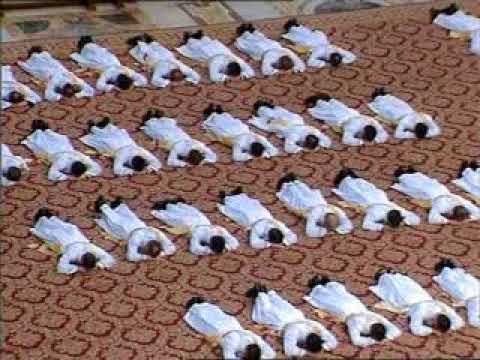
On the day of ordination the priest lies down upon the floor.

He is, in that moment, part of the floor.

He is the lowest thing in the church.

Consider two sets of contrasts.

First, there is the contrast of the low state of the servant sinner and the majesty of God.

Second, there is the present moment contrasted with the future to come.

Majestas is like gloria, Hebrew kabod or Greek doxa, a divine characteristic which – some day – we may encounter in heaven in such a way that we will be transformed by it forever and forever.  When Moses encountered God in the cloud on the mountain and in the tent, he came forth with a face shining so brightly that he had to wear a veil.  This is a foreshadowing of the transformative power of God’s majestas which he will share with the saints in heaven.

The priest waits upon majestas.

He waits on it, in that he awaits it.  And he waits upon it.  He serves it, like a waiting waiter, he serves it out as well.  He also desires it for his own future.  But in the present moment he waits upon it as a servant.  He is an attendant, in every sense.  He is one who waits and he is one who waits.

May God have mercy on all priests, sinner servants, attendant on the unmerited grace and gifts of the Victim Priest and Savior.

May God have mercy on me, a sinner.

Pray for me, a sinner.

Daily Prayer for Priests

O Almighty Eternal God, look upon the face of Thy Christ, and for the love of Him who is the Eternal High Priest, have pity on Thy priests. Remember, O most compassionate God, that they are but weak and frail human beings. Stir up in them the grace of their vocation which is in them by the imposition of the bishop’s hands. Keep them close to Thee, lest the Enemy prevail against them, so that they may never do anything in the slightest degree unworthy of their sublime vocation.

O Jesus, I pray Thee for Thy faithful and fervent priests; for Thy unfaithful and tepid priests; for Thy priests laboring at home or abroad in distant mission fields; for Thy tempted priests; for Thy lonely and desolate priests; for Thy young priests; for Thy aged priests; for Thy sick priests, for Thy dying priests; for the souls of Thy priests in Purgatory.

But above all I commend to Thee the priests dearest to

 me; the priest who baptized me; the priests who absolved me from my sins; the priests at whose Masses I assisted, and who gave me Thy Body and Blood in Holy Communion; the priests who taught and instructed me, or helped and encouraged me; all the priests to whom I am indebted in any other way, particularly N. O Jesus, keep them all close to Thy Heart, and bless them abundantly in time and in eternity. Amen.

IMPRIMATUR
+Robert C. Morlino, Bishop of Madison, 6 September 2018
Posted in Liturgy Science Theatre 3000, Priests and Priesthood | Tagged
6 Comments

26 May 1991: 34th anniversary of ordination – Trinity Sunday and St. Philip Neri

Booklet for the Mass

Many priests observe the anniversary of their ordination at this time of year. It is a common time for ordinations, probably because Ember Days were common times for ordinations and Ember Days fall during the Pentecost Octave.

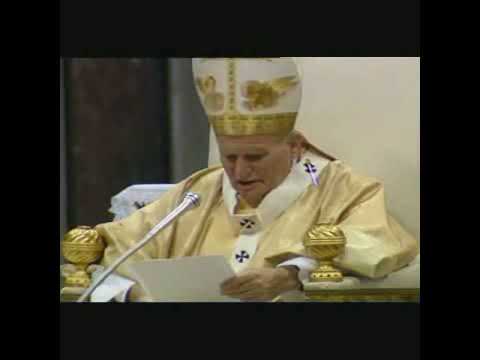
In any event, today is my turn.  Today is my anniversary of ordination, 34 years ago, by St. John Paul II in St. Peter’s Basilica.  That might make me a 2nd class relic.

When this date rolls around, I usually say to myself:

“Well… I made it this far.”

And so begins the 34th year.  I’ve now been a priest longer than the earthly Jesus.

On 26 May 1991, the Feast of St. Philip Neri, it was also Trinity Sunday.

It is a wonderful synchronicity that The Parish™ in Rome to which I am so attached, is both the place of St. Philip Neri’s great work and also in honor of the Most Holy Trinity.

It was a perfect Roman May day.

I got up that morning, ate breakfast, said my prayers, and walked alone across town to the basilica, where I entered through the main doors with the rest of the crowd. After that, however, I went to the right, to the nave near the Pietà, where we ordinands vested and waited for the Holy Father. My family members came separately from a different part of town. They had special tickets which brought them very close to the altar.  St. Theresa of Calcutta was there, just in front of where my folks sat.

Since we were 60 in number, and from many countries, the basilica was absolutely jammed with people from all over the world who had come for the ordinations, probably some 50k.

You have not experienced the Litany of Saints until you have heard it sung by that many people in a space like that.

I arranged for my grandmother, a convert to Catholicism in her 80’s, to receive Communion from the Holy Father, St. John Paul.

I often wonder what happened to the other men with whom I was ordained. I only knew a few of them personally, since I had been at the Lateran University with them.

It was the first year that the Iron Curtain was raised a bit.  A few men were permitted out Romania to come to Rome to be ordained by the Pope. There were some Opus Dei guys ordained with us.  Another of the group was John Corapi of the SOLT group, though I didn’t know him at the time. Pray for him.  One priest was ordained for the Archdiocese of Southwark in England. I know that one fellow is now a bishop in Haiti.  Last February he was injured in an explosion but is recovering.

This day, especially when I review some of these videos and think about what has happened between then and now, underscores the fact that God doesn’t choose men who are worthy. He chooses those whom it pleases Him to choose.

I ask for your prayers today and in an ongoing way for my cares, my health, and my future.  Pray for canceled priests.

And please, in a special way, pray for the mother of a priest, my own.

The sermon from the Mass. The sermon is in Italian and the text is HERE.

YouTube thumbnailYouTube icon

I really miss him.

Here are some excerpts from the broadcast of the ordination, which was on national television in Italy.  We have the interrogation, litany and the prayer (form).

YouTube thumbnailYouTube icon

Imposition of hands.


Posted in Linking Back |
14 Comments

ROME 25/5– Days 45: Pilgrimage to the Holy Door

On this beautiful Sunday, when Pope Leo took possession of the Cathedral of Rome, the sun rose at 5:39 and it set at 20:36.

The Ave Maria Bell would have rung at 21:00

Today is the feast of Gregory VII, Venerable Bede and Maria Magdalena de’ Pazzi… and it is the 5th Sunday after Easter in the more venerable and not pazzo calendar.

WELCOME REGISTRANT:

Campion

Today was The Parish™ pilgrimage for the Jubilee … which maybe is starting to pick up a little… to St. Peter’s and its Holy Door.   It was sunny and very warm today, so we really got heated up, but a large crowd of parishioners came, impressive.

I might try to assemble some videos people send (if they are not all in the pernicious vertical orientation which makes them hard to deal with).

All along the way we sang the Litany and other things all in Latin.  Many gawkers took photos of us.

Just behind me is where I lay prostrate on the floor during the Litany of Saints exactly 34 years ago… tomorrow!

Please remember me when shopping online and use my affiliate links.  US HERE – UK HERE  WHY?  This helps to pay for health insurance (massively hiked for this new year of surprises), utilities, groceries, etc..  At no extra cost, you provide help for which I am grateful.

OPPORTUNITY
10% off with code:
FATHERZ10

Posted in SESSIUNCULA | Tagged
4 Comments

Your Sunday Sermon Notes – 5th Sunday after Easter 2025 (N.O. 6th Sunday of Easter)

Too many people today are without good, strong preaching, to the detriment of all. Share the good stuff.

It is the 6th Sunday of Easter in the Novus Ordo and the 5th Sunday after Easter in the Vetus Ordo.

Was there a GOOD point made in the sermon you heard at your Sunday Mass of obligation?

Tell about attendance especially for the Traditional Latin Mass.

Any local changes or (hopefully good) news?

I have a few thoughts about the orations in the Vetus Ordo for this Sunday: HERE

A taste:

[…]

The dedicated, self-reflective Christian doesn’t let the Word (aka Christ) go in one ear and out the other.  The Christian strives to take a firm grip on the Word and make it his own. We eat the bread from the good crops God protects and transform it into our bone and flesh.  On a deeper level, the Word (aka Christ) isn’t what we, as the agents of transformation, change into ourselves.  The Word is the change agent that transforms us more and more into what He is, more manifest images of God in whose likeness we are made.   This is true of the Word, Christ, in Holy Scripture as it is true of the Word in the Eucharist.   If we are professed Christians who are not actively striving to be transformed by the Word, we are not true to ourselves or true to the Word.

[…]

Posted in SESSIUNCULA | Tagged
7 Comments

ROME 25/5– Days 43-44: double dip and video

This morning the sun was on time to rise at 5:40. The sun was similarly punctual in setting at 20:35.
We don’t know about the Ave Maria Bell for the Curia, since they don’t ring it, but it ought to have rung at 21:00.

Today is the Feast of Our Lady, Help of Christians.

Today is also the “World Day of Prayer for the Church in China”.

Yesterday was the Feast of a wonderful saint, and important for The Parish™, St. Giovanni Battista de Rossi (+1764). He was entombed beneath the altar of one of the side chapels for a long time, until a church was built in his honor on the periphery of Rome. His body was translated there. However, the side chapel and tomb are still sacred and relics, by the fact that the saints body was there.   Right now that side of the church is in scaffolding for cleaning and restoration.   St. Philip Neri’s altar is also there, so the devotions that began today had to be at the main altar.

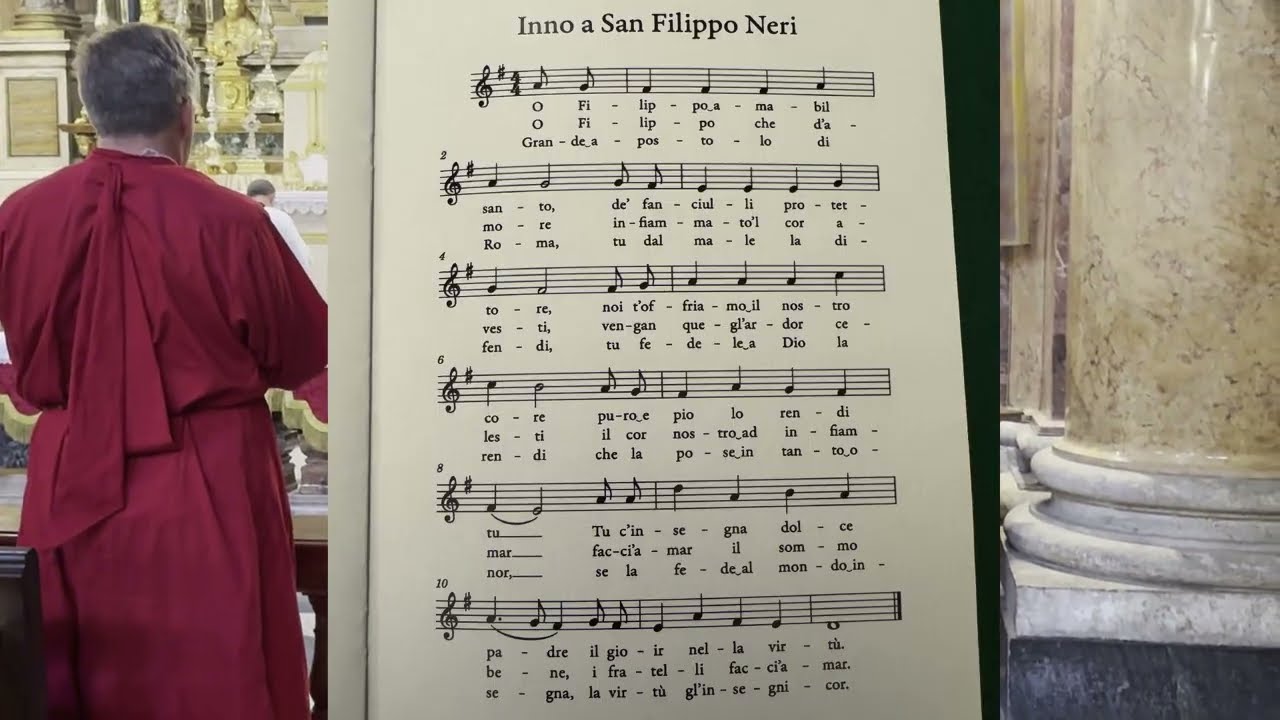
To bring you into the life of The Parish™ a bit, I made this little video.   I tried to incorporate some pages of the booklet so you could at least here and there follow the litany, prayers and hymn.  A triduum has begun in anticipation of the Feast of St. Philip Neri.

YouTube thumbnailYouTube icon

Here’s the hymn.  I’m sure you will sing along!

Welcome registrants:

Edgar L.
MedicusSubterraneus

A couple shots of the altar of today’s saint from last year:

Another painting but in a different church:

A reliquary with relics of saints who have been here or were involved with the Archconfraternity.

Note also St. Joseph and the House of Loreto.

Posted in SESSIUNCULA |
1 Comment

From “The Private Diary of Bishop F. Atticus McButterpants” – 25-04-16 – Meeting about updating liturgy in the diocese

EDITOR’S NOTE: This entry seemed particularly apropos, given today’s news of the cruelty of the Bishop of Charlotte, NC.

_____

16 April 2025

Dear Diary,

Today was the sort of day that makes you long for an undisclosed sabbatical and a lot of Crown Royal.  It was about that draft on “Liturgical Unity and Contemporary Expression” from Dozer* that Vice and McSwiney have been pushing at me because according to them “its what Rome wants”.  My old chum Dozer did something like this over in Pie Town and now that he’s on the bishops liturgy committee he’s throwing his weight around the state kinda onimously.  So I get the priests of the diocese gathered for what was billed as a “fraternal consultation” but before that I asked Fr. Tommy to do me a favor and ask around a little, spread a rumor here and there about the draft so that it would be pretty dead when I got everyone in the room.  I’m not into this stuff, but sheesh, the draft is like a grudge against… beauty?  “Ad oriwhazit”… the “back to the people” thing is too “directional” which is kinda the point, Latin is too “exclusionary” which it kinda is, lace “antiquated and feminine” which is hard to disagree with, bells “auditory clutter” which I don’t get ’cause I like them, birettas “costume drama” – big deal, it’s a hat, and black vestments are “macabre”, every other word is “pastoral” which is a load of crap, of course.  I’m not much into those things.  Fun once in a while.  But they make a lot of people happy and that counts!  Collections count too!

The draft wants what Bp. Jude when I asked him called “a mass deforestation of anything remotely traditional” and that it would make liturgies look like hotel conference meetings.  “But go ahead and try, if that’s what you really want.  It sure would be courageous.  You’ll enjoy the fallout.”  He’s knows me, darn him.

I didn’t know what to do. Frankly, I’d rather do a Chester and EAT a biretta than get between the chancery ideologues, the McSwiney** crowd, and Fr. Tommy and the younger guys with their maniples. So, I punted. “Let’s hear from the presbyterate,” I said, hoping they’d just handle it for me like a liturgical jury and get me off the hook.

Well, they did. Ninety percent at least, more probly – even Fr. Jerry who once held a yoga retreat in the sanctuary said a firm “nope”. Chad “Jazz Hands” Mallory stood up and rejected it outright saying that, yeah, he sort of agrees with the goal but right now it would tear things apart. Fr. Axel, who’s so progressive he tried to baptize a rescue ferret last year, stood up and said, “This is neither pastoral nor sensible. It’s just ugly.”  Naturally “Just Call Me Bruce”*** was all for it but he was glared into retreat by the boys.

Fr. Tommy, God bless him and the young guys, they did their work.

Ah, yes—the sandwiches for the meeting. Who decided on humus and elfalfa sprouts? Msgr. Hubble took a bite and whispered to me “This tastes like penance.” Fr. Biggins, who’s been on a diet since Vatican I, tossed his into a ficus pot.

In the end, I walked out relieved, though starving, and fully aware Dozer will be on me soon. I’ll practice my deep listening face, as Sr. Randi calls it, and take him out to Razzo’s for some shrimp scampi.

This should all blow over by the September convocation.

___

*Bp. Antuninu “Dozer” Ruspe is in the neighboring Diocese of Pie Town. +F. Atticus often copies what his old classmate Dozer does to his parishes.  Not called “Dozer” for nothing, he consolidated in a program called “That They May All Be One”.

**Msgr McSwiney is rector of “Spirit and Truth” Cathedral.

***Fr. “Just Call Me Bruce” Hugalot is community animator (“pastor) at Sing A New Faith Community Into Being Faith Community.

Posted in Diary of Bp. McButterpants, Liturgy Science Theatre 3000, SESSIUNCULA | Tagged
2 Comments