Leo XIV’s first public words

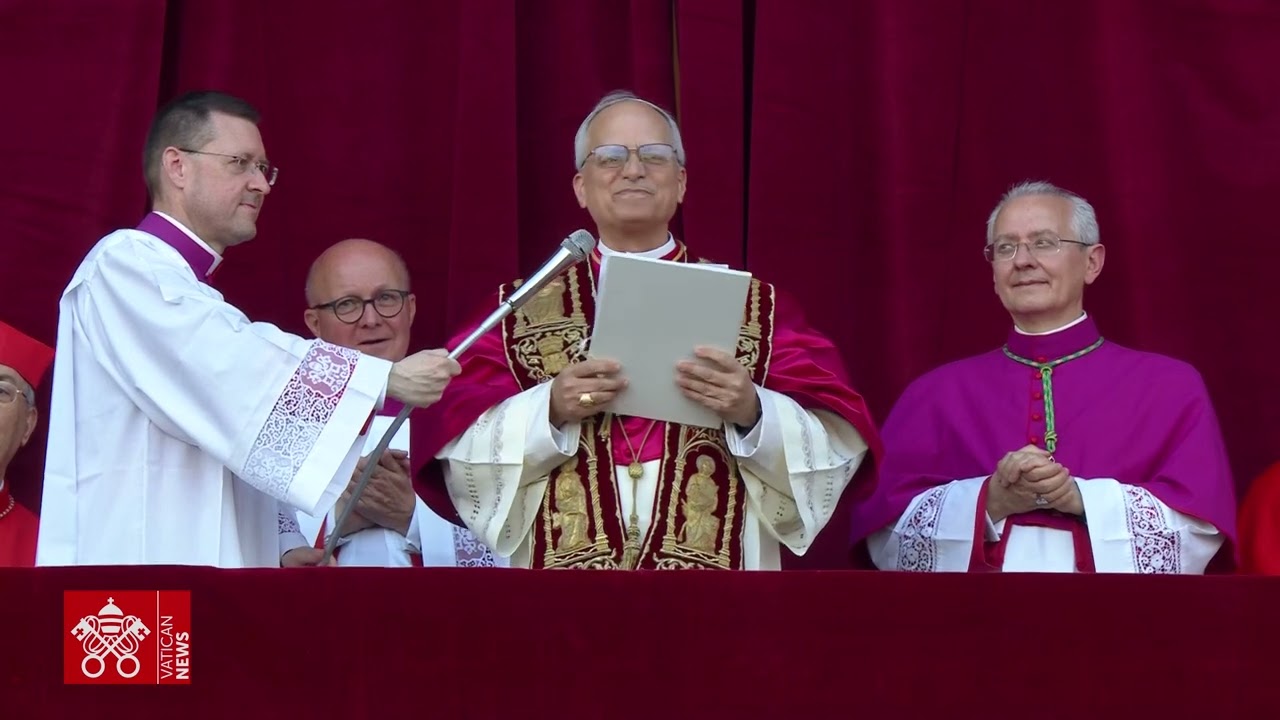
Pope Leo XIV greeted the city of Rome and the world with these words at his first appearance as the Successor of Peter from the Central Loggia of St Peter’s Basilica:

Pope Leo XIV: Greetings to Rome and to the world

Peace be with you! Dearest brothers and sisters, this was the first greeting of the risen Christ, the good shepherd who gave His life for the flock of God. I, too, would like this greeting of peace to enter your hearts, to reach your families and all people, wherever they are; and all the peoples, and all the earth: Peace be with you.

This is the peace of the Risen Christ, a disarming and humble and preserving peace. It comes from God. God, who loves all of us, without any limits or conditions. Let us keep in our ears the weak but always brave voice of Pope Francis, who blessed Rome – the Pope who blessed Rome and the world that day on the morning of Easter.

Allow me to continue that same blessing. God loves us, all of us, evil will not prevail. We are all in the hands of God. Without fear, united, hand in hand with God and among ourselves, we will go forward. We are disciples of Christ, Christ goes before us, and the world needs His light. Humanity needs Him like a bridge to reach God and His love. You help us to build bridges with dialogue and encounter so we can all be one people always in peace.

Thank you Pope Francis!

Thank you to my Cardinal brothers who chose me to be the Successor of Peter and to walk together with you as a united Church searching all together for peace and justice, working together as women and men, faithful to Jesus Christ without fear, proclaiming Christ, to be missionaries, faithful to the gospel.

I am a son of Saint Augustine, an Augustinian. He said, “With you I am a Christian, for you a bishop.” So may we all walk together towards that homeland that God has prepared for us.

To the Church of Rome, a special greeting:

We have to look together how to be a missionary Church, building bridges, dialogue, always open to receiving with open arms for everyone, like this square, open to all, to all who need our charity, our presence, dialogue, love.

[In Spanish]:

Hello to all and especially to those of my diocese of Chiclayo in Peru, a loyal, faithful people accompanying the bishop and helping the bishop.

[Returning to Italian]:

To all you brothers and sisters of Rome, Italy, of all the world, we want to be a synodal church, walking and always seeking peace, charity, closeness, especially to those who are suffering.

Today is the day of the Supplicatio [Plea] to Our Lady of Pompei.

Our blessed mother Mary always wants to walk with us, be close to us, she always wants to help us with her intercession and her love. So let us pray together for this mission, and for all of the Church, and for peace in the world.

We ask for this special grace from Mary, our Mother.

Hail Mary…
YouTube thumbnailYouTube icon

Posted in SESSIUNCULA | Tagged
39 Comments

ASK FATHER: What if the cardinals chose a man who is not in the conclave?

From a reader…

QUAERITUR:

What if the cardinals chose a man who is not in the conclave?   They can chose a baptized male, right?   It’s unlikely that they would go outside the Cardinals in the conclave, even for an older non-voting Cardinal.  It’s extremely unlikely that they would choose a non-Cardinal.  But if they do, what happens?

BTW… see the post immediately before this one!  The Sonnet by Belli about this topic.

The document about death the election of Popes is called Universi Domini Gregis.  UDG says:

90. If the person elected resides outside Vatican City, the norms contained in the Ordo Rituum Conclavis are to be observed.

The ORC says:

62. Si autem Electus extra Civitatem Vaticanam degit, Cardinal, electores duos Cardinales eligunt ut Cardinali qui praeest continuo adsint usque ad adventum et acceptationem Electi.

Deinde Cardinalis qui praeest et duo Cardinales qui ei adsunt Substitutum Secretariae Status arcessent, qui caute et prudenter efficiat ut Electus quantocius ad Urbem perveniat, vitatis omnino mediis communicationis socialis per quae secretum Conclavis violari possit. Cum Electus in Civitatem Vaticanam pervenerit, Substitutus Secretariae Status immediate dc cius adventu Cardinalem qui preeest cer-tiorem faciat eiusque mandata adamussim exsequatur. Cardinalis qui praeest, consiliis cum duobus Cardinalibus qui ei adsunt collatis, Cardinales electores convocabit et Electum in Sacellum Sixtinum introducet, ut ad acceptationis ritum procedatur.

63. Post acceptationem, Electus qui episcopali ordinatione iam pollet est illico Romanae Ecclesiae Episcopus simulque verus Summus Pontifex et Caput Collegii Episcopalis; idemque actu plenam et supremam potestatem in universam Ecclesiam acquirit.

or

62. If the Elect resides outside Vatican City, the Cardinal electors choose two Cardinals who assist the presiding Cardinal until the arrival and acceptance of the Elect. Then the Cardinal who presides and the two Cardinals who assist him will call the Substitute of the Secretariat of State, who will carefully ensure that the Elected One comes to Rome as soon as possible, absolutely avoiding the means of communication by which the secret of the Conclave can be violated. When the Elected Representative is in Vatican City, the Substitute of the Secretariat of State immediately informs the presiding Cardinal of his arrival and follows his orders exactly. The presiding Cardinal, after having taken counsel from the two Cardinals assisting him, shall convoke the Cardinal electors and introduce the Elected Cardinals into the Sistine Chapel so that the rite of acceptance may take place.

63. After acceptance, the Elect who has already received priestly ordination is immediately Bishop of the Church of Rome, true Supreme Pontiff and Head of the Episcopal College; he acquires in fact the full and supreme power over the universal Church.

So, they send a couple of guys (they better be strong) to go get the poor man and drag him to the Sistine Chapel and put the question to him formally.  By this time, he has probably figured out what’s going on.

I would be tempted to make them stop at a bar first before getting to Vatican City.

One problem I have with this is that at the death of a Pope, all roles in the Curia cease except for the Camerlengo, the Vicar of Rome, and the Major Penitentiary.   So, there shouldn’t be a Sostituto, technically, since there is also not Secretary of State, technically.

Posted in "How To..." - Practical Notes, ASK FATHER Question Box, Conclave |
7 Comments

A Sonnet “The Election of the Pope” in Roman dialect by G.G. Belli

We are privileged again to have another sonnet from the 19th c. poet Giuseppe Gioachino Belli… Er Belli. He wrote seriously funny sonnets in the Roman dialect about life in Rome and aimed deadly satire at Rome’s clerics, religious, prelates and popes.   The characters in the poems are often rough ready street people and shop keepers and artisans making observations about the dealing of the high and mighty they see about town.   And this was back in the day when Popes got around in town, walking or with a carriage, etc.

Belli can be biting and funny and sometimes off-color.

La sscerta der Papa

Sò ffornasciaro, sí, ssò ffornasciaro,
Sò un cazzaccio, sò un tufo, sò un cojjone:
Ma la raggione la capisco a pparo
De chiunque sa intenne la raggione.

Sscejjenno un Papa, sor dottor mio caro,
Drent’a ’na settantina de perzone,
E mmanco sempre tante, è ccaso raro
Che ss’azzecchino in lui qualità bbone.

Perché ss’ha da creà ssempre un de loro?
Perché oggni tanto nun ze fa ffilisce
Un brav’omo che attenne ar zu’ lavoro?

Mettémo caso: io sto abbottanno er vetro?
Entra un Eminentissimo e mme disce:
Sor Titta, è Ppapa lei: vienghi a Ssan Pietro.

22 dicembre 1834

The election of the Pope

I’m a glassblower, okay, I’m a glassblower,
I’m a bum, a dummy, a jerk:
but I understand the reason as well as anyone
who knows how to understand the reason.

They chose a Pope, my dear doctor,
among about seventy people,
and not always so many, it is rare
that they find good qualities in him.

Why do they always have to create one of their own?
Why is it that now and then they don’t find
a good guy who will do his job?

Imagine: So I’m wrapping up some glass?
A fancy Eminence enters and says to me:
“Mr Giambattista, you’re Pope: Come to Saint Peter’s”.

Posted in Poetry | Tagged ,
Comments Off on A Sonnet “The Election of the Pope” in Roman dialect by G.G. Belli

“…qui sibi nomen imposuit [NAME]”? Nominative? Accusative? Genitive?

From a priest…

QUAERITUR:

  I’m sure Rome is exciting this week more than Easter Week. I noticed something peculiar watching old Habemus Papam videos. Following the sibi nomen imposuit, ir seems the name has traditionally been given first in the genitive case : “ Johannis Pauli” “ Benedicti” , but for some reason Cardinal Tauran announced “Franciscum” (accusative?) rather than Francisci.  Is there a hard and fast rule on this, or some wiggle room?  Just curious.

Also, JP 1 had the “primi” added in the announcement, JP2 did not get “secundi” but Benedict did have the decimi sexti … I suppose it’s not as important, but this is what I’m thinking at 2:30am.

Let’s hope for “Pii” or something good,

Here’s the formula of the announcement:

Annuntio vobis gaudium magnum; habemus Papam: Eminentissimum ac Reverendissimum Dominum, Dominum [NAME in ACCUSATIVE] Sanctae Romanae Ecclesiae Cardinalem [LAST NAME usually not declinable] qui sibi nomen imposuit [REGNAL NAME].

I suppose that the name could be in the nominative, as if there were a mental colon after imposuit [: Leo… Leo.].  That’s Leo not Lío.    It could be accusative as the object of imposuit [“Leonem… Leo”].  I think it could be a kind of apposition genitive, “who has imposed upon himself the name “Leonis … of Leo”.

Anyone else on this matter of grave importance?

Pius XII – “Pium”
John XXIII  ?
Paul VI “Paulum Sextum”
John Paul I – “Ioannis Pauli Primi”
John Paul II – “Ioannis Pauli”
Benedict XVI – “Benedicti Decimi Sexti”


Posted in SESSIUNCULA |
7 Comments

Conclave watch… WATCH: Readers… get involved! (UPDATE: NEW POPE watch WATCH!…)

UPDATE:

Well that was fast!

Let’s keep going.


Originally Published on: May 8, 2025 at 06:36

Collectively we can do some looking around.

If you are watching online or by TV any coverage of the conclave, or the chimney, what service or network are you watching?

Also, WHOM have these services or networks brought in for their commentary?

For example, in my daily text group (which includes serious, highly-credentialled people) after the 1st black smoke today, one texter told us that on EWTN the cleric compared the waiting for white smoke to the Parable of the Wise and Foolish Virgins and, perhaps also the cleric, to Advent.   This provoked hilarity and a “face palm” in our group.

Our texter went on to say that CNN was better.   Better than EWTN, that is.  Pretty sad.

That’s what made me wonder who is commenting on which network or service.

Hence, this post.

I INVITE YOU READERS… to post about what and whom you are watching.

Also, please, post comments made which caught your attention – the good, the bad, the ugly.  Try to be accurate for the sake of fairness.  Don’t worry about being repetitive.   I’ll try to check the message/comment queue often to keep it fresh.

Posted in SESSIUNCULA | Tagged
24 Comments

DURING A CONCLAVE! 8 May – Indulgence for the Supplication to Our Lady of Pompeii (twice a year)

This year the 8 May Supplica to Our Lady of Pompeii has fallen during the FIRST FULL DAY OF A CONCLAVE.

It is often recited at 1200 Noon.

Perhaps you would say it for a good result from the Conclave.

Once upon a time one could obtain this day a plenary indulgence by reciting the Supplication to the Madonna of Pompei.  The other day for this is the first Sunday of October.

Bl. Bartolo Longo, who fostered this devotion was dedicated also to St. Michael the Archangel.  For this reason he wanted the Supplica to be said on the Feast of the Apparition of St. Michael which occurred in 490.   The place, Mt. Gargano, is one of the points that can be drawn through Michael shrines from Ireland to the Holy Land, St. Michael’s Sword, firmly fixed also with Mary’s Supplica.

With the changes to the concessions for indulgences, according to the Enchiridion Indulgentiarum, there is no longer any plenary indulgence for this prayer, notwithstanding anything you might see in some old book or on a website.  For example, if you see something about Pope Leo XIII granting an indulgence, etc., that is null and void now.

However, the new Enchiridion says with concession #17, §3 that Marian prayers obtain a partial indulgence under the condition that the prayer is approved by competent authority and that it is recited with fervor in the state of grace (you don’t need confession and Communion within 20 days, nor must you recite the prayers for the Roman Pontiffs intentions for a partial indulgence). You can receive a partial indulgence, by maintaining this beautiful custom of the Supplication today. 

For more about this, including the prayers, click HERE.  

I included background on Bl. Bartolo Longo, a converted Satanic priest! John Paul II beatified Bartolo Longo in 1980.  Some of his writings form the basis of the Luminous Mysteries of the Rosary.

Posted in Our Catholic Identity, Our Solitary Boast | Tagged
2 Comments

Catholic school staged an educational monk Conclave

I’ve been sitting on these for a couple of days but this is a good time to post them.

A priest reader here sent photos and links to video of the St. Lawrence parish school’s “conclave”.

Father wrote:

Fr. Hollowell and Fr Meyer in the parishes of Dearborn County, Indiana led the youth through a Mock Papal Conclave. The young people were led through the death, seal of the papal residence, transfer and burial of the body, and the entire conclave process. The costumes, props and sets made the experience come alive!

Fun.

Video link 1: HERE
Video link 2: HERE

He sent lots of still photos but in individual links that I frankly don’t have the time or energy to tackle.  However, I think they are well represented in this YouTube “short”: HERE


Posted in SESSIUNCULA | Tagged
1 Comment

ROME 25/4– Day 28: Conclave day

On this Conclave Day 2025, the sun rose on Rome at 5:56.
It will set – whether there is a new Pope or not – at 20:18.

The Ave Maria won’t ring in the conclave at 20:30.

It is the Feast of Flavia Domitilla.

There will be a new full Moon on 12 May.

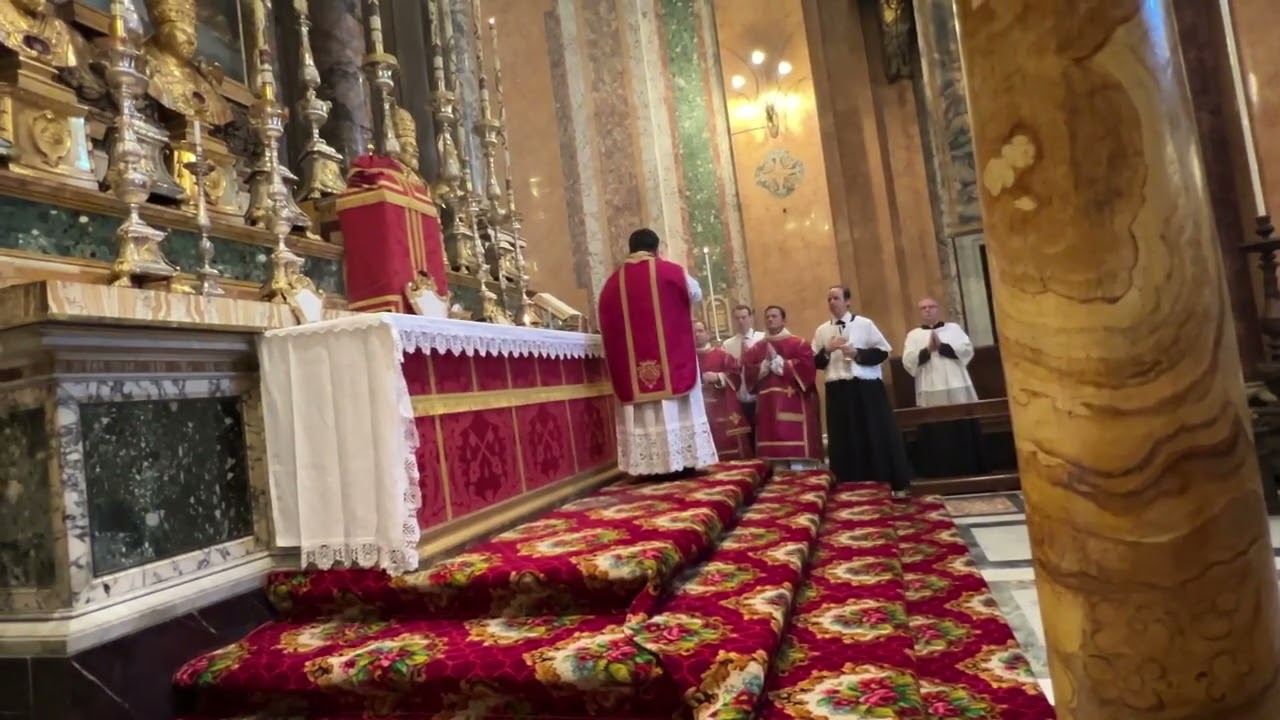
Last night at The Parish™ we had a Solemn Mass for the Election of a Supreme Pontiff.

Here is a brief video from the beginning of the Mass.

YouTube thumbnailYouTube icon

After Mass the whole congregation sand the Litany of Loreto as the clergy knelt before the parish’s lovely image of Mary over the altar in the transept.

I was at a gather of Catholic journalistic glitterati tonight.  You would have known most of them.

In the cab on the way home.

I’m tired.

Tomorrow, four votes.

I predict Friday evening.

Posted in SESSIUNCULA |
8 Comments

Another Roman Sonnet from “Er Belli” – “The end of the conclave” (1831)

Here is another of the brilliant Roman dialect sonnets by Giuseppe Gioacchino Belli.

Belli was a sharp observer of like in 19th c. Rome.

L’upertura der concrave

Senti, senti castello come spara!
Senti montescitorio come sona!
è sseggno ch’è ffinita sta caggnara,
e ’r Papa novo ggià sbenedizziona.

Bbe’? cche Ppapa averemo? è ccosa chiara:
o ppiù o mmeno la solita-canzona.
Chi vvôi che ssia? quarc’antra faccia amara.
Compare mio, Dio sce la manni 1 bbona.

Comincerà ccor fà aridà li peggni,
cor rivôtà le carcere de ladri,
cor manovrà li soliti congeggni.

Eppoi, doppo tre o cquattro sittimane,
sur fà 2 de tutti l’antri 3 Santi-Padri,
diventerà, Ddio me perdoni, un cane.

The Great Roman™

2 febbraio 1831

Listen!  Listen to how Castel Sant’Angelo fires cannons!
Listen to how Montecistorio rings bells!
It’s the sign that this dog and pony show is done,
the new Pope is already giving his blessing.

Well? What kind of Pope will we have? It is clear:
more or less, the same old song.
Who do you think it will be? Some other grim face,
my friend, may God send us good turn.

He will begin by having the things pawned at Monte di Pietà returned,
by again emptying the thieves’ prisons,
by operating the usual mechanisms.

And then, after three or four weeks,
by acting like all the other Holy Fathers,
he will become, God forgive me, a dog.

Posted in Poetry | Tagged , ,
1 Comment

Priests, Sacrament of Penance again under attack by the State

You have probably heard about law in Washington that priests will be required to divulge to law enforcement anything about child abuse which they learned when hearing confessions (in the internal forum).



Fox now reports HERE that priests who obey that and who tell law enforcement something they learned during a confession will be excommunicated.

It’s canon law.

Can. 1386— § 1. A confessor who directly violates the sacramental seal incurs a latae sententiae excommunication reserved to the Apostolic See; he who does so only indirectly is to be punished according to the gravity of the offence.

Catholic Church to excommunicate priests for following WA law requiring child abuse confessions to be reported
‘Catholic clergy may not violate the seal of confession — or they will be excommunicated from the Church,’ the Archdiocese of Seattle said

The Catholic Church announced that priests will be excommunicated if they follow a new Washington state law requiring clergy to report confessions about child abuse to law enforcement.

“Catholic clergy may not violate the seal of confession — or they will be excommunicated from the Church,” the Archdiocese of Seattle said in a statement. “All Catholics must know and be assured that their confessions remain sacred, secure, confidential and protected by the law of the Church.”

“The Catholic Church agrees with the goal of protecting children and preventing child abuse,” the statement added, noting that it “remains committed to reporting child sexual abuse, working with victim survivors towards healing and protecting all minors and vulnerable people.”

The new law — signed by Democrat Gov. Bob Ferguson last week — added “members of the clergy” to a list of professionals who are required to report information that relates to child abuse or neglect to law enforcement, and the measure does not provide an exception for information offered at a confession booth.

Priests in the Catholic Church have been bound by the absolute seal of confidentiality, an obligation that requires them to keep anything learned in confession a secret.

The Archdiocese of Seattle said its policies already require priests to be mandatory reporters unless the information is received during confession.

“While we remain committed to protecting minors and all vulnerable people from abuse, priests cannot comply with this law if the knowledge of abuse is obtained during the Sacrament of Reconciliation,” its statement said.

The U.S. Department of Justice’s Civil Rights Division has opened an investigation into the law for possible violations of the First Amendment’s religious protections.

“SB 5375 demands that Catholic Priests violate their deeply held faith in order to obey the law, a violation of the Constitution and a breach of the free exercise of religion cannot stand under our Constitutional system of government,” Assistant Attorney General Harmeet K. Dhillon of the DOJ’s Civil Rights Division said.

“Worse, the law appears to single out clergy as not entitled to assert applicable privileges, as compared to other reporting professionals,” she continued. “We take this matter very seriously and look forward to Washington State’s cooperation with our investigation.”

The bill will go into effect on July 26.

Washington is one of just five states that does not explicitly or implicitly require clergy to report suspected child abuse or neglect, a federal report shows, according to Fox 13. Most states exempt information obtained through confession from mandatory reporting, but Washington now joins just a handful of states that do not provide such exemptions.

“This new law singles out religion and is clearly both government overreach and a double standard,” the Archdiocese of Seattle said. “The line between Church and state has been crossed and needs to be walked back. People of every religion in the State of Washington and beyond should be alarmed by this overreach of our Legislature and Governor.”

More Canon Law about the priest and the Seal.

Can. 983 §1. The sacramental seal is inviolable; therefore it is absolutely forbidden for a confessor to betray in any way a penitent in words or in any manner and for any reason.

§2. The interpreter, if there is one, and all others who in any way have knowledge of sins from confession are also obliged to observe secrecy.

Can. 984 §1. A confessor is prohibited completely from using knowledge acquired from confession to the detriment of the penitent even when any danger of revelation is excluded.

Posted in Pò sì jiù, Priests and Priesthood, The Coming Storm, The Drill, The future and our choices, The Last Acceptable Prejudice | Tagged , ,
6 Comments





















